Jackets & Blazers
How a Blazer Should Fit: Length, Sleeves and Closure
Check shoulder, jacket length, sleeve length, chest room and closure one at a time. What a blazer should do off the rack and what a tailor can fix.

Outfit inspiration
Wear a blazer over a dress by checking how the two garments move together: room at the sleeve and shoulder first, then the open-versus-fastened comparison, then the length of jacket you prefer over the dress you own.
Begin hereInspiration
Wear a blazer over a dress by checking how the two garments move together. Start with enough room at the sleeves and shoulders, then compare the outfit with the jacket open and fastened. Short and long blazers can both work; choose the outline you prefer and make sure the dress does not bunch or restrict you underneath.
Layering is a fit question before it is a styling question. A blazer cut to be worn over a shirt or thin top may not have the ease to sit cleanly over a sleeveless dress's armhole, a gathered skirt or a belt at the waist. Put the combination on and check the jacket's actual behaviour, not its size label.
Before thinking about the mirror picture, check:
If the jacket pulls at any of these points, a larger or softer-shouldered blazer solves more than any styling adjustment. Structured jackets layer best over slim dresses; unstructured ones forgive more underneath.
The dress's shape drives the pairing, not a universal hem rule. A belted shirt dress already has a waist; a column dress does not; a slip dress asks for length. The table below works through six common dress shapes with a jacket decision and complete shoes for each.
| Dress | Jacket decision | Why the combination works | Shoes and extras |
|---|---|---|---|
| Khaki shirt dress, waist tie | Navy blazer worn open | The dress's tie supplies its own definition, so the open jacket needs none; keep both layers visible rather than buttoning over the belt | Tan loafers |
| Black jersey column dress | Grey single-button blazer, fastened or open — compare both | A straight dress carries either outline; buttoned, the jacket adds the middle; open, the outfit reads as two straight layers | Black heels or pointed flats |
| Floral midi with a waist seam | Soft unstructured pale-blue blazer | A soft shoulder reads occasion rather than office, and the jacket comes off cleanly for the evening without disturbing the dress | Block-heel sandals |
| Champagne slip dress | Long-line black blazer, hem ending near the slip's hem | The longer jacket acts as the outer layer of a two-piece; the slip's lace hem showing beneath keeps it reading as a dress | Heels, to keep the longer line from flattening the frame |
| Deep green wrap dress | Black crepe blazer, open and on the shorter side | The wrap's crossover bodice defines the waist already, so an open jacket avoids two structures competing at the same point | Heeled sandals |
| Dark pleated mini dress | Black blazer that ends below the dress, fine pleats | With the shorter hem underneath, the jacket becomes the long layer; fine pleats keep bulk from building under the jacket's hem | Sheer tights and heeled ankle boots |
Shirt dress under a shorter blazer
Slip dress under a long-line blazer
The same two garments produce two different outfits depending on the closure, and both can be right. Put the combination on and look at it both ways before deciding — the dress's own waistline is usually what tips the answer.
A blazer over a dress must be cinched or belted to define the waist, or the outfit cuts your body in half.
Waist definition is one option, not a requirement. A long, straight blazer over a column dress reads as a deliberate column-and-jacket line; a short open blazer over a belted dress reads as layers. Try both outlines in a full-length mirror and keep the one you prefer — no hem position is disqualifying on its own.
Shirt dress, open navy or grey blazer, loafers or low heels. Keep the dress's belt visible and the jacket a colour that contrasts gently with the dress, so the two layers stay legible across a desk or a meeting table.
Slip or wrap dress under a longer or blacker blazer, heeled sandals, and jewellery moved up to the ears since the neckline is covered. Fasten the jacket for the journey and open it at the table if the dress carries its own shape.
Add sheer or opaque tights under a midi or mini dress, ankle boots beneath the hem, and a scarf that lives outside the jacket collar rather than stuffed inside it. A wool-blend blazer earns its place here; a linen one does not.
A blazer-and-dress combination is worn sitting, reaching and taking the jacket off, not standing in front of a mirror. Run these checks with two minutes to spare, while there is still time to change.
Sit, reach, remove:
Where to go next
Every jacket and blazer guide on the site.
The same layering questions with a softer third piece.
Footwear decisions for the shirt-dress versions above.
1 look to explore
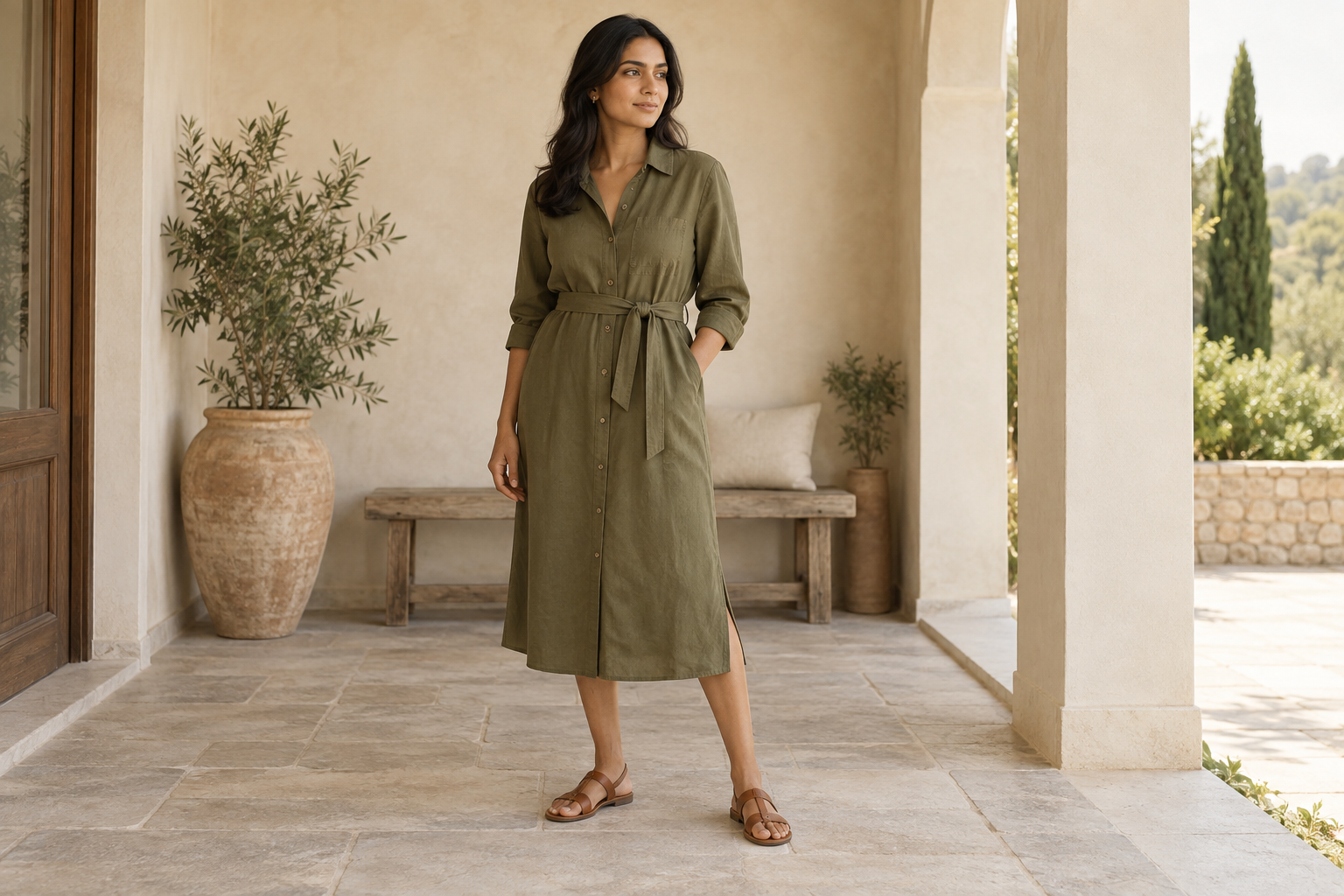
A woman wearing an olive belted shirt dress and tan sandals on a stone verandah. The image shows the underlayer for the shirt-dress pairing above — it is a generated illustration, not a photograph of a finished blazer outfit, and no blazer appears in it. Use it to picture the dress that the open navy blazer layers over, with the belt left visible.
Jackets & Blazers
Check shoulder, jacket length, sleeve length, chest room and closure one at a time. What a blazer should do off the rack and what a tailor can fix.
Jackets & Blazers
A fitting method for coats worn over tailoring: shoulder and sleeve room, length, fabric weight, and the movement test done with the blazer on, not off.
Jackets & Blazers
How to wear a blazer casually: knit, shirt and relaxed-layer combinations built around complete outfits, with the swaps and checks that make each one work.