Jackets & Blazers
Blazer vs Sport Coat vs Suit Jacket: How to Tell
Matching trousers, fabric and construction are the useful tells. Compare blazers, sport coats and suit jackets — and learn which works with odd trousers.
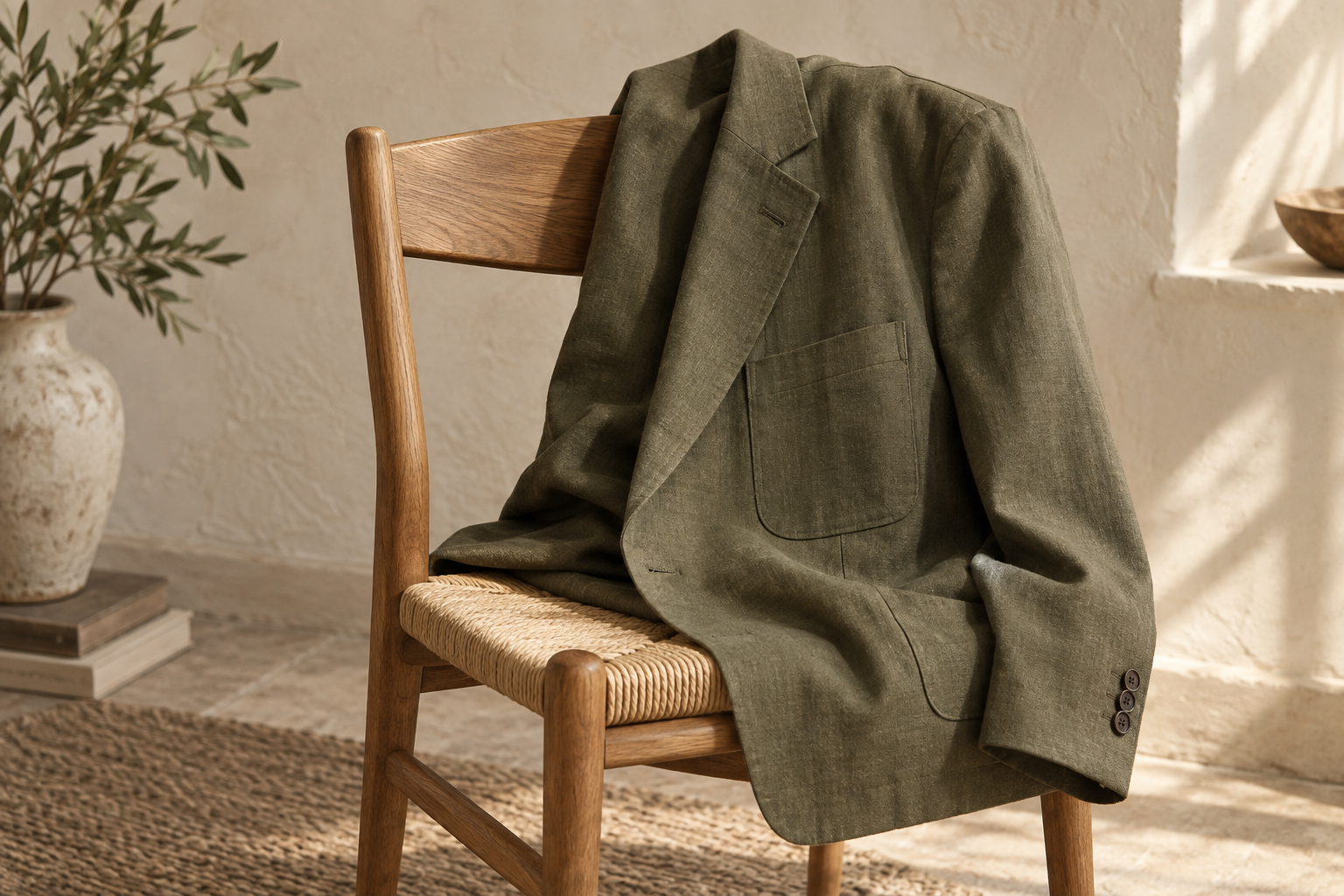
Layering guide
A coat that fits over shirts will not necessarily fit over a blazer. The fix is simple but often skipped: every fitting decision gets made with the blazer actually on, checked at the shoulder, sleeve, and hem.
Begin hereHow-to
Choose a coat over a blazer by trying both on together. Fasten the coat, reach forward and sit to check whether the sleeves and chest stay comfortable. Compare the two hems as well, especially if you want the blazer covered. Size labels and shoulder-seam measurements alone cannot tell you whether the layers will work.
Most fitting advice assumes a set-in shoulder — a sleeve sewn into a defined armhole with the seam sitting at your shoulder point. On a set-in coat worn over a blazer, you want the coat's seam to sit slightly outside the blazer's, so the tailoring underneath has somewhere to live without dragging the coat out of line.
But plenty of layering-friendly coats avoid that geometry entirely. A raglan sleeve runs diagonally from the neckline to the underarm and has no shoulder seam at all, and a dropped-shoulder coat places the seam deliberately down the upper arm. On those cuts, seam-to-seam comparison is meaningless — judge by what happens when you move, which the movement test below covers.
| Construction | Where the seam sits | How to judge it over a blazer |
|---|---|---|
| Set-in sleeve | At the shoulder point, on the edge of your shoulder | Coat seam should sit just outside the blazer's seam, with the coat's shoulder line staying smooth when your arms hang |
| Raglan sleeve | Diagonal from neckline to underarm — no shoulder seam | Ignore seam placement; check that the shoulder area does not pull or bunch when you reach and that the sleeve does not crush the blazer sleeve |
| Dropped shoulder | Down the upper arm, past the shoulder point | Expect a wider seam by design; judge by sleeve room, closure comfort and the movement test rather than the seam's position |
A specific shoulder clearance — some fixed number of centimetres between the two seams — tells you whether any coat will fit over a blazer.
Seam placement varies by construction: set-in, raglan and dropped shoulders put the seam in different places entirely, so a single clearance number cannot apply across coat cuts. The reliable check is trying the coat over the blazer and watching what the shoulder area does when you move.
This is where thin coats fail over tailoring. Fasten the blazer, put the coat on, and slip a flat hand inside the coat's chest — it should slide in with light contact, not wedge in. Then look at the sleeves: the blazer's sleeve should sit inside the coat's sleeve without bunching at the elbow or being pinched along its length.
A coat sleeve cut trim for shirts alone will compress the blazer sleeve into a crumpled roll at the forearm, and no amount of smoothing fixes it while you wear it. Feel the lining against the blazer sleeve too — a clingy lining drags the layers every time you move your arm.
Signs the layers are compatible
Signs to walk away
How far the coat should clear the blazer is a functional preference. A longer coat covers the blazer's hem and vent completely, which suits cold commutes and keeps the layers tidy in wind. A shorter coat shows more of the blazer, which reads lighter and suits milder days or offices where the coat comes off indoors.
Whatever you prefer, check it with both layers on from every angle: the coat hem should hang level all round, and if you want the blazer covered, it should be covered — a blazer vent flapping outside the coat's hem is the classic sign the coat is shorter than you intended.
Fabric names are not performance specifications. A wool overcoat, a waxed-cotton topcoat and a lined rain shell layer over a blazer very differently — and water resistance, where it exists, is a treatment or membrane claim for that specific garment, not a property of the fibre. Ask for the maker's stated specification rather than generalising from the fabric name.
If you are shopping with a salesperson or having the coat adjusted, hand over the specifics instead of adjectives. A short written note keeps the conversation on measurements that matter for layering.
Where to go next
Every jacket guide on the site in one place.
If the layer underneath is the soft kind, its fit rules come first.
Styling the coat you chose — open, belted, and in wet weather.
A coat you have verified over your actual blazer: shoulder and sleeve room that survives movement, a hem relationship you chose deliberately, and a construction that matches the weather you bought it for — checked by named tests you can repeat in any fitting room.
Put your blazer on, then the coat, and read the shoulder according to its construction. On a set-in coat, the coat's seam should sit just outside the blazer's seam with the shoulder line staying smooth when your arms hang — there is no universal clearance number to chase. On a raglan or dropped-shoulder coat, skip the seam comparison and judge by movement instead.
Check: With the blazer on underneath, the coat's shoulder area — read by its own construction — stays smooth when your arms hang and when you reach forward.
This is where thin coats fail over tailoring. Fasten the blazer, put the coat on, and slip a flat hand inside the coat's chest — it should slide in with light contact, not wedge in. Then look at the sleeves: the blazer's sleeve should sit inside the coat's without bunching at the elbow, because a coat sleeve cut trim for shirts alone will crumple it at the forearm and no smoothing fixes that while you wear it.
Check: A flat hand slides inside the coat chest over the buttoned blazer, and the blazer sleeve inside the coat sleeve can be smoothed flat with no bunching at the elbow.
With both layers on, decide how much of the blazer you want covered and check that the coat delivers it. A longer coat covers the blazer's hem and vent completely and suits cold, windy commutes; a shorter coat leaves more of the blazer showing and reads lighter indoors. Either is fine — the failure is unintended: a blazer vent flapping outside the coat's hem means the coat is shorter than you wanted.
Check: The coat hem sits where you chose — covering the blazer completely or clearing it by a visible margin — and hangs level all round, with the blazer's vent tucked under if coverage was the goal.
A coat worn over tailoring needs enough body to drape over the bulk without fighting it. Heavy wool overcoating holds its line and insulates but is a chore to carry indoors; mid-weight wool twill is the flexible middle; brushed cotton and lighter blends layer easily but can cling at the shoulders. For rain or warmth, go by the maker's specification for that coat rather than the fabric name, and check the care label — dry-clean-only wool is common at this weight.
Check: The fabric holds a clean line over the blazer without clinging, and the coat's stated water-resistance and care requirements match how and how often you will actually wear it.
This is the step people skip and regret. Still wearing the blazer underneath, button the coat, then reach forward as if gripping a bus rail, raise both arms, sit down, and shrug hard. The coat should move with you: no pull across the back, no buttons straining, no shoulder seams sliding off. Then take the coat off over the blazer — a coat that needs a wrestle every time will quietly stop being worn.
Check: After reaching forward, raising your arms, sitting, and shrugging with the blazer on underneath, the coat stays seated at the shoulders with no strain at the closure and comes off smoothly.
Look at the whole layered picture, not the coat alone. The coat's colour should sit in the same tonal family as your usual blazers — charcoal, navy and camel cover most wardrobes — and its collar should sit clear of the blazer's lapels rather than swallowing them. Check the sleeves end just past the shirt cuff and the closure sits flat over the blazer's buttons, so every layer reads as layered on purpose.
Check: The blazer's lapels and cuffs remain visible in their correct positions under the coat, the closure sits flat, and the coat's colour works with at least two blazers you already own.
The coat is too narrow at the shoulder or cut too slim through the upper back to accept a layer. No alteration reliably fixes the shoulder, so return or exchange and size up — but recheck the new size at the hem and sleeve, since a larger size can fix the shoulders while adding unwanted length.
The coat's sleeves are too tight for layering, which is common in fashion-cut coats designed for shirts only. Try the same coat one size up, or look for a coat explicitly cut for wearing over jackets — overcoats and many woollen topcoats carry the extra sleeve room, while lightweight raincoats often do not.
The extra room needed for layering is being worn without a defined shape. Tighten the frame you can control: choose a coat with a higher button stance or a belt option to restore a waist line, and keep the collar neat so the eye reads the layers as deliberate rather than stacked.
Jackets & Blazers
Matching trousers, fabric and construction are the useful tells. Compare blazers, sport coats and suit jackets — and learn which works with odd trousers.
Jackets & Blazers
How to wear a blazer over a dress: sleeve and shoulder checks, jacket length and open-versus-fastened comparisons, worked shirt-dress, slip and wrap versions, and a movement check before you leave.
Jackets & Blazers
Check shoulder, jacket length, sleeve length, chest room and closure one at a time. What a blazer should do off the rack and what a tailor can fix.