What smart casual means ↗
The full definition of the code, the pieces that reliably satisfy it, and the mistakes that push an outfit too formal or too loose.
Style foundations
Dress codes are shorthand, but the shorthand is rarely written down. This section unpacks what each one asks for, starting with smart casual.
Explore the collectionFIND YOUR STARTING POINT
Everything you need is usually in four or five lines of text. Take a hypothetical invitation: “Join us for an evening of drinks and canapés at the Harbourview Hotel, Saturday 7pm. Dress code: smart casual. Please no trainers or sportswear.” Read it in passes, not all at once.
That last distinction does most of the work. Requirements are the things that, if ignored, get noticed: a prohibition, a stated code, a venue rule. Hints are tone-setting phrases you can interpret.
When an invitation says “black tie optional” it is giving you a choice; when it says “no black” it is not.
Most codes you meet sit in four broad families. None of them is governed by an official body, so treat this as a comparison of common expectations rather than a binding scale — different hosts, workplaces and countries use the same words differently.
| Label | What it usually asks for | How much choice you have | Where people get caught out |
|---|---|---|---|
| Casual | Clean, intact everyday clothes — jeans, t-shirts, trainers are commonly fine. | The most choice of the four. | Assuming casual means sloppy; stained or worn-out items read as careless at any code. |
| Smart casual | A deliberate mix: something structured (a jacket, collared shirt, or smarter shoe) with relaxed pieces. | Wide, which is exactly the problem — the range is the test. | Guessing wrong on jeans or trainers when the invitation or venue is silent. |
| Business casual | Office-adjacent: trousers or chinos, a shirt or blouse, closed leather or leather-look shoes. Jeans usually sit outside it. | Narrower than smart casual; the office frame does the deciding. | Treating it as identical to smart casual — the two overlap but are not the same. |
| Formal | A suit, or eveningwear for black tie; little room for interpretation. | The least choice; the label does most of the deciding for you. | Substituting “smart” pieces for the named garments, especially for black tie. |
Notice the pattern in the middle two rows: the looser the label, the more the setting decides instead of the words. That is why two people can wear the same outfit to two “smart casual” events and be appropriately dressed at one and underdressed at the other.
For the full definition of smart casual — the code this site starts from — the detailed guide breaks it down piece by piece, and a separate comparison walks through smart casual versus business casual line by line.
“Smart casual” has an official definition you can look up and rely on.
No body defines these labels, and their meaning drifts between countries, industries and years. A London law firm's “business casual” and a Berlin startup's are unlikely to describe the same outfit — and neither is wrong.
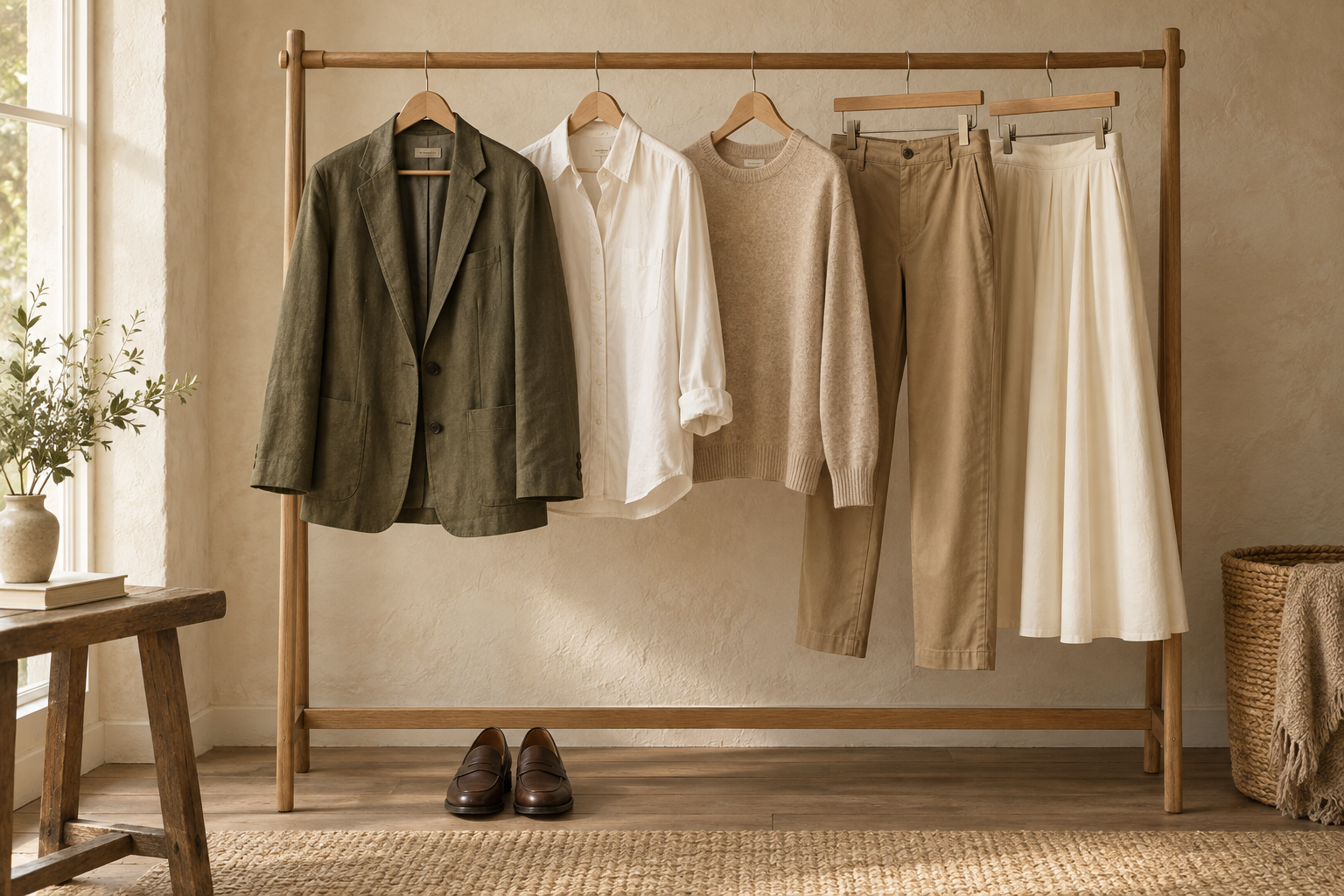
Start on the bottom half, because it anchors the outfit: dark, unfaded trousers or a knee-length or midi skirt in a stable fabric meet smart casual in most settings and business casual in many offices. Condition matters more than price — nothing pulled, stained or fraying.
On top, a fine-knit jumper or a collared shirt keeps the look deliberate. Plain beats busy here: the top is where a printed t-shirt or a stretched neckline quietly drops the whole outfit toward casual.
Finish with leather or leather-look loafers or derbies, or flat shoes such as ballet flats and low boots. Footwear is where venue rules bite hardest — clean and intact is the baseline, and the invitation's own exclusions always win over general advice.
If you prefer skirts or dresses, the same logic applies with different pieces: a knee-length or midi skirt in a stable fabric, a plain top or fine knit, and flat shoes such as loafers, ballet flats or low boots. Add a structured layer — a blazer or a tailored coat — if the event leans formal or runs into the evening.
Knowing which lever does what saves you from buying new clothes for every invitation. Fabric and condition move the needle more than brand or price: a pressed shirt reads smarter than a wrinkled blazer.
Dress it up
Dress it down
One more calibration habit: on a first day at a new job or a first visit to a venue, dress one notch above what you observed last time, then adjust. Drift runs over time too — many offices that banned jeans a decade ago accept dark, unfaded pairs now.
Guessing wrong feels worse than asking, and hosts almost always answer. A short, specific message works best.
A code tells you what to wear; your evening tells you whether you can actually live in it. Check four practical things before you leave.
None of this trades formality for comfort. It just means choosing, within what the code allows, the version of the outfit you will still be glad to be wearing two hours in.
From here, follow the decision you are actually facing.
The full definition of the code, the pieces that reliably satisfy it, and the mistakes that push an outfit too formal or too loose.
The two codes overlap, but they are not the same. A side-by-side look at what changes, and how to tell which one an invitation means.
Complete outfit examples for the events people actually get invited to, each with the reasoning behind every piece and swap.
The pieces that do the most work across dress codes, compared in detail — starting with linen versus cotton shirts.
OUR APPROACH
Good style starts with understanding what works for you.
A LITTLE FURTHER READING
Work & Dress Codes
A plain definition of smart casual: tidy, considered clothing a step below business dress, with complete example outfits, non-examples, and how the setting shifts the balance.
Work & Dress Codes
Smart casual vs business casual: the two codes overlap, and context decides which one applies. Compare jackets, shirts, shoes, denim and knitwear, and learn what actually settles the choice.