
Dress Codes
Are Jeans Smart Casual? Wash, Fit and Setting
Jeans can be smart casual when the setting allows denim at all. How wash, condition, fit and pairing decide whether a pair passes.
Footwear, defined
Some sneakers are smart casual in settings that allow them. Check the venue or workplace rule first, then judge the pair's design, condition and how it meets your practical needs.
Begin hereDefinition / explainer
Sneakers can be smart casual in settings that allow them. Check the venue or workplace rules before judging the pair's appearance. A simple, well-kept design may be easier to combine with tailored clothes, but neither a brand name nor a leather upper guarantees acceptance. Choose footwear that also meets your practical needs.
Policy comes before styling. A venue or employer with a no-trainers rule has already answered the question, and no amount of minimal design changes it. Where sneakers are not mentioned, look at the setting: a relaxed office or neighbourhood restaurant leaves room for them, while a formal venue usually does not. If you cannot find the rule and the occasion matters, ask the host or choose a different pair.
Once permission exists, the judgment is about the pair in front of you — its shape, its condition and the outfit it joins. The table below is a planning guide based on common design cues, not a rule any venue has published.
| Pair in question | Relaxed office or cafe | Dinner or drinks | Ceremony or formal venue |
|---|---|---|---|
| Plain low-top in leather or clean canvas | Commonly reads smart casual | Often workable with tailored trousers or a structured top half | Risky — check whether any sneaker is welcome at all |
| Minimal suede or knit low-top, quiet colours | Usually fine | Workable when clean and simply designed | Usually below the line |
| Retro or skate-inspired leather pair | Leans casual; depends on the room | Rarely reads smart | No |
| Chunky running or training shoe | Reads as sport or weekend | No | No |
A minimal leather sneaker always passes — the material does the work for you.
Leather is one helpful cue among several, not a passport. Venues with no-trainers policies apply them to leather pairs too, and a scuffed or bulky leather shoe can read worse than a pristine canvas one. Design, condition and the setting all weigh in; no single material guarantees acceptance.
Design and condition are the cues people actually see from across a room. None of them is a moral test — a running shoe is the right tool for its job, and a relaxed pair is a legitimate choice in a relaxed room. They simply place the pair on a spectrum, and smarter settings sit toward one end of it.
Before wearing a pair to a smart casual occasion, confirm:
Sneakers are judged as part of a whole outfit, so pair them with clothes that share their temper: tailored trousers or dark denim, a shirt or fine knit, and nothing shouting. Where a venue is stricter or you would rather not think about it, loafers and derbies are the low-risk substitutes — the combinations barely change. Our guide to smart casual shoes without heels covers the same territory for anyone avoiding heeled options.
Minimal leather low-tops with pleated wool trousers, a white shirt or fine knit polo, and no-show socks. Keep the sneakers plain so the tailoring stays the story.
Clean canvas court sneakers with dark, straight jeans, a navy overshirt and a plain tee. This is the relaxed end of smart casual — right where sneakers are most welcome.
Swap the sneakers for penny loafers or derbies and keep everything else identical. If the occasion is uncertain, this version removes the only gamble in the outfit.
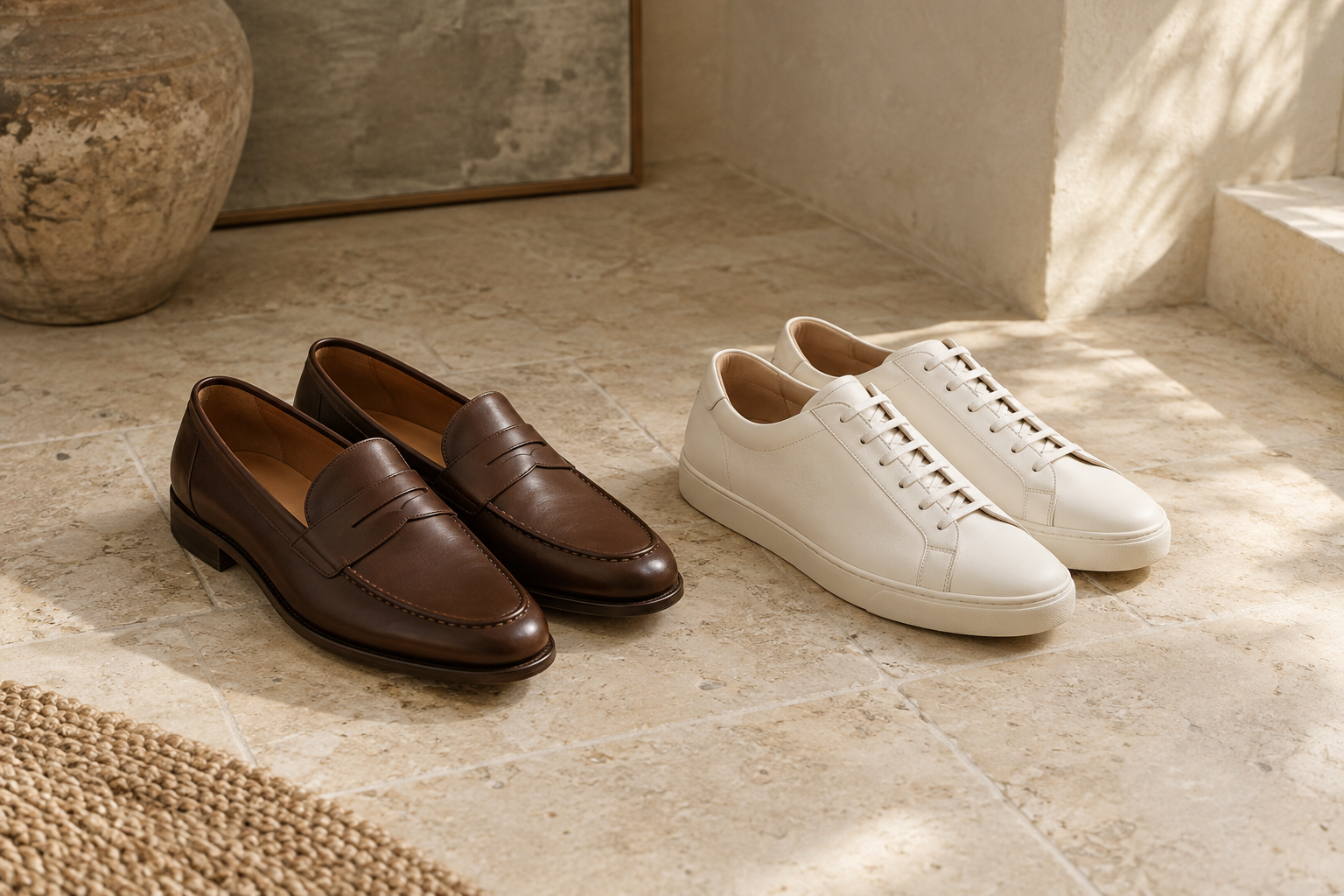
The photo on this page shows a pair of brown penny loafers beside cream sneakers, because the choice between them is the decision this page is about. It is a generated illustration of that choice, not evidence of any material, comfort or result — and the same caution applies to every outfit image on this site.
Condition carries more weight for sneakers than for almost any other smart casual shoe, so cleaning matters more than upgrading. Follow the maker's care instructions for the actual materials of your pair rather than generic shoe advice. If a pair cannot be brought back to presentable, it belongs in settings that read casual anyway.
Shoe polish is the fix — give the sneakers a shine like you would a derby.
Polish is formulated for smooth finished leathers; on canvas, suede or knit uppers it can stain, stiffen or clog the material. Clean each pair by its own material — a brush and suitable cleaner for canvas or suede, products intended for the leather treatment your pair actually has. When in doubt, the maker's instructions outrank habit.
Keep reading
The full code, and where footwear sits inside it.
Every shoe guide on the site, in one place.
Flat and low options that meet the code, sneakers included.
Sneakers are smart casual wherever a setting allows them and the pair reads as part of a considered outfit. The useful judgment is not sneakers yes or no but which pair: a simple, low silhouette in clean leather or canvas, worn with tailored-adjacent clothes, is a normal smart casual shoe in relaxed-leaning settings, while technical or worn pairs read as sport or weekend. Brand has nothing to do with the verdict, no single material guarantees acceptance — and all of it applies only after the venue's rule is checked.
Dress Codes
Jeans can be smart casual when the setting allows denim at all. How wash, condition, fit and pairing decide whether a pair passes.
Dress Codes
Shorts can fit a smart casual outfit when the host or venue allows them. Start with that check, then choose a pair you can sit and walk in comfortably.
Work & Dress Codes
Smart casual vs business casual: the two codes overlap, and context decides which one applies. Compare jackets, shirts, shoes, denim and knitwear, and learn what actually settles the choice.