Dress Codes
Are Jeans Smart Casual? Wash, Fit and Setting
Jeans can be smart casual when the setting allows denim at all. How wash, condition, fit and pairing decide whether a pair passes.
Dress code question
Shorts can fit a smart casual outfit when the host or venue allows them. Start with that check, then choose a pair you can sit and walk in comfortably. A shirt and loafers may dress up tailored shorts, but they cannot override a rule requiring long trousers.
Begin hereDefinition / explainer
Shorts can fit a smart casual outfit when the host or venue allows them. Start with that check, then choose a pair you can sit and walk in comfortably. A shirt and loafers may dress up tailored shorts, but they cannot override a rule requiring long trousers.
Temperature argues for shorts; policy decides whether the argument lands. Two venues on the same summer evening can differ completely — an open-air terrace may welcome them while the restaurant downstairs requires long trousers. Neither setting is invented here; the point is that both exist, which is why the check comes first. Consult the venue's own guidance where it publishes one, and ask when it does not.
Where shorts are welcome, the rest is styling — and where they are not, no outfit rescues them. Our guide to smart casual explained shows how the same permission-first logic applies to jeans and sneakers too.
Tailored shorts are smart casual by definition — get the construction right and any summer venue will take them.
Construction describes a pair; it does not admit it. A well-made tailored short still fails at a venue that requires long trousers, and a drawstring-tailored style is a legitimate design rather than sportswear simply because of its waistband. Permission first, construction second — in that order.
The distinction that matters is descriptive. Tailored shorts borrow their language from trousers: a structured waistband, a clean front, real pockets and a hem that behaves. Athletic shorts announce their job — mesh linings, side stripes, training fabrics — and belong to settings built around sport.
Two cautions keep the distinction honest. First, a drawstring on an otherwise tailored pair is a design choice, not an automatic demotion to gym wear. Second, fabric blend alone cannot guarantee anything: a cotton-linen short can crease by dinner, and a synthetic one can hold a pressed line — judge the pair in front of you, not the label's percentages.
| Pair | Construction cues | Where it usually fits |
|---|---|---|
| Tailored chino or cotton-linen shorts | Structured waistband, flat front, real pockets, hem that holds its line | Terraces, resort dinners, relaxed summer offices that allow shorts at all |
| Tailored short with drawstring waist | Clean cut and pockets like a trouser, softened closure by design | Same settings as any tailored pair — the drawstring alone does not disqualify it |
| Athletic shorts | Mesh lining, stripes, performance fabrics, built for movement | Sport, training and deliberately casual settings — right tool, different room |
The combinations below assume shorts are already welcome — the check has been passed. The third outfit is the fallback that works everywhere the first two do, and somewhere they don't.
Tailored shorts with a fine polo, a belt that speaks to the shoes, and loafers or suede desert boots. Swap the loafers for clean leather sneakers where the setting leans younger and looser.
The same shorts with a short-sleeve linen or oxford shirt, sleeves as pressed as the morning allows, and loafers or boat shoes. The open collar sets the read; keep everything else quiet.
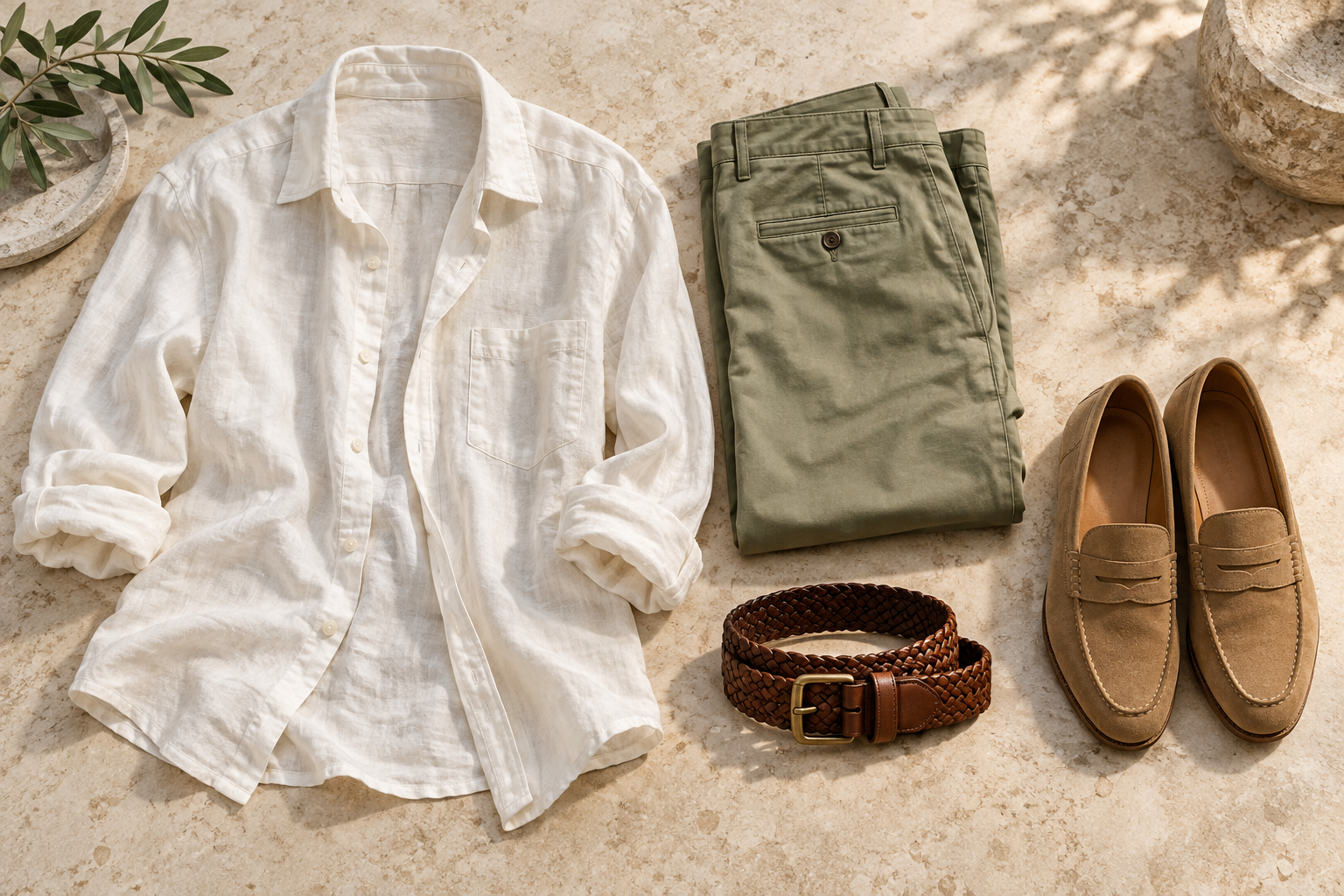
Lightweight trousers in linen or a cotton blend with the identical shirt and shoes. This outfit passes everywhere, including heavily air-conditioned rooms where shorts fail on comfort anyway.
Mobility is part of the outfit check, not an afterthought: shoes you can walk in and a rise you can sit in are what make a summer outfit look deliberate rather than endured. The flat-lay image on this page shows the fallback outfit — shirt, light trousers and loafers arranged together. It is a generated illustration of a combination, not evidence of fit or fabric behaviour, and no shorts image in our library honestly shows the lesson above.
Fit checks for shorts are about behaviour, not measurements on a ruler. The waistband should hold without a belt doing rescue work, the hem should stay put when you sit, and the thigh should allow a full stride. Preferred length varies with body, climate and fashion — somewhere above the knee is common precisely because it balances seated coverage with ease, but the exact distance is yours to choose.
In front of a mirror — then sitting down — confirm:
Uncertainty resolves with a single line to the host or venue: ask whether long trousers are required. Nobody resents the question; people remember the guest who had to borrow a pair at the door. If the answer is unclear before you leave, pack trousers that fold to nothing and change on arrival — the fallback outfit costs little and covers every outcome.
Where to go next: denim lives under the same permission-first logic in are jeans smart casual, and sneakers get the same treatment in are sneakers smart casual.
Keep reading
Every code on the site, from black tie to casual.
The same permission-first logic applied to denim.
Judging a pair once the venue's rule allows it.
Shorts are smart casual wherever a host or venue allows them and the pair reads as part of a considered outfit. That makes them the most permission-dependent piece in the code: a tailored short with a real waistband and a comfortable, seated-honest fit is a normal summer answer on a terrace, while the same pair waits outside a restaurant that requires long trousers. Construction describes the garment rather than admitting it — and preferred length varies, so the checks that matter are coverage when seated and freedom at the thigh.
Dress Codes
Jeans can be smart casual when the setting allows denim at all. How wash, condition, fit and pairing decide whether a pair passes.
Dress Codes
Some sneakers are smart casual. Judge silhouette simplicity, material, condition and cleanliness — the name on the tongue matters least.
Work & Dress Codes
Smart casual vs business casual: the two codes overlap, and context decides which one applies. Compare jackets, shirts, shoes, denim and knitwear, and learn what actually settles the choice.