Dress Codes
Are Jeans Smart Casual? Wash, Fit and Setting
Jeans can be smart casual when the setting allows denim at all. How wash, condition, fit and pairing decide whether a pair passes.
The foundation guide
What is smart casual? A plain definition first, then complete example outfits, the things that break it, and how to judge any garment or combination against it.
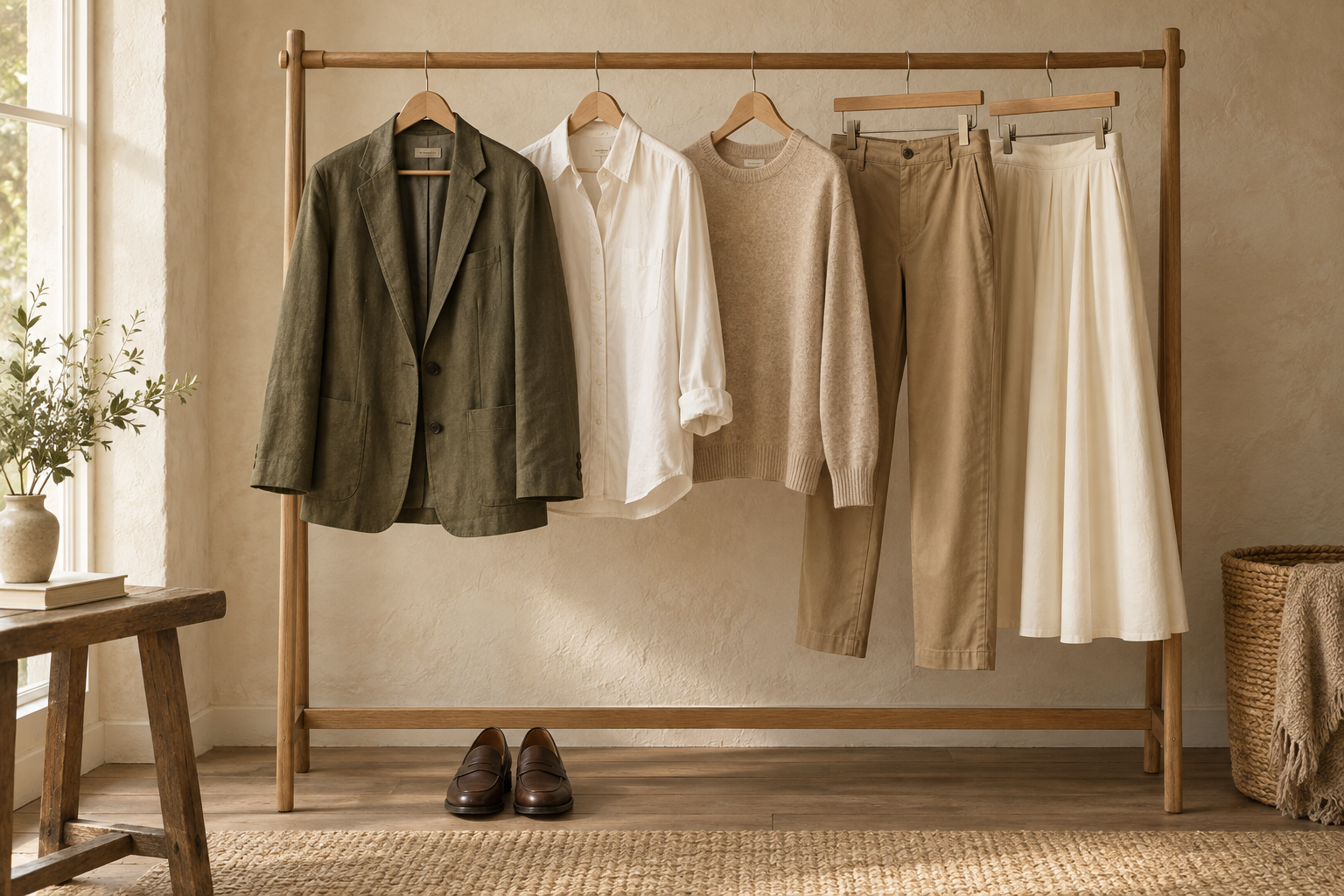
Begin hereIllustrative rail of smart casual garments: olive blazer, ivory shirt, oatmeal knit, tan trousers and cream skirt above brown loafers. Individual pieces, not a required uniform.
Definition / explainer
Smart casual usually means an outfit that combines everyday ease with a more considered finish. The exact expectation depends on the host, workplace or venue, so check stated rules first. Trousers with a shirt or knit and suitable shoes are one starting point; a dress or skirt outfit can serve the same purpose.
'Smart' and 'casual' are each doing real work in the name. Smart points to structure and condition; casual points to ease and comfort. Smart casual is the combination, so no single garment is always in or always out — a jacket can be the anchor in one outfit and absent from another that still qualifies.
Smart casual is one fixed formula — jacket, collared shirt, tailored trousers — and anything else breaks the code.
There is no universal garment list. A shirt dress with loafers, or a tucked blouse with a midi skirt and clean leather sneakers, can meet the same brief. What stays constant is the balance of structure, ease and condition — not the specific pieces.
Because hosts and venues use the label differently, the practical skill is reading the setting before assembling the outfit. These are the questions that do the sorting.
Lean tailored when…
Lean relaxed when…
| Setting | Where the balance sits | A complete starting outfit |
|---|---|---|
| Client meeting or interview | Leaning tailored; ease stays subtle | Navy blazer, white oxford shirt, charcoal tailored trousers, dark leather derbies |
| Office without a stated code | Balanced; structure visible but not strict | Fine merino crewneck over a collared shirt, straight black trousers, black leather ankle boots |
| Dinner at a good restaurant | Balanced to relaxed; polish matters more than structure | Charcoal chinos, tucked-in striped button-down, brown belt, suede chukka boots |
| Weekend brunch or gallery | Leaning relaxed; ease can lead | Dark straight-leg jeans, plain quality t-shirt under an unstructured blazer, clean minimal leather sneakers |
| Daytime celebration | Balanced; dresses and skirts carry it easily | Knee-length shirt dress with a slim belt, low leather loafers, structured bag |
Once you can name the pieces, evaluating an outfit takes a minute. Run the checklist below on any combination — including ones you own already — before deciding it qualifies.
Five checks, in the order that matters:
Smart casual has no fixed uniform, so condition is the standard that does the enforcing.
These three are the pieces people argue about, and the honest answer is that each one is conditional. All three can sit inside smart casual when the wash, condition and the rest of the outfit do the compensating work — and all three can sink it when they do not.
Each of these has its own guide on this site — jeans, sneakers and the t-shirt question each get a full page, because the conditions differ more than a summary can carry. If one of the three is the piece you are unsure about, start there.
Smart casual is tidy, considered clothing worn a step below full business dress: at least one piece has structure (a blazer, tailored trousers, a collared shirt or a proper dress), at least one piece is relaxed (dark jeans, a fine knit, clean sneakers or loafers), and everything is clean, intact and fits well. The setting calibrates the balance — the same person can lean more tailored for a client meeting and more relaxed for brunch, and both are smart casual as long as structure and ease are both present and nothing looks neglected.
Dress Codes
Jeans can be smart casual when the setting allows denim at all. How wash, condition, fit and pairing decide whether a pair passes.
Dress Codes
Some sneakers are smart casual. Judge silhouette simplicity, material, condition and cleanliness — the name on the tongue matters least.
Dress Codes
A T-shirt can work for smart casual when the setting allows it and the complete outfit suits the occasion. How to check the tee and what to wear instead when it does not pass.