Skip to content

Find your next good read.

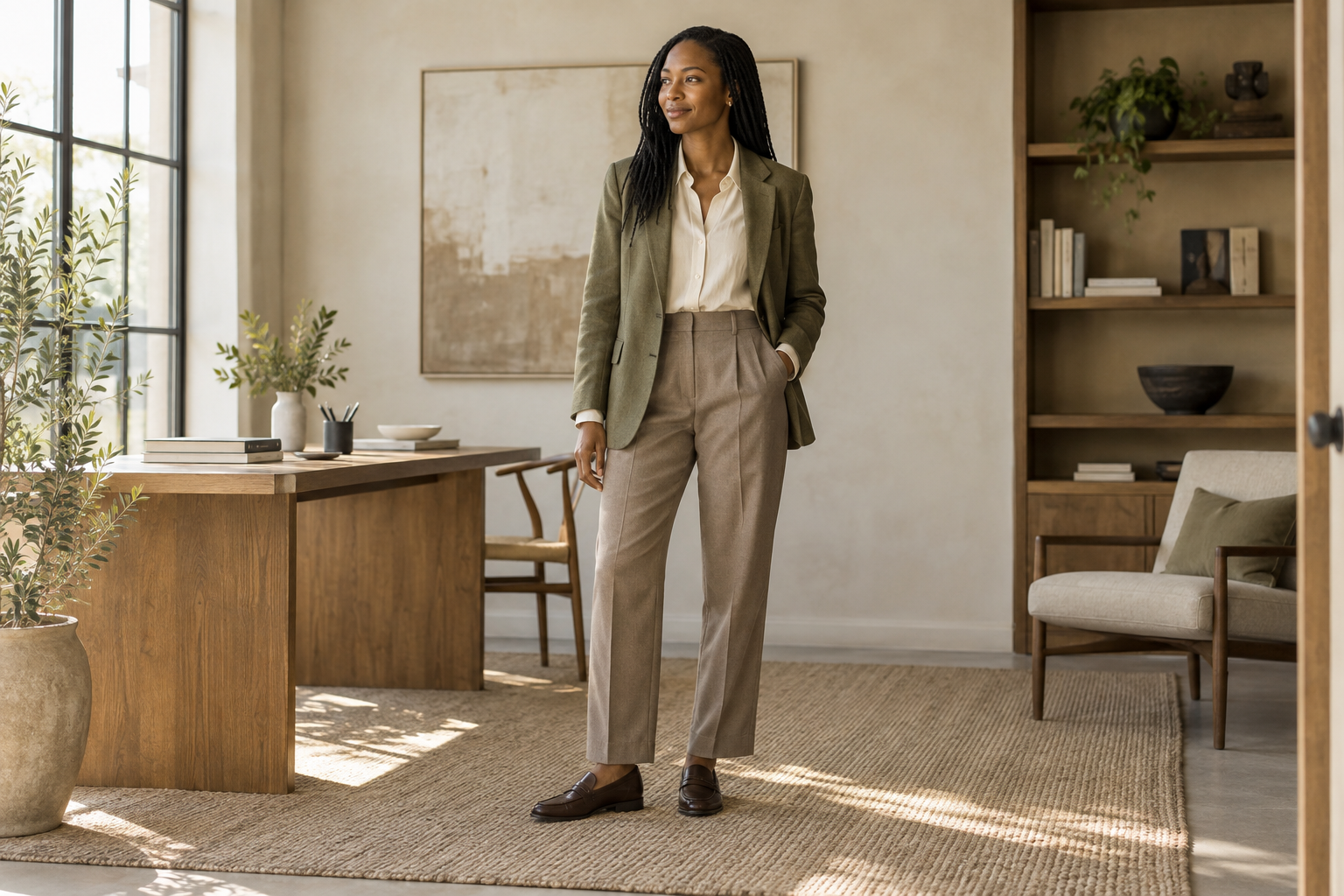
Woman in an olive blazer, cream shirt and taupe trousers with brown loafers in a sunlit office.

Dress code comparison

Smart Casual vs Business Casual: What Changes?

Smart casual vs business casual: the labels overlap, and neither comes with a fixed garment list. Compare them side by side, then let the setting — and whoever set the rules — decide.

Begin here

Illustrative image of a workplace outfit: olive blazer, cream shirt, taupe trousers, brown loafers. It shows one combination, not a requirement of either code.

Comparison

Smart casual vs business casual: what actually changes

Smart casual and business casual overlap, but the setting changes how people use the labels. Business casual describes workplace expectations; smart casual is also used for social occasions. Neither term supplies a universal garment list. Compare the stated rules first, then choose an outfit that meets the particular employer's or host's expectations.

Why the two labels get confused

Both codes sit between a suit and jeans-and-a-t-shirt, and both describe a balance rather than a uniform. Because the balance shifts with context, the same outfit can be someone's business casual and someone else's smart casual on the same day. That is a feature of the labels, not a mistake in your reading of them.

Myth

Business casual always requires a jacket, and smart casual never allows one — so you can tell the codes apart by looking for a blazer.

Fact

No published rule makes a jacket compulsory under every business casual code, and plenty of smart casual settings reward one. The jacket expectation belongs to specific employers and occasions, so check the policy in front of you rather than the label.

Which code is being asked of you?

Before choosing garments, work out which register the occasion actually calls for. The words used in the invitation, email or job ad are the fastest signal.

Points towards business casual

  • The words office, client, interview or induction appear in the invitation
  • You are meeting the employer's customers or leadership
  • The team's day-to-day dress is structured even on relaxed days
  • The cost of looking underdressed is high, such as a first meeting

Points towards smart casual

  • The setting is social: dinner, drinks, a gallery, a party
  • The invitation names a venue rather than an employer
  • Senior people at the event dress expressively rather than formally
  • The evening rewards polish and personality over structure

Check the stated rules before choosing garments

The fastest way to waste the comparison is to skip the source. Someone wrote down what the occasion expects, or someone in the room can tell you, and either beats a generic definition of the two labels.

  1. Find the primary source

    For work, that is the employee handbook, the invitation email or the recruiter. For social occasions, it is the invitation line or the host. A named source outranks any article, including this one.

  2. Look for garment-level specifics

    Some policies name items directly — 'collared shirts', 'no denim', 'jackets preferred'. Treat those as the actual rule; they override whatever the words smart casual or business casual usually imply.

  3. Read the audience, not just the code

    A business casual code applied to client-facing teams behaves differently from the same label applied to back-office roles. Who you will be seen by decides how strictly the baseline applies.

  4. Ask one question if it stays unclear

    'Is there a dress standard I should follow?' costs nothing and resolves conflicting signals instantly. The answer from the employer or host settles what no comparison table can.

Before you settle on the outfit, you should be able to tick:

  • I have a stated source for the expectation, or a named person to ask
  • I know whether denim and sneakers are actually permitted where I am going
  • I can name the one structured piece my outfit hangs on
  • My choice would still work if the event ran one step more formal than expected

THE SHORT ANSWER

Choose for the day ahead.

For most settings, business casual sits one step more formal than smart casual: it leans on structured shirts, tailored trousers and leather shoes as its common baseline, where smart casual gives more room to fine knits, dark denim and lighter footwear. What actually changes is the jacket expectation, the structure of the shirt or top, the shoe, and how much the setting forgives casual fabrics. Every one of those differences is conditional on the specific employer or host — no row below is a rule that applies everywhere. When in doubt, dress for business casual and relax one piece; that usually lands inside smart casual too.

Side by side.

The differences that matter
AspectSmart casualBusiness casual
JacketOptional in most social settings; unstructured blazers, knit blazers and overshirts all appearVaries by employer: some offices expect a blazer in client-facing or formal settings, others never require one — check the actual policy, not the label
Shirt or topFine knit, polo, a quality t-shirt under a jacket, or an open-collar shirtCommonly a collared or structured shirt, often tucked; blouses and structured knit tops serve the same role. Policies that require a collar exist, but many offices accept fine knits too
TrousersTailored trousers, chinos, or dark clean denim depending on the venueTailored trousers, chinos or pencil skirts as the safe default; denim permission is employer-specific and worth confirming
ShoesLoafers, derbies, clean minimal sneakers, heeled boots or smart flatsLeather loafers, derbies or heels as the reliable choice; trainers rarely pass in a formal workplace, though relaxed offices differ
DenimDark, straight, undistressed denim is usually acceptable in social settingsSplit across employers: some relaxed offices allow dark denim, many do not. The written policy or the team's habits answer this one
KnitwearA fine-gauge knit can replace the shirt entirelyWorks in most offices as a layer over or instead of a collared shirt — but where a specific policy asks for collars, the knit becomes the layer, not the substitute
Fit and colourMore room for texture, mid tones and personal expressionCommonly a neutral palette and conservative cuts, tuned to the industry — creative offices stretch this further than banks do
Overall messageConsidered and individual — dressed up for an occasion, not a roleProfessional and reliable — dressed for colleagues and, where relevant, clients

What should guide your choice?

  • Read the invitation or brief literally: the words business, office, client or interview push towards business casual, while dinner, drinks, gallery or party point to smart casual.
  • Consider workplace norms if the setting is professional — the code your colleagues wear day to day is the real baseline, not a generic definition.
  • Look at what the hosts or most senior people in the room are likely to wear, and aim within one step of that.
  • Weigh the consequence of being underdressed: at a job interview or client meeting it costs more, so default to the more formal of the two codes.

The right choice depends on the setting.

Job interview at a business-casual office

Interview one step above the daily norm: a structured blazer, an ironed shirt with the top button open, tailored trousers and polished leather derbies or loafers. The panel will likely be dressed a notch below this, and that gap reads as respect rather than mismatch. Skip denim and sneakers for the first meeting even if the office wears them.

Creative office with a client visiting

Creative teams can dress for smart casual day to day — knit, dark denim, loafers — but the client meeting resets the level to business casual. Keep the trousers or swap denim for chinos, add a blazer over the knit, and keep shoes leather. Once the client leaves, the outfit still works as smart casual with the jacket off.

One base outfit, two settings

Start with taupe tailored trousers, a cream shirt and brown loafers. For the workplace that expects structure, add an olive blazer and keep the shirt buttoned to one open collar. For the dinner the same evening, take the blazer off, open a second button or swap the shirt for a fine knit — the base does the work, the adjustments carry the register.

Dinner where either code works

A good restaurant rarely specifies, and smart casual is the safer read: a fine knit or open-collar shirt, tailored trousers or dark denim, and loafers or heeled boots. If you learn the group is coming straight from the office, the same outfit holds — just add the blazer you would have worn anyway. Either code lands fine here because the room rewards polish, not structure.

The invite just says casual

Casual on an invitation can mean anything from relaxed smart casual down to genuinely informal, depending on the host and the venue. Ask if you can — 'anything particular I should wear?' — or read the setting: an evening city dinner wants the blazer end of the range, a weekend backyard party does not. When you cannot check, relaxed smart casual is the version of casual that rarely misfires.

Keep exploring.

Work & Dress Codes

What Is Smart Casual? A Practical Guide

A plain definition of smart casual: tidy, considered clothing a step below business dress, with complete example outfits, non-examples, and how the setting shifts the balance.