Oxford vs Derby shoes ↗
The two classic lace-ups compared by lacing, fit and where each sits in a smart casual outfit.
Clothing
Work through smart casual shoes the way a fitting does: check what the setting permits, compare the shoe families on their actual features, then test a real pair for the walking you will do.
Explore the collectionFIND YOUR STARTING POINT
Shoes set the tone of a smart casual outfit faster than anything else you wear, which is why they deserve a deliberate check rather than a habit. The method on this page runs in order: permission, comparison, fit, then the day's activity and hemlines.
Choose smart casual shoes by checking the venue's rules, the outfit and the walking you need to do. Loafers, lace-ups, flats and some trainers may all be options, depending on the setting. Try the actual pair with your usual socks or hosiery, because a dressier appearance does not make a shoe comfortable or suitable for every surface.
An explicit restriction beats every general principle. If an invitation, workplace policy or venue states “no trainers”, “no open-toe shoes” or “no plimsolls”, that single line settles more than any guide can. Broad style advice only fills in the picture where nothing specific has been said.
It is tempting to rank shoes from “most casual” to “most formal”, but the ranking breaks down fast: a chunky-soled derby can read more casual than a sleek loafer, and a minimalist trainer out-dresses a battered boat shoe. The useful comparison is feature by feature. Fastening, upper material, sole and toe shape each shift a shoe smarter or more casual, and combinations matter more than categories.
| Family | Typical fastening | Reads smarter when | Reads more casual when |
|---|---|---|---|
| Derby | Open lacing | Polished leather, slim sole, dark colours | Suede or heavy stitching, chunky or crepe sole |
| Oxford | Closed lacing | Smooth leather, slim profile, black or dark brown | Rarely casual — the closed lacing keeps it dressy |
| Loafer | Slip-on with a structured upper | Firm leather upper, low profile, penny or horsebit detail | Soft unlined suede, rubber forecastle soles, worn sockless and creased |
| Ballet flat | Slip-on | Structured leather that holds its shape | Soft, foldable constructions that crease at every step |
| Trainer | Laces | Plain leather or suede upper, slim sole, muted colour | Mesh uppers, chunky soles, logos and bright colours |
Two honest corrections to common advice follow from this table. Laces and buckles often accompany dressier shoes, but fastening alone does not make a shoe smart — a worn lace-up with a collapsed heel is worse than a firm loafer. And leather is not an automatic pass: a smart casual setting accepts leather because it is clean and reasonably sleek, not because of the material itself.
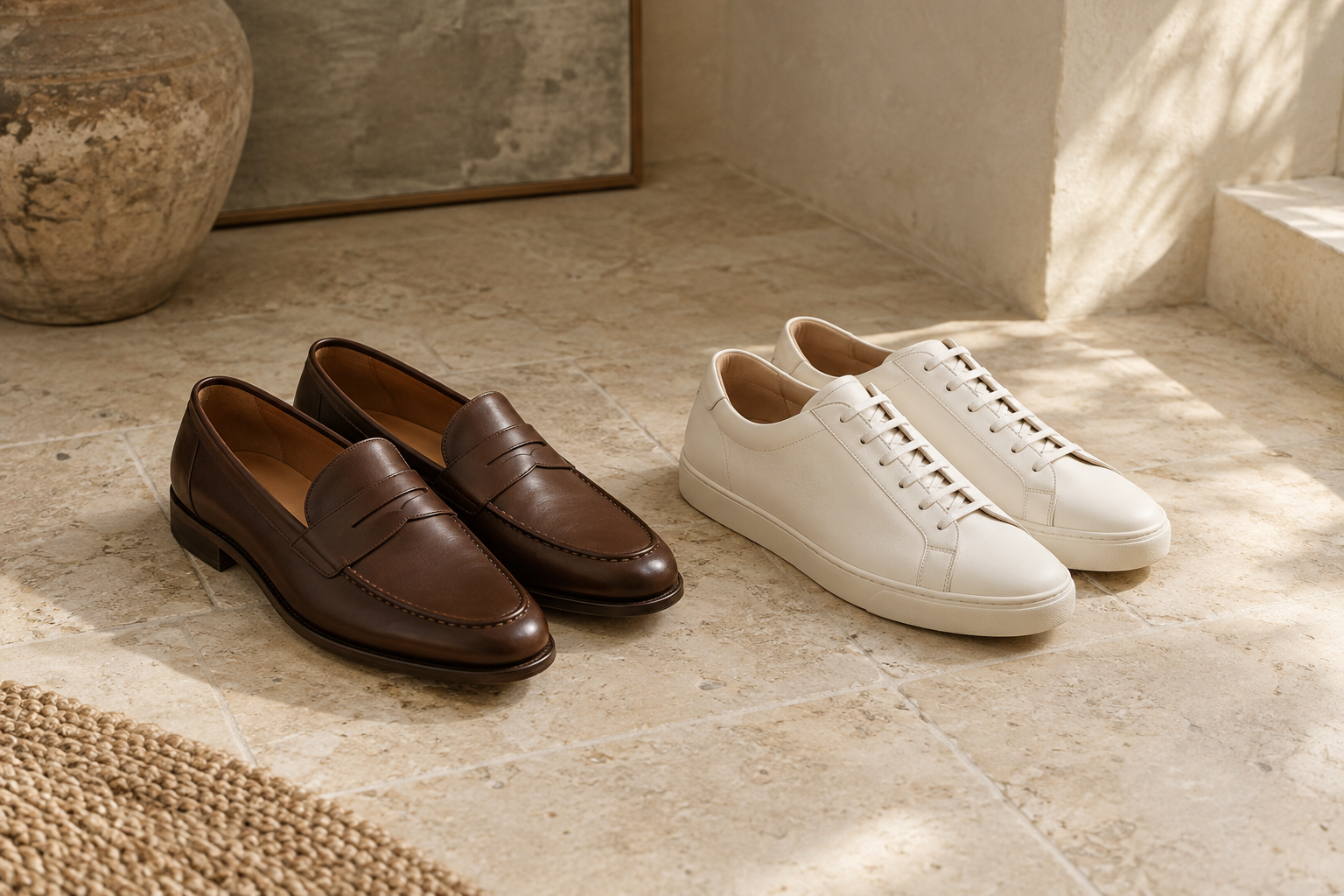
The image on this page pairs brown penny loafers with cream sneakers side by side on a pale stone floor. It shows two families many readers are choosing between — it is a styling illustration, not evidence of what any venue accepts or how either pair performs.
All slip-ons are too casual for smart casual.
A structured leather loafer is a slip-on and sits comfortably in most smart casual settings. What matters is the firmness of the upper, the sole and the condition of the pair — not whether it has laces.
Flat shoes support your feet all day because they are flat.
Flat soles offer no arch support by default, and a paper-thin ballet flat can be harder to walk in than a low heel. Support comes from the footbed and construction, which you only assess by trying the pair.
A shoe that photographs well can still pinch, slip or raise a blister by the second hour. Fit is checked in the wearing, not on the shelf. Run the same short test on any pair you plan to wear for a full day, at home first so you can still change your mind.
Wiggle all toes while standing. If they touch the end or rub the top line, the length or depth is wrong — sizing up half a size often fixes it.
Walk a few lengths. A little heel slip is normal in new leather loafers; persistent lifting or grinding means blisters later, whatever the label promises.
Thickness changes fit more than most people expect. Test with what you will actually wear, including tights or no-show socks for loafers and flats.
Smooth leather soles slide on polished floors and wet paving. If the day involves those, check the sole material or plan a rubber-soled alternative.
Choose the pair when
Think again when
The same pair can be perfect for a seated dinner and punishing for a day of standing and transit. Smart casual settings often hide more walking than the invitation suggests: car parks, stations, standing rooms, cobbled streets between venues. Estimating the day's terrain and duration honestly is part of choosing the shoe, not an afterthought.
Trainers are the most setting-dependent family in the table, so they deserve their own judgement rather than a blanket yes or no. Whether sneakers are smart casual depends on the pair and the place, and the honest answer is that neither can be assessed from across the room. A short set of checks narrows it down quickly.
Run these on the pair, then re-run them against the setting:
The hem above the shoe decides how much of it shows and where the outfit's weight sits. A long, straight trouser should end at or just above the shoe with a small break, so a slimmer sole keeps the line tidy while a chunky sole visually shortens the leg. With a mid-length skirt, the clearance between hem and shoe matters: a low, sleek shoe lets the hem hang cleanly, while a heavy boot can pull the fabric and bunch it.
Condition changes how any family reads. Scuffed toe caps, grey suede and frayed laces pull a dressier shoe toward shabby, while a clean, well-kept pair keeps even a casual trainer presentable. A quick check the night before is enough.
Before you wear the pair out:
The two classic lace-ups compared by lacing, fit and where each sits in a smart casual outfit.
Heel slip, toe room and sizing for loafers, including what changes when you wear them sockless.
Two slip-on families with different trade-offs in structure, comfort and the hems they suit.
Flat and low options that hold up in smart casual settings, with honest notes on support and dressiness.
How to judge a specific pair of trainers against a specific setting, since the answer genuinely varies.
OUR APPROACH
Good style starts with understanding what works for you.
A LITTLE FURTHER READING