
Shoes
Smart Casual Shoes for Women Who Don’t Wear Heels
How to find flat shoes that still read smart casual: judge material, construction and toe shape, then try on with the hem length you actually wear.
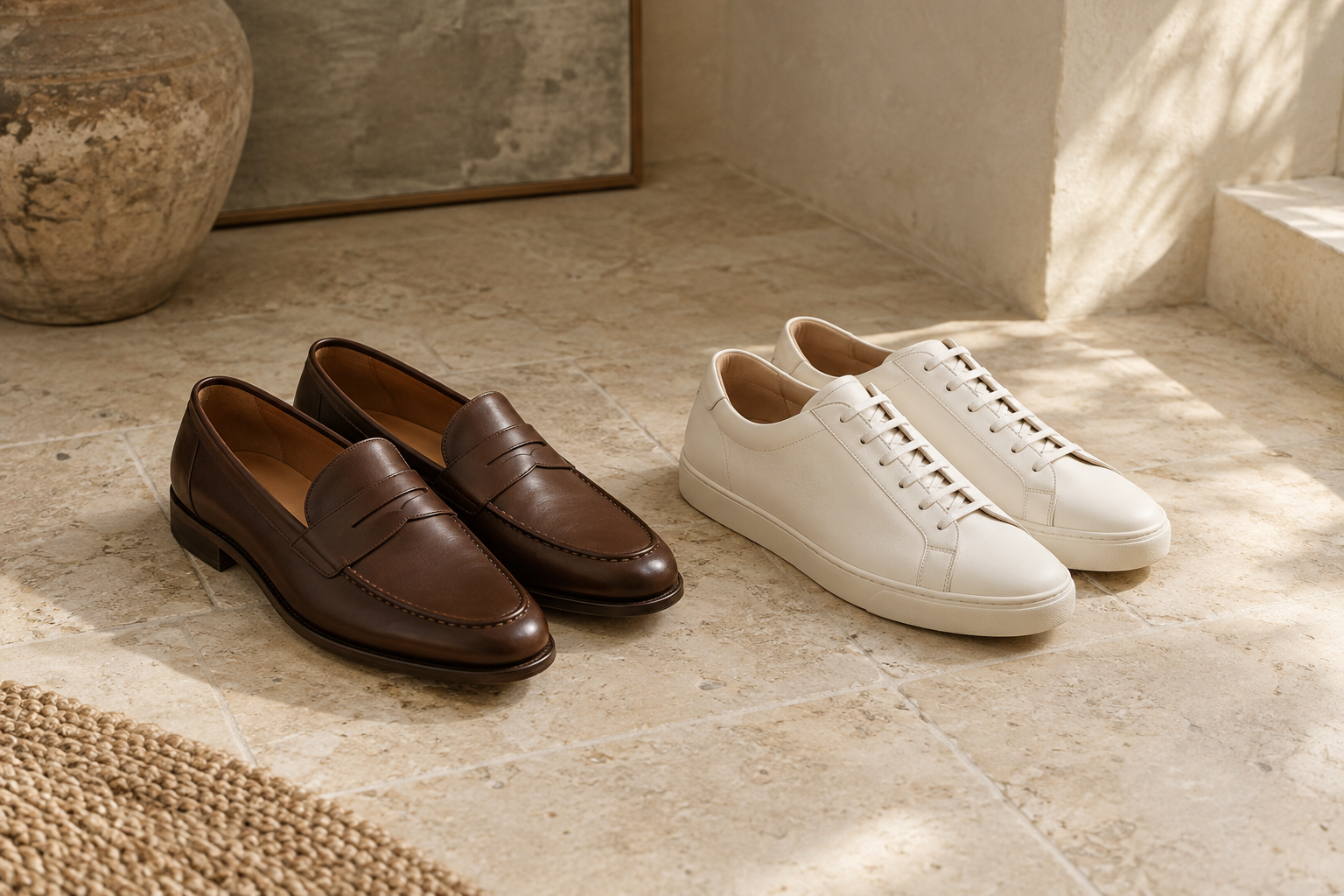
Shoe buying guide
The sole is the quietest part of a shoe and one of the loudest signals it sends. Leather reads dressier but minds the rain; rubber grips and relaxes the look. This is how to weigh the two before you buy.
Begin hereHow-to
Choose a smart casual shoe sole by considering where you will walk, how the shoe fits and what the maker says about its construction. Leather, rubber and crepe each vary. Visible stitching does not prove a shoe is welted or easily resoled, and a chunky tread does not by itself prove reliable grip on wet surfaces.
Two shoes in the same leather can sit a full step apart in formality, and the difference is usually the sole. The choices run in a fixed order — material, construction, profile against the trouser, edge colour — and each one is a tradeoff rather than a rule. Work through them in sequence and the sole that matches your wardrobe is usually obvious by the end.
A visible line of stitching on the side of a sole proves the shoe is welted, resoleable and well made, while a glued sole is a disposable shoe.
Stitching at the sole edge can be decorative, and some stitched constructions still limit resoling. Cemented shoes are common and perfectly serviceable at moderate prices. The only reliable route is to ask the retailer or maker what construction the pair uses and what that means for future repair — a cobbler can confirm before you commit to a resole.
Rubber or crepe soles guarantee grip, and a chunky tread means a shoe is safe on wet pavement.
Sole material alone guarantees nothing about wet-surface performance — grip depends on the compound, the tread pattern and the surface. Treat grip as a specification question: use whatever traction information the manufacturer documents, and judge the rest with your own careful walking rather than an improvised slip test.
| Sole material | Weather it suits | Line it gives | What to accept |
|---|---|---|---|
| Leather | Dry city days and indoor settings. | Slimmest and quietest under tailored trousers. | Smooth leather hardens when wet and offers little traction on wet ground. |
| Standard rubber | Rain, mixed commutes, everyday wear. | Slightly heavier; low dark profiles stay visually quiet. | Chunkier profiles read casual under fine wool. |
| Crepe | Cool, dry-to-damp casual wear. | Soft, thick, relaxed — pairs with denim and heavy cottons. | The most casual look of the three and cushioning that some find too soft. |
Before paying for any pair, run this construction question list:
Decisions this page feeds
The parent guide — where sole choice sits in the wider shoe wardrobe.
If most of your walking is the commute, this extends the sole and surface decision.
If the shoe is right but the fit still feels off, the problem is width and volume, not the sole.
A pair of smart casual shoes whose sole matches your climate, your usual surfaces and the dressiness you need — chosen by checking the material, asking about the construction and the documented specification, and testing the fit underfoot before paying, not by assuming one sole type is always correct.
Leather soles are the dressier choice — slimmer under the foot, quieter in line with tailored trousers, and the traditional pairing for loafers, derbies and dress boots. The honest tradeoff is weather: smooth leather hardens when wet and offers little traction on wet pavement or tiled floors. Rubber and crepe trade a little of that sharpness for weather tolerance and cushioning, which for many wardrobes is a trade worth making. If your wet-weather days outnumber your dry ones, let the rubber sole win without guilt.
Check: Look at the last month of your calendar, not an ideal week — if rain was a regular feature, choose rubber or crepe as the default and keep leather for the dry-weather pair.
Turn the shoe over and ask what you are looking at. Welting, blake stitching and cementing all exist at a range of prices, and a stitched-looking sole edge can be decorative rather than structural. Cemented (glued) construction is common and perfectly serviceable at moderate prices, and it allows slimmer, lighter profiles; its limit is that once the bond fails, repair means a cobbler's judgement call rather than a routine resole. The retailer or maker can tell you which construction the pair uses and what resoling would involve — ask them rather than reading the stitching, and ask a cobbler before buying any shoe you expect to resole.
Check: You have the construction named by the retailer or maker — not inferred from a stitch line — plus a rough answer on what a future resole would involve.
Tread depth and sole colour say nothing reliable about performance on wet surfaces. If grip matters for your routes, ask what the manufacturer documents about the outsole compound and any traction testing, and prefer a named outsole with published information over an unmarked one. Absent documentation, assume nothing and walk cautiously until you know how the pair behaves.
Check: For any pair you will wear in rain, you can state what the maker documents about the outsole — or you have accepted the gap knowingly.
A slim sole keeps the shoe visually quiet and pairs most naturally with tailored trousers, where the hem should fall close to the shoe. A thicker rubber or crepe sole adds visual weight that suits denim, heavier cottons and relaxed fits — it reads as deliberate with those fabrics and clunky with fine wool. Neither is more correct; the mistake is a mismatch, such as a heavy lug sole under pleated fine trousers or a razor-thin leather sole under raw denim.
Check: Try the shoes on with the trousers you own: the hem should break once on the shoe without pooling, and the sole should not look borrowed from a different outfit.
Most soles are dyed at the edge — a natural tan edge on a brown shoe, black on black, or a contrasting off-white stitch-and-edge on some rubber styles. A natural or tonal edge blends the sole into the upper and reads slightly dressier; a stark white edge stitching on dark rubber leans casual and sporty. There is no right answer, but choosing the edge with the same intent as the rest of the shoe keeps it coherent.
Check: Photograph the shoe in store lighting at ankle height, where it will actually be seen — an edge that disappears into the upper in the photo will do the same on the street.
Bend the shoe gently at the ball: leather soles flex more stiffly at first and soften over weeks of wear, while crepe and cushioned rubber flex immediately. A press of the fingertip tells you only that the sole is soft or firm — it does not predict how the shoe feels after a full day on hard floors. The check that carries real information is a several-minute indoor walk in your own socks, ideally while the return policy still stands.
Check: A pair passes when the flex point of the sole lines up with where your own foot bends, and a short walk leaves nothing pinching, slipping or numb.
Step back and place the shoes next to what you already own. If most of your smart casual rotation is tailored — trousers, unstructured jackets, fine knitwear — a leather or slim rubber sole keeps the register consistent. If your rotation is denim, chore jackets and heavier cottons, a chunkier rubber sole fits without thought. The sole that matches the clothes you actually wear will be worn far more often than the one that matches a dress-code diagram.
Check: Before buying, name three outfits already in your wardrobe the shoes would complete; if you cannot, the sole or the shoe is the wrong register, however well made it is.
Keep them and adapt rather than replace: many people reserve leather-soled shoes for dry days and office hours, and a cobbler can add a thin rubber topiece over the leather sole for extra grip without changing the shoe's line. Check with your cobbler first — not every sole and not every cobbler takes this work, and it is a modification, not a grip guarantee.
Choose a slimmer rubber profile in a colour matched to the upper — a low, dark rubber sole keeps most of leather's visual quietness while adding weather tolerance. If the trousers are fine wool and you need the dressiest line, this is the case where leather soles remain the honest answer and an umbrella is part of the outfit.
Sole stiffness, not size, is often the cause in the first weeks — leather-soled pairs in particular soften and mould with wear, so give a well-fitting pair several short outings before judging them. If the heel slips or the toes press after that period, the fit rather than the sole is the problem, and no sole choice will fix it. Width and volume, not length, are the usual culprits.
Ask for the manufacturer's product page or specification sheet, which usually names the construction and outsole. If no one can document what the sole is, treat every construction and grip assumption as unverified and buy accordingly — or choose a pair where the maker publishes the details. An undocumented sole is not necessarily bad, but it cannot be sold to you as stitched, resoleable or slip-tested.
Shoes
How to find flat shoes that still read smart casual: judge material, construction and toe shape, then try on with the hem length you actually wear.
Shoes
Oxford vs Derby shoes comes down to open versus closed lacing. What the difference is, what it changes for fit and dressiness, and what it does not guarantee.
Shoes
Pair sneakers with tailored trousers by checking the venue, then matching sneaker profile to trouser width and hem. Six profiles, three formulas and the checks that settle it.