
Shoes
Smart Casual Shoes for Women Who Don’t Wear Heels
How to find flat shoes that still read smart casual: judge material, construction and toe shape, then try on with the hem length you actually wear.
One-shoe method
Choose one pair by checking both settings before you shop, trying it with your normal outfits, and considering the walking between them.
Begin hereHow-to
Choose one pair of shoes for work and dinner by checking both settings before shopping. Then try the pair with your normal outfits and consider the walking between them. Loafers, derbies, flats or boots may fit the brief, but no colour or material works everywhere. If the requirements conflict, carrying a second pair is a reasonable solution.
Most shoe mistakes happen before the shopping trip, when one of the two settings is only vaguely imagined. Put the demands in two columns on paper. Substitute your own realities — the template below is a starting point, not a verdict.
A typical workday demands
A typical dinner demands
Where the two columns overlap, one pair can work. Where they contradict each other — a strict office floor and a garden dinner, say — you have learned that before spending money.
With the columns written, compare silhouettes against them rather than asking which shoe is "most versatile" in the abstract. Loafers, derbies, flats and sleek boots all span work and dinner for someone. The comparison below is a map of tendencies, not a ranking.
| Silhouette | Where it tends to work | Watch-outs |
|---|---|---|
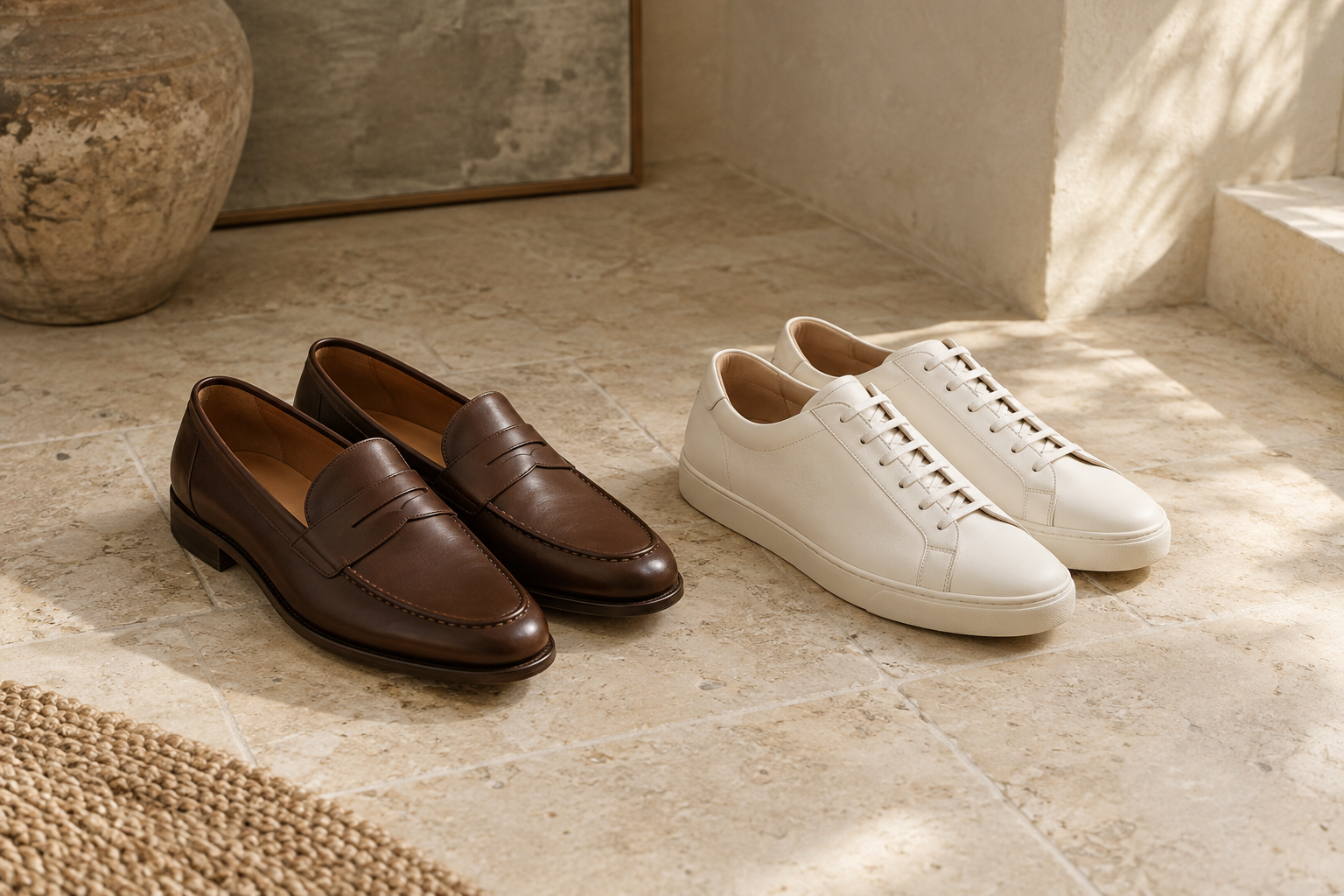
| Penny loafers | Structure for tailored trousers at work; ease with dark jeans or a dress at dinner | Leather soles slip in rain; a very casual office may find them dressy, a very formal one may not |
| Clean-toed derbies | Hold their own under tailoring and relax acceptably in most evening settings | Can read formal at a casual dinner; check the sole profile is not purely dress |
| Flats | A full candidate, not a compromise — sharp with workwear and natural at dinner | Thin soles meet cold pavement and long walks directly; check cushioning for your route |
| Sleek ankle boots | Strong in cooler months; read as deliberate in both settings | Warm offices and long indoor days; watch the heel height against a full day |
| Clean leather sneakers | Fit the brief only where the office dress code genuinely allows them | Often the fastest way to look under-dressed at dinner venues with a dressier crowd |
Fastenings are part of the comparison, not an afterthought. If laces or buckles are difficult for you, slip-on loafers, zip-side boots and flats with elastic access are full candidates — the pair must be wearable, not only appropriate.
Dark brown leather is the universally correct choice for a work-and-dinner shoe.
No colour or material works everywhere. A dark brown loafer can be wrong for a black-heavy wardrobe or a wet climate, just as black can sit awkwardly at a relaxed dinner. Match the finish to your actual clothes and weather, not to a rule of thumb.
Shop lighting and a single outfit flatter almost any shoe. The honest test is your own wardrobe, tried on in ordinary light. Three outfits are enough to decide.
Run this simulation with any shortlisted pair, before you buy it or before the tag comes off:
A shoe worn for twelve hours needs to fit at its largest, so try sizes late in the day. Sole and material choices should follow the same two columns as everything else: a slim sole reads sharper with tailoring, while weather and walking distance may argue for rubber and grip. Neither is automatically right — check them against your commute and climate rather than accepting any default.
Finish works the same way. A soft, low sheen sits between a formal mirror shine and a distressed texture, but the right point depends on where your two settings actually sit. Judge it in the simulation, not on the box.
Some workplaces and some dinners simply cannot share a shoe, and no purchase fixes that. The workable fallback is a planned second pair: one that lives at the office, a fold-flat pair in a bag, or the dinner pair kept under the desk. Deciding this before shopping is what makes it a plan rather than a panic buy.
Where this decision goes next
The parent guide to every shoe decision on this site, including dress codes by silhouette.
If the walk between your two settings is long, this extends the fit and sole checks.
The other half of the comparison — what the shoes need to sit beside at the table.
A chosen pair — loafers, derbies, flats or boots — that you have verified against your real work dress code, your real dinner contexts, your own outfits and the walking between them; or a deliberate two-pair plan where one pair cannot honestly cover both.
Write the workday demands in one column and the dinner demands in another, using your real contexts rather than generic ones. Mark any line where the two columns contradict each other — those lines decide whether one pair is even possible.
Check: You have two written columns and can point to at least one demand in each that a shoe could plausibly fail.
Compare loafers, derbies, flats and sleek boots against what you wrote, keeping every silhouette that fits both columns. Do not exclude flats or slip-on and zip fastenings — accessibility is part of the fit. Drop anything that clearly violates a column, such as sneakers where the office dress code does not allow them.
Check: Your shortlist has at least two silhouettes, each of which you can justify against both columns in one sentence.
Try each shortlisted pair with three outfits: your standard work look, your dressier meeting look, and your typical dinner outfit. Photograph each combination in ordinary light and judge the photos. A pair that survives all three earns the purchase; a pair that works with only one will sit unworn.
Check: Three photos exist for the finalist pair, and the shoes are not the weakest element in any of them.
Walk the actual distance between your two settings in the shoes, or at least a fair proxy, and check the fit late in the day when feet are largest. Match sole and material choices to your real commute and climate rather than to any default rule. Weather on the route can legitimately overrule the sharpest-looking pair.
Check: You have walked a representative distance in the pair, checked the fit at day's end, and confirmed the sole and material stand up to your route's weather.
If a pair passes the simulation and the reality checks, buy it and stop. If any column contradiction survived every candidate, plan for two pairs instead — one kept at the office, or a changeable pair carried — and budget for that honestly. Both outcomes are successes of the method.
Check: You can state the decision in one sentence: the chosen pair and why, or the two-pair split and where each lives.
Trade down the sole — thinner and smoother — or move from suede to smooth leather, or choose a more closed silhouette such as a derby over a chunky loafer. Small formality cues usually close the gap without losing dinner versatility. Re-run the simulation after the change.
Soften what surrounds the shoe rather than the shoe itself: dark jeans instead of suit trousers, a knit instead of a shirt-and-blazer. A simple dark loafer or derby relaxes quickly in casual company; the reverse is harder. If the gap persists, that dinner context may simply belong to the second-pair plan.
Twelve-hour wear exposes fit and support problems that a shop try-on hides. Re-check the fit at day's end and add a supportive insole if the footbed is flat. If fatigue persists, the shoe's last likely does not match your foot — swap styles rather than enduring it, and note the walking distance honestly in your constraints.
Shoes
How to find flat shoes that still read smart casual: judge material, construction and toe shape, then try on with the hem length you actually wear.
Shoes
Oxford vs Derby shoes comes down to open versus closed lacing. What the difference is, what it changes for fit and dressiness, and what it does not guarantee.
Shoes
Pair sneakers with tailored trousers by checking the venue, then matching sneaker profile to trouser width and hem. Six profiles, three formulas and the checks that settle it.