Skip to content

Find your next good read.

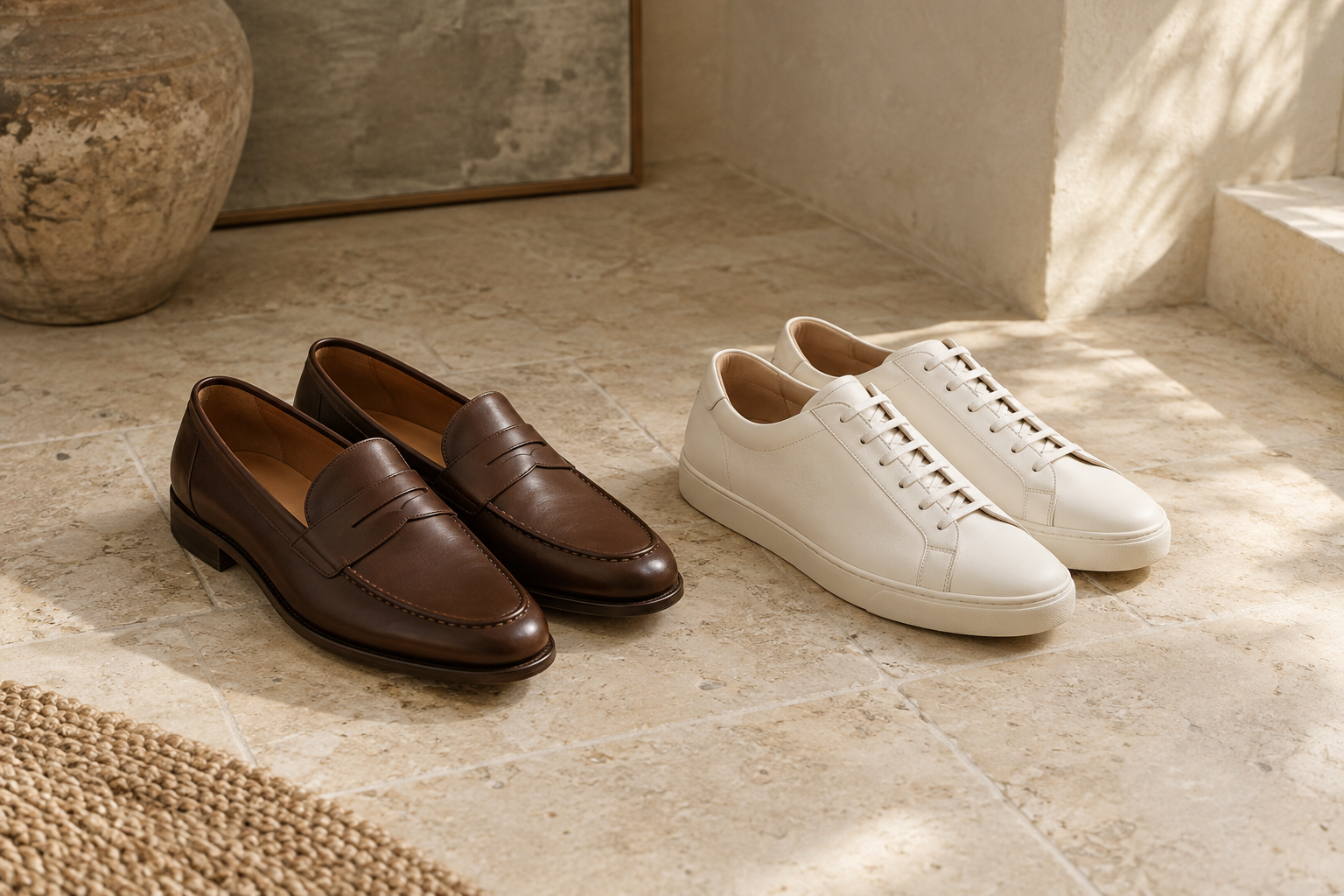
Brown penny loafers and cream leather sneakers side by side on a pale stone floor.

Shoe comparison

Loafers vs Derby Shoes and Sneakers

Three shoes, one wardrobe question: what does the setting, the fit and the day's activity actually ask of your footwear?

Begin here

Comparison

Loafers, derbies or minimal sneakers: the three-way choice

Choose between loafers, Derby shoes and sneakers by checking the setting, the fit and the activity first. Laces let a Derby tighten across the instep, while a loafer relies on its shape staying secure on your foot, and sneakers vary widely pair to pair. Compare actual pairs rather than assuming one category is always smarter or always more comfortable.

Spot the Derby: why lacing construction matters

Not every lace-up is a Derby. In a Derby, the eyelet tabs are sewn on top of the vamp, leaving the lacing open — which is why the shoe can spread and tighten across a high or wide instep. In an Oxford, the tabs are sewn under the vamp and the lacing closes over itself, giving a closed, snugger instep.

Myth

All lace-up dress shoes are Derbies, and laces always mean a smarter shoe.

Fact

Derby and Oxford are both lace-ups with different constructions, and sneakers lace too. Lacing changes how a fit adjusts, not how formal a shoe is by definition.

This distinction matters when you shop. If adjustability is what you are after, the Derby's open lacing is the feature doing the work. Our Oxford vs Derby guide picks the construction apart in more detail, and the table below uses the term in that precise sense.

Check fit and foot security on your own foot

Shoe type alone establishes neither comfort nor support — two Derbies from different makers can feel like different shoes. Walk the shop floor, stand for a few minutes and notice where pressure gathers. A loafer that grips only at the instep can feel fine for an hour and loose by evening, so judge it after real movement rather than standing still.

Before buying any of the three, run this check in the shop:

  • Slide a finger behind your heel while standing: a loafer that lifts more than a finger-width will slip later.
  • Lace the Derby snugly across the instep and confirm there is no sharp pressure point on top of the foot.
  • Bend the sneaker's sole with your hands and note how much cushioning is actually there.
  • Walk on a hard floor for a few minutes and check for heel lift, toe crowding or arch strain.

A pair you already own can be the right answer

If your current pair passes the fit checks above and suits the setting, the right decision is to wear it. A category swap rarely fixes an outfit problem that a hem length, sock choice or colour change could solve. If comfort is your reason for shopping, our guide to smart casual shoes without heels works through flat options by setting first.

THE SHORT ANSWER

Choose for the day ahead.

There is no single winner — the three shoes cover different halves of the same wardrobe. Laced Derbies are the most formal of the three and the usual choice with blazers or tailored trousers, partly because lacing lets you adjust the fit across the instep. Loafers sit just below: nearly as sharp with tailoring, more relaxed with denim, and the most convenient to get on and off. Minimal sneakers are the casual anchor — right for chore jackets, overshirts and relaxed tailoring, and the likely wrong choice wherever a dress code leans formal.

Side by side.

The differences that matter
AspectLoafersDerby shoesMinimal sneakers
How formal it readsDressed-up but relaxed; reads smart in most smart casual rooms, though the setting sets the bar, not the shoe alone.The most formal of the three; lacing plus leather construction reads deliberate with tailoring.Casual by definition; clean leather versions read considered, but never formal.
Getting them on and offSlip on and off in a second; convenient for travel, offices with shoe rotation, or homes where shoes come off.Lacing and untying takes a moment every time; the trade-off for the adjustable fit.Lace or slip on depending on the pair; low effort either way, especially in slip-on silhouettes.
Adjustability and securityHeld by the shaped instep only; whether it stays secure over a long day depends on your heel and the pair — test it.Open lacing adjusts across the instep, which suits high insteps and long days on foot.Secure once laced, but support depends on the sole; dressier versions often have thin, flat soles.
Seasons and weatherUnlined and suede versions suit warm months; thin leathers are a poor match for deep winter or rain.Year-round in leather; the natural cold-weather choice, and pairable with heavier socks.Best in mild weather; canvas versions are summer-only, and most leather pairs fare poorly in rain.
What they pair withTailored trousers, chinos, denim and linen; how sharp the result looks depends on the whole outfit, not the loafer alone.Suits, blazers, flannel trousers and dark denim; the most conventional match for tailored clothing.Relaxed tailoring, chore jackets, overshirts and dark denim; they pull an outfit toward the casual end.
Sock strategyOften worn with no-show socks for the intended line; visible socks work better with chunkier, more casual pairs.Visible socks are expected and correct; match trouser colour or choose a deliberate contrast.No-show socks keep the minimal look intact; visible athletic socks break the clean line.
Care and upkeepSuede needs a brush and protector spray; leather needs occasional polish and a shoe horn to spare the heel counter.Polish, cedar trees and rotation extend leather life; welted pairs can often be resoled rather than replaced.Minimal upkeep; wipe clean and replace when the sole wears through or the toe box creases irreversibly.

What should guide your choice?

  • How formal the setting is, from the stated dress code down to what colleagues and hosts actually wear
  • How much walking and standing the day involves, and whether the fit adjusts enough for it
  • Weather: heat, rain, and whether the sole gives the grip and cushioning the surface needs
  • What the rest of the outfit is doing — jacket, trousers, denim — and how deliberate you want the contrast
  • Longevity and cost per wear, since well-maintained leather Derbies often outlast both alternatives

The right choice depends on the setting.

A dinner reservation at a nicer restaurant

Loafers or Derbies, depending on the rest of the outfit. Dark Derbies with tailored trousers are the safe call; loafers with fine knitwear or well-cut denim can look just as considered. Minimal sneakers read underdressed at most reservation-only rooms.

A full day of walking in a city

Derbies or a genuinely cushioned sneaker, matched to how casual the day is. Open lacing gives the most adjustable fit over long distances, while a cushioned sneaker wins when the setting stays relaxed. Test loafers for heel slip over several hours before committing to them.

The office with no strict dress code

Loafers are the common default: convenient, smart enough for meetings, relaxed enough for after work. Keep Derbies for client-facing days and minimal sneakers for days when the whole outfit leans casual.

Smart casual wedding guest or daytime event

Derbies or loafers in dark leather or suede, worn with tailored trousers and socks the shoe calls for. Clean sneakers are a poor match here — the occasion, not the outfit, sets the floor, and this occasion usually sits above them.

Keep exploring.