
Shoes
Oxford vs Derby Shoes: Lacing, Fit and Style
Oxford vs Derby shoes comes down to open versus closed lacing. What the difference is, what it changes for fit and dressiness, and what it does not guarantee.
Shoe guide
Nothing about a heel makes a shoe smart — the fabric, the finishing and the shape do most of that work. This is how to pick flats that hold their own with dresses and tailored trousers.
Begin hereHow-to
You can build a smart casual outfit without heels. Start with the venue’s rules, then compare flats, loafers, lace-ups or permitted trainers for fit and the walking you need to do. Try the shoes with your actual outfit and usual socks or hosiery, because heel height alone does not determine whether a pair works.
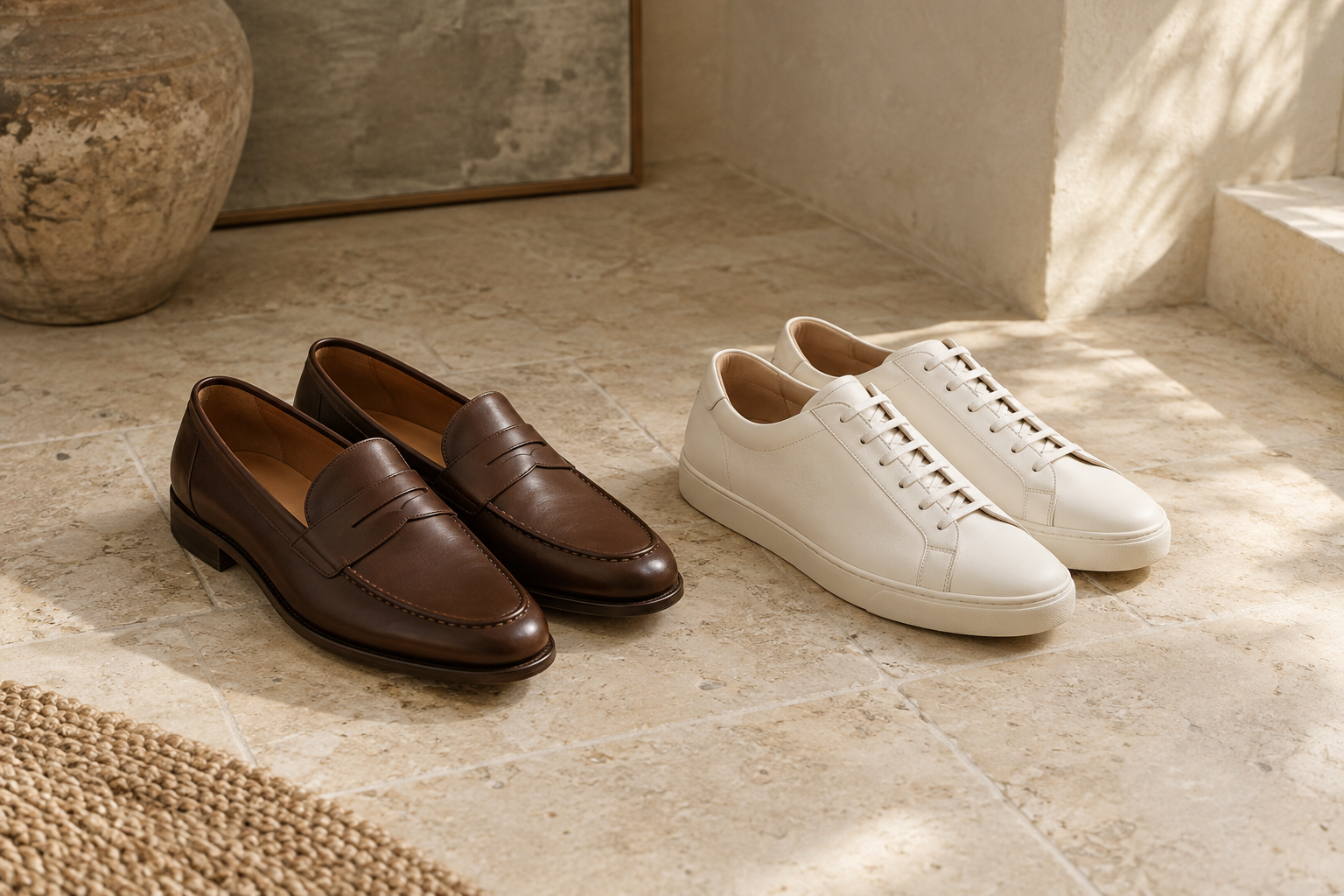
Each family covers different ground, and none ranks above the others outright — the venue, the outfit and your feet decide. Use the table to shortlist, then judge individual pairs on material and fit.
| Family | Reads smart because | Watch out for |
|---|---|---|
| Loafers | Polished leather, structured shape and a low profile that sits cleanly under trousers | A loose fit; many loafers stretch, so the heel should not slip when new |
| Ballet flats | A refined, dress-adjacent line that works with skirts and dresses | Slipping heels and thin forefoot cushioning; favour a firm heel counter or strap |
| Lace-ups and derby-style flats | A secure fastening and tailored patterning borrowed from dress shoes | Chunky commando soles on some models, which pull the look casual |
| Flat boots | Coverage and structure that read deliberate under trousers and longer hems | Shaft width and zipper placement, which change where the leg line breaks |
| Minimal sneakers (where permitted) | Clean leather, slim sole and no visible branding keep them near-smart | Most venues and dress codes still exclude them — check before relying on a pair |
Sole choice is an honest trade between look and practicality, not a test of quality. Decide it by where you will actually walk.
Slim sole
Modest rubber sole
A heel is what makes a shoe smart casual.
Material, finishing and shape carry most of the formality. A polished flat loafer reads smarter than a barely-there heel in patent plastic.
A thin, foldable sole means the shoe will fall apart within a season.
Flexibility alone says little about durability — construction, materials and how you wear the shoe matter more. Judge build quality by stitching, bonding and upper material rather than by how much the sole bends.
Flat shoes — loafers, ballet flats, lace-ups, refined permitted trainers or flat boots — that hold their place next to dresses and tailored trousers, so a no-heels wardrobe still covers dinners, offices and events without a second thought.
Read the shoe the way you would read a jacket: smooth leather with stitched, minimal detailing sits at the smart end, while distressed finishes, visible branding and rubberised coatings sit at the casual end. The finishing on the individual pair tells you more than the material name alone. When you shop, filter by material first and let heel height be the last consideration rather than the first.
Check: Pick up the shoe and ask whether the material and finishing would look at home with a blazer. If the answer is no, no heel height will rescue it.
An almond or slightly pointed toe lengthens the leg and reads dressier, which helps flats work with midi skirts and wide-leg trousers. A round toe reads softer and more relaxed but still works if the leather is refined. A broad, padded or sporty toe box belongs to the sneaker family — fine with dresses in relaxed settings, less convincing with tailored trousers.
Check: Hold the shoe next to the outfit you have in mind: the toe should continue the line rather than bluntly end it. Under a long skirt or wide hem, a slightly narrower toe keeps the silhouette from stopping short.
Flats live or die on staying on the foot. Look for a secure closure — a lace, a strap, a buckle or a heel counter that actually grips — rather than a loose slip-on mule that makes you claw your toes to keep it on. Sliding, gripping feet change how you walk, and an awkward gait undoes the polish of any shoe.
Check: Try the shoe on and walk a full loop. Your heel should not lift out of the back, and you should not feel you are holding the shoe on with your toes.
A slim leather or thin rubber sole reads smarter than a chunky lug sole but offers less cushioning — that is an honest trade, not a flaw in either direction. For mostly indoor or dry-weather wear, a slimmer sole is worth it; for cobbled streets and winter, a modest rubber sole in a dark colour keeps the look while adding practicality. Judge durability by stitching, clean bonding and upper quality rather than by sole thickness alone.
Check: Check that the sole is bonded or stitched cleanly with no visible glue lines, and that the forefoot bends where your foot bends rather than folding anywhere with no resistance.
Bring or wear the real garment: the midi skirt, the wide-leg trousers, the ankle-grazing denim. A ballet flat that disappears completely under a floor-length hem is doing no visible work, while the same flat with an ankle-length trouser shows a clean line of skin or sock at the ankle. Long hems pair best with slightly dressier, more visible toes; short hems give you freedom.
Check: Stand and sit in front of a mirror in the full outfit. The shoe should be at least partly visible when you walk, and the gap between hem and shoe should look deliberate rather than accidental.
Flat shoes reveal their faults on hard surfaces in a way carpeted fitting rooms hide. Walk on a hard floor for a few minutes: listen for slapping soles, feel for the insole sliding under your foot, and notice whether you shorten your stride. Squeaking, slipping or gripping insoles are the reasons flats get abandoned after one wear.
Check: After a few minutes on a hard floor, your stride should be your natural one, the insole should not have moved, and nothing should rub at the heel or the little toe.
Change one variable at a time: swap a canvas or distressed-leather pair for smooth leather in a darker tone, or choose the same style with a slightly narrower toe. If the shoe still reads weekend, the problem is usually the sole — a chunky white sneaker sole under fine wool is the most common mismatch. A dark, slim sole fixes it without changing the shoe's comfort.
Flat shoes concentrate pressure on the heel and ball of the foot, and very thin soles make it worse. A thin, low-profile insole often solves it without changing the shoe's look — but if the pain sits at a specific spot, like a stiff heel counter digging in, the shoe's shape is wrong for your foot and no insert will fix it. Retire that pair rather than suffering through events, and if pain persists across pairs, ask a qualified podiatrist rather than working around it.
Look for versions with an elasticated top line, a small ankle strap, or a firmer heel counter — these grip without adding bulk. Heel grips stuck inside the counter help with mild slipping. If the whole shoe moves with every step, it is a half size too large; sizing down usually fixes it, since most flats stretch slightly with wear.
Shoes
Oxford vs Derby shoes comes down to open versus closed lacing. What the difference is, what it changes for fit and dressiness, and what it does not guarantee.
Shoes
Loafers, laced derbies and minimal sneakers sit at different points on the formality scale. How to choose between them for smart casual settings.
Shoes
Loafers fit differently from laced shoes. How to judge heel slip, toe room, vamp width and instep grip, and when a size change is the wrong answer.