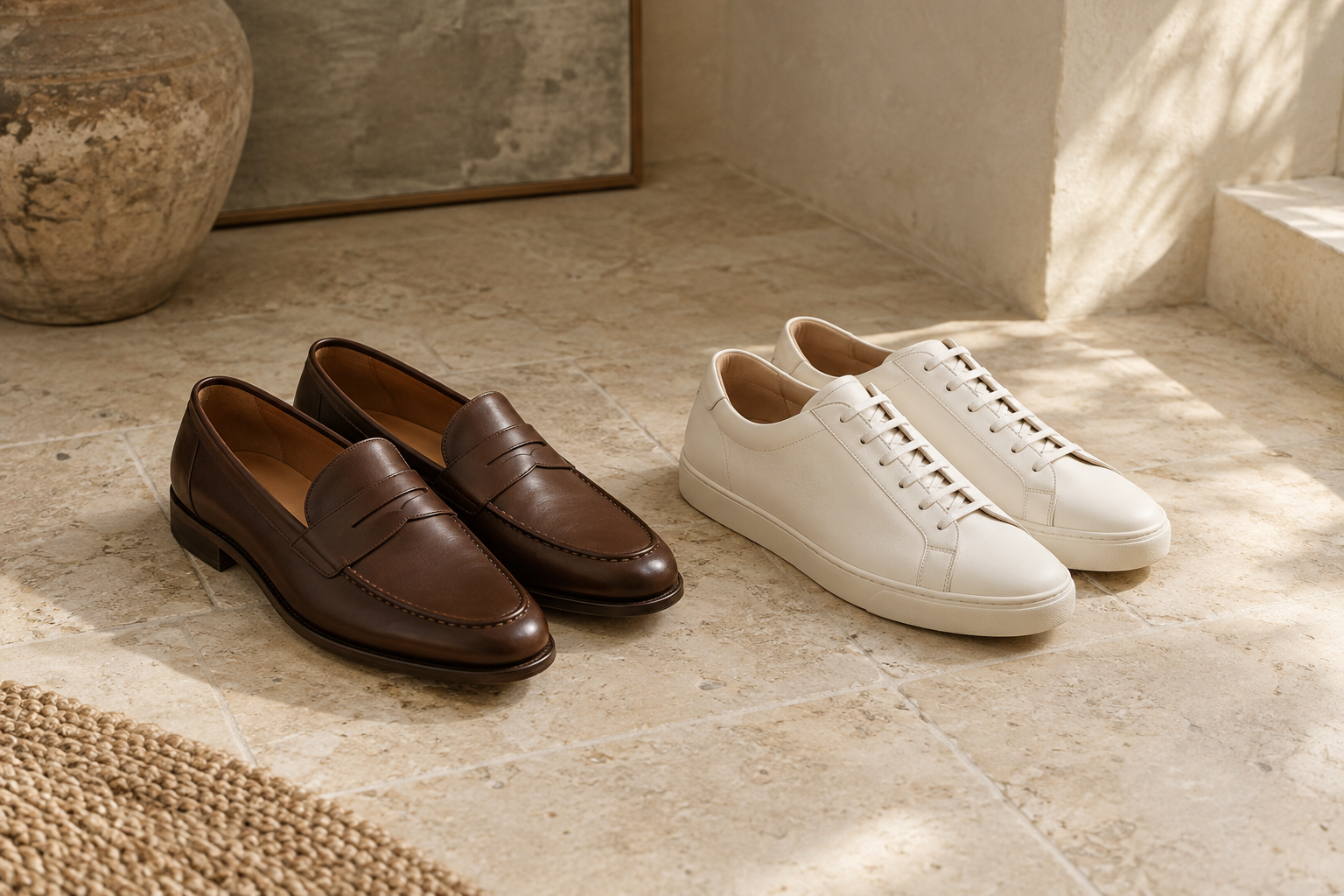
A shoe can measure exactly right and still hurt by lunchtime. Length is one dimension; width, volume, and last shape decide whether the fit actually works.
A shoe can have enough toe length and still feel wrong because its width, depth or shape does not suit your foot. Try a different fit or style rather than automatically buying a longer size. Stop wearing a pair that causes pain or numbness; persistent symptoms need professional advice, not another round of guessed inserts or sizing changes.
If your toes have room to spare but the shoe still fights you, the length measurement is not the problem. Fit lives in several dimensions at once — width across the ball, volume through the instep and toe box, heel-to-ball proportion, and the curve of the last — and each failure feels different. Match your symptom below, run the fitting checks, and change the fit or the style before you change the size.
Where each fit dimension lives, in plain language
Dimension
What it means
What going wrong feels like
Width
The room across the ball of the foot, where your foot is widest.
Pinch or pressure at the outer ball and little toe, unchanged by a longer shoe.
Volume (depth)
How much vertical space the upper gives the height of your instep and toes.
Tightness over the top of the foot, or pressure and numbness across the toes.
Heel-to-ball proportion
The distance from heel to the ball line compared with your own foot's.
Heel slip even though the toes are not crowded, because your foot sits forward of the shoe's flex point.
Last shape
The three-dimensional form the shoe was built around — straight or curved, pointed or round, waisted or flat.
A shoe that measures right on every chart yet simply does not feel like your foot.
Myth
If the shoe pinches at the ball, buy a longer size — and when width and length disagree, width always wins.
Fact
A longer shoe adds empty toe room while leaving the squeeze exactly where it was, and giving away correct length brings its own problems — tripping room, heel slip, creasing in the wrong place. Adjust width, volume or style first, and only accept a small length surplus when a fitter has confirmed the trade for your actual foot.
Run these checks with both shoes on, your usual socks, and any insert you have been prescribed:
Stand, then walk for several minutes — including stairs if you can. Standing still hides heel slip, ball pinch and toe pressure.
Watch where the shoe creases: it should bend where your foot bends, not behind or ahead of the ball.
Slide a finger behind your heel with your weight on the ball — snug contact, not a gap you can wiggle into.
Check the toe area while standing: no pressing on the top or the nail of any toe.
Shop late in the day, when feet are at their largest and match the conditions you will actually wear the shoes in.
Myth
Standing on a piece of paper and comparing the tracing with the insole tells you your true size.
Fact
A footprint shows contact area under load, not the height and volume of your foot, and an insole shows only the outline of the interior, not how the upper wraps it. Both are rough guides, useful for spotting an obviously wrong shape — not measurements. Treat any comparison of footprints and insoles as a first filter, and have width, volume and heel-to-ball measured properly by a fitter.
If the walking test is your daily reality, this extends fit into route and distance.
Open the symptom that matches. Start there.
Pinch across the ball of the foot
Possible cause: Possibly the widest part of your foot sits forward of or behind the shoe's widest point, or the shoe is built on a narrower width than your foot needs. Length cannot fix this — a longer shoe just adds empty toe room while the squeeze stays put.
Try first: Try a wider width in the same length, and check that the shoe creases where your foot bends. Wide-fit ranges and brands that cut a roomier forefoot solve this without changing size at all.
Heel slip even though the length is correct
Possible cause: Possibly the ball of your foot sits too far forward in the shoe (a heel-to-ball mismatch) or your instep is low, leaving surplus volume that lets the heel lift. Lacing tighter feels like a fix, but the geometry stays wrong.
Try first: Try a narrower width in the same length, or a style with a strap, higher vamp, or laced instep that holds volume down. A heel grip pad is a patch, not a fix, but it buys time while you find the right cut.
Numbness or pressure over the toes
Possible cause: Possibly the toe box is too shallow or too low-volume for the height of your toes, so nails and knuckles press the upper all day. If numbness persists once you are out of the shoes, stop adjusting and seek professional advice — that is not a fitting problem to solve at home.
Try first: Choose styles with a taller, rounder toe box instead of a long pointed one, and try the taller fit rather than a longer one. Soft leather gives a little; structured or synthetic uppers give almost nothing, so do not count on break-in.
Arch fatigue by the end of the day
Possible cause: Possibly the shoe's last does not match the curve of your foot — and a thin, unstructured sole can make the feeling arrive faster. Recurring arch or heel pain that shows up in shoe after shoe is a question for a foot-health professional, not for another insole experiment.
Try first: Look for a last with contour that follows your arch line and a sole with some structure under the midfoot. A quality insole can bridge a small mismatch; a fundamentally wrong last cannot be insoled into shape.
Different causes need different fixes.
Length is the one dimension people measure, which is why it gets all the blame. In practice a shoe last sets several things at once: the width across the ball, the volume through the instep and toe box, the heel-to-ball proportion, and the arch curve. Two shoes in identical length can fit like different species because their lasts differ. That is also why feet of the same length often need different sizes once brand and style enter the picture.
Make one small change.
Re-measure both feet at the end of the day, when they are at their largest, and trace each footprint. Then pull the insole out of the problem shoe and stand it against the tracing. Treat this as a rough shape filter only: a footprint shows contact area, not volume, and an insole shows the interior outline, not how the upper wraps your foot. Use it to rule out an obviously wrong shape — then have width, volume and heel-to-ball measured properly.
Work on the part that needs it.
Fit to the larger foot; trade length for width only with care
Most people's feet differ in size, so fit the bigger one and even out with lacing, straps, or a thinner sock on the smaller side. Where width and length disagree, do not simply surrender length: try a wider width in the same length first, and only accept a small length surplus when you or a fitter have confirmed the shoe still holds the heel and bends at the right place.
Change style before changing size
A lace-up holds a low-volume foot far better than a loafer; a round-toe derby forgives high insteps that a pointed shoe punishes. Often the answer is not a different size of the same shoe but a different cut altogether.
Test-fit with a walk, not a mirror
Wear both shoes for at least ten minutes of real walking, including stairs if you can. Heel slip, ball pinch, and toe pressure show up in motion; standing still hides all three. Keep any prescribed insert in the test — a shoe that only works without it does not work.
When to stop adjusting.
If pain or numbness persists in shoes that pass every check above — or the pain is in your foot rather than from the shoe — stop guessing with sizes and insoles. An experienced shoe fitter can measure width, volume and heel-to-ball properly; a qualified foot-health professional, such as a podiatrist, is the right call for recurring arch, heel or toe pain that follows you between pairs. Persistent symptoms deserve assessment, not another round of self-diagnosis.
Oxford vs Derby shoes comes down to open versus closed lacing. What the difference is, what it changes for fit and dressiness, and what it does not guarantee.