
Trousers & Pants
How Long Should Wide-Leg Pants Be?
Set wide-leg pants length with your actual shoes on: check the hem clears the ground when you walk, choose full-length or cropped on purpose, and prepare a safe alteration.
Fit guide
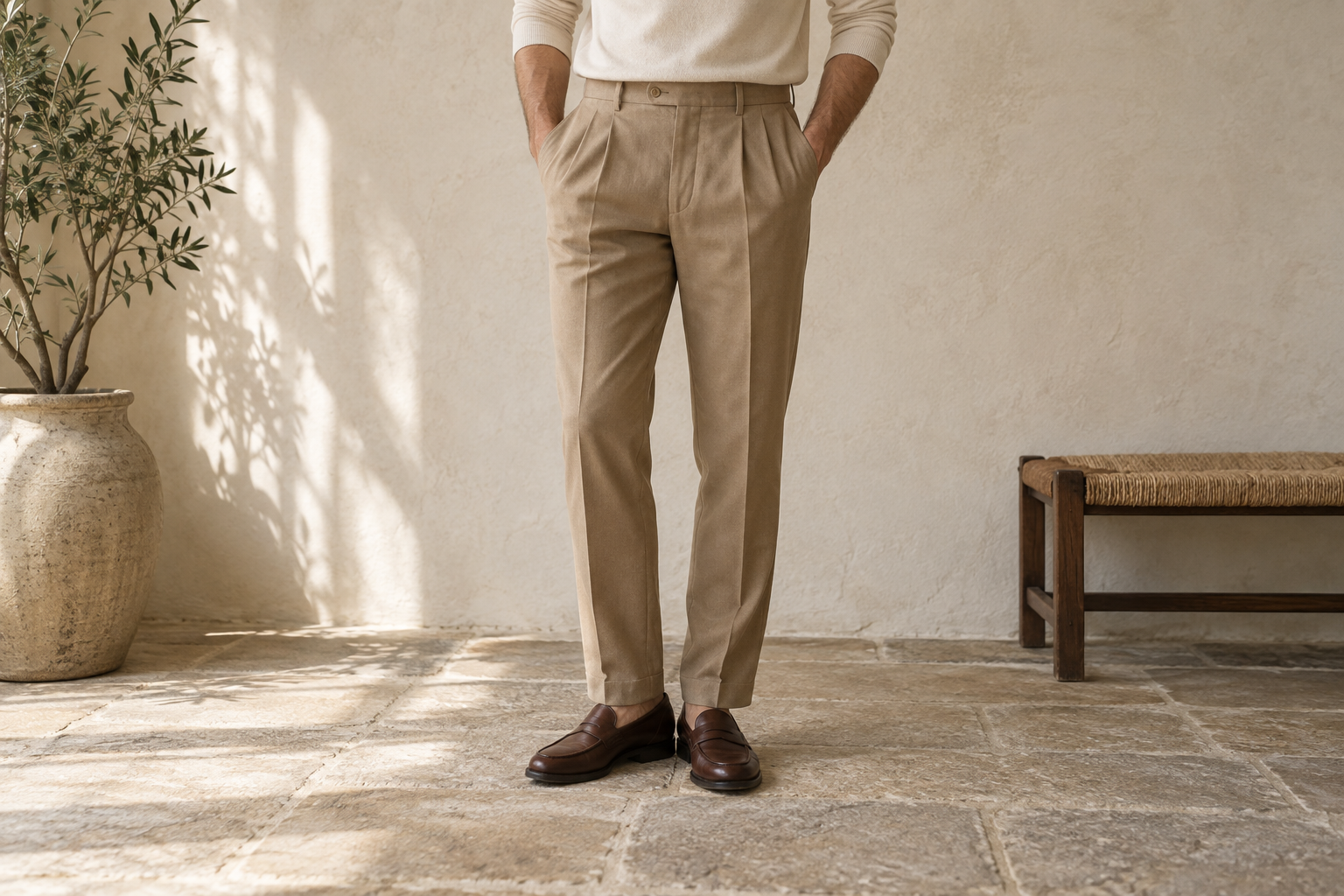
Straight-leg trousers can end without a break or rest lightly on the shoe. Set the length in the shoes you will actually wear, then walk and sit before committing to a hem.
Begin hereHow-to
Straight-leg trousers can end without a break or rest lightly on the shoe. Choose the length while wearing the shoes you expect to use, then walk and sit before pinning the hem. The useful test is whether the fabric falls as you intend without catching under your heel — not whether it matches one fixed ankle measurement.
A break is the small fold where the hem rests against the front of the shoe. Straight legs are usually worn full length, and the real decision is how much break — none at all, or a single soft fold. Neither is the correct answer by default; the wrong move is a deep stack of folds, which reads as too long rather than relaxed.
| Aspect | No break | Slight break |
|---|---|---|
| Where the hem sits | Just at the top of the shoe, touching nothing | One shallow fold against the shoe front |
| Reads as | Sharp, tailored, slightly fashion-forward | Relaxed, traditional, full-length on purpose |
| Works best with | A narrower leg opening and low-profile shoes like loafers | A wider straight leg, boots, or any shoe with some height |
| Main risk | Looks short if the leg opening is wide or the hem creeps up in wear | Deepens into a stacked double break if the trousers run long |
There is one correct hem height for straight-leg trousers — usually stated as a bare ankle, or a fixed distance from the floor — and every pair should be hemmed to it.
Length is a relationship between the hem and the shoe underneath it. The same pair can be right at two lengths with two shoes, so set the hem for the footwear you actually wear and accept a compromise for any other pair.
Where this decision goes next
The parent hub: fit, fabric and styling guides for every trouser shape.
The same hem-to-shoe logic for a wider leg, where full-length and cropped both come into play.
Where the trousers sit at the waist quietly changes the hem — set rise before length.
Where to go next: the same hem-to-shoe logic on a wider leg, where a deliberate crop enters the picture, is covered in how long wide-leg pants should be. Where the trousers sit at the waist quietly moves the hem, so how to choose trouser rise is worth settling first — and low-profile shoes show a length mistake fastest, which is why how loafers should fit pays attention to every millimetre.
A hem length chosen on purpose — a clean no-break ankle or a single soft break — set for the shoes you wear most, checked standing, walking and sitting, with a written alteration note before any fabric is cut.
Put the trousers on with the shoes on and let the hem fall naturally. For a no-break finish, the hem stops right at the top of the shoe with no contact — sharper, but it needs a narrower leg opening to read as intended. For a slight break, the hem kisses the shoe and folds once, gently; on a wider straight leg this carries better, because a no-break hem on a wide opening can look short rather than sharp.
Check: Stand still and look side-on: no break means the hem touches nothing; a slight break means one shallow fold that springs back when you lift your foot — not a stacked roll.
Try the same pair with loafers and then with boots or a heeled shoe, and look at the difference from a step back. Low-profile shoes ask for the hem to sit closer to the top line; chunkier boots or a higher heel take up more of the drop and can pull a no-break hem up too far. This is why a hem set in the fitting room in socks so often looks wrong at home.
Check: You can say which shoe these trousers belong to, and how much the length changes with the other pair.
Fold or pin the front of one leg up to the intended length, then assess the hem from the front, the side and the back in the mirror. Plain straight-leg hems show any unevenness, so check whether the hem sits even at the side seams and the front — but read what you see before judging. A hem that sits lower at the back may simply be cut shaped on purpose; only a hem meant to be level that hangs uneven is a fault.
Check: The pinned length reads the same from front, side and back — and any unevenness you see matches an intentional shaped hem, not a twist or an uneven inseam.
Walk a few natural steps, climb one step, and sit down while watching the hem. Fabric that catches under your heel or traps against the shoe tongue is a functional problem to fix; a fold that appears when you sit and settles back when you stand is just fabric behaving normally, not a fault. Length that works standing still but fails on stairs is not yet right.
Check: After a minute of moving, the hem sits where it did standing still — no riding above the ankle bone, nothing catching under the heel.
Note three things for the tailor: which shoes the length is set for, the finish you want (plain or with the existing cuff preserved), and the hem allowance to take up. Shortening is routine, but a heavily taped or cuffed finish may not re-create identically, so name the finish explicitly. Length that has been cut away cannot be restored — if the hem clears every shoe and rises when you move, check inside the leg for spare fabric before buying into a pair that rides high.
Check: The note names shoes, desired finish and hem allowance, and you have confirmed there is spare fabric inside the hem before agreeing to cut.
The trousers are simply too long for the shoe. Have them shortened to a single break; a modest take-up usually restores the vertical line without changing the fit elsewhere.
If the hem clears the shoe even with flats and rises when you move, the allowance may have been cut away. Check inside the leg for spare fabric at the hem; if there is none, a longer inseam or a different pair is the realistic fix.
A hem set for low loafers will sit wrong with heeled boots, and the reverse is also true. Pick the shoe you wear most with these trousers and fit to it, accepting that the other pairing needs a slight compromise — or a second hem, if the fabric allows a cuff to be let down and re-finished.
First ask whether the hem was cut shaped — many trousers are, deliberately, to cover the heel. If the hem is meant to be level and one side drags, the inseam may be uneven or the fabric is twisting; that is a fitting issue, not a length one, and a tailor should see it before any hem is cut.
Trousers & Pants
Set wide-leg pants length with your actual shoes on: check the hem clears the ground when you walk, choose full-length or cropped on purpose, and prepare a safe alteration.
Trousers & Pants
How chinos and dress pants differ in fabric, sheen, crease and care, and how to tell which one a given smart casual setting actually calls for.
Trousers & Pants
How to judge chino fit area by area: waist and rise, seat, thigh room, leg shape, inseam break with real shoes, and the seated comfort test.