
Trousers & Pants
Chinos vs Dress Pants: Choosing Smart Casual Trousers
How chinos and dress pants differ in fabric, sheen, crease and care, and how to tell which one a given smart casual setting actually calls for.
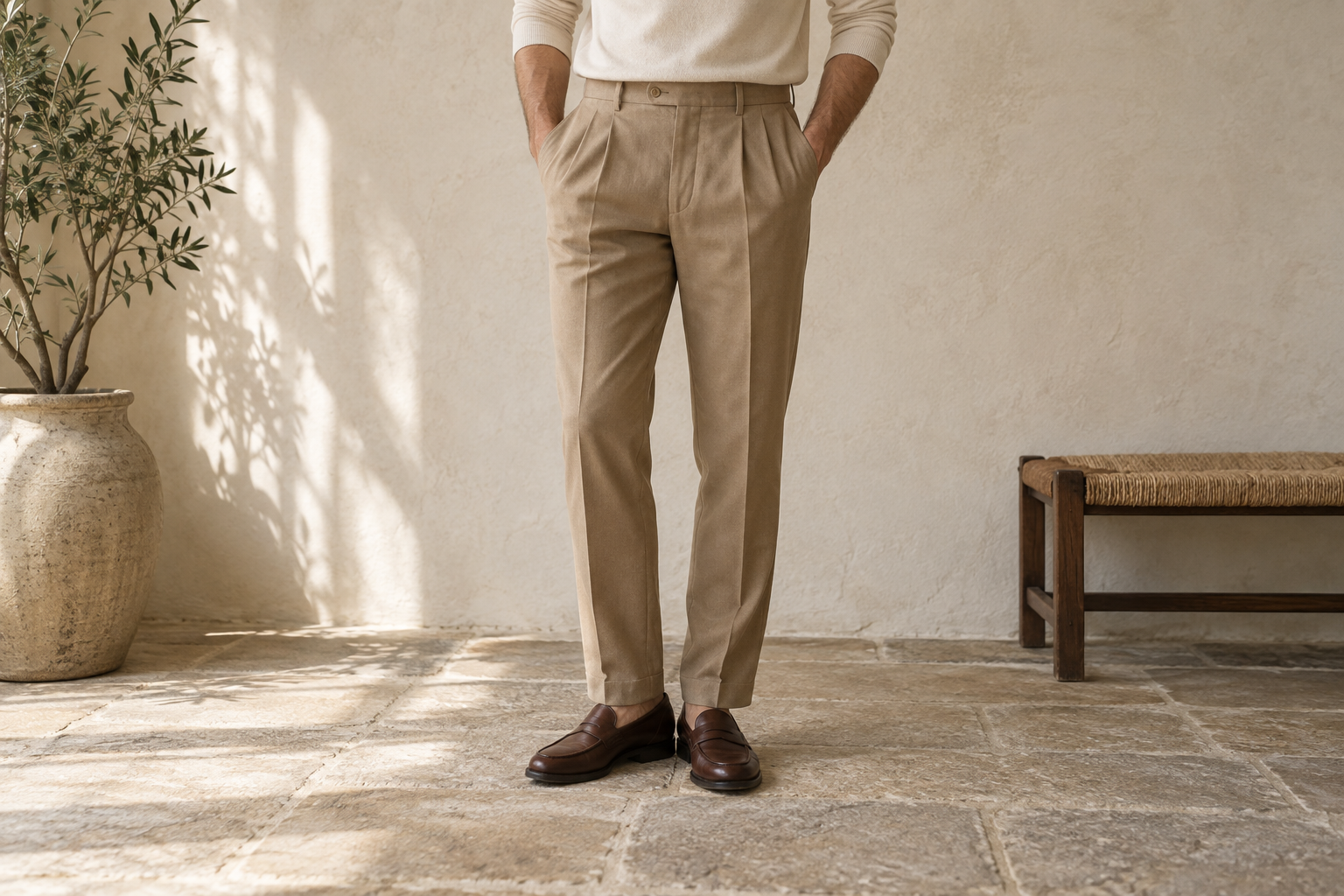
Fit guide
A good pair of chinos passes a series of quick checks: waist, seat, thigh, leg shape, length, and how they behave when you sit. Here is how to run each one honestly.
Begin hereHow-to
Chinos should feel comfortable at the waistband, seat and thighs when you sit and walk. Check them without relying on a tight belt, and judge the hem with the shoes you plan to wear. The intended rise and cut matter: a relaxed or low-rise pair should not be forced to follow the measurements of a slim, higher-rise design.
Chino waistbands should always sit at the natural waist, and a correct waist lets exactly two fingers inside the band.
Waistband placement follows the design: mid-rise, low-rise and pleated pairs sit at different heights on purpose. Finger-width rules are rough shopping folklore, not a standard — comfort while sitting and no slipping without a belt are the checks that actually matter.
| Leg shape | How the leg falls | What to check when trying on |
|---|---|---|
| Straight | Roughly even width from knee to hem — the most common chino cut. | The line hangs clean without gripping the knee or billowing at the calf. |
| Tapered | Narrows from knee to hem for a sharper, closer line. | Enough thigh and knee room that the taper does not pull when you sit. |
| Relaxed / wide | Extra room through thigh and leg by design; the width is intentional. | The extra fullness reads as a chosen shape, not as a size that is too big. |
| Athletic | More room through seat and thigh with a taper below the knee. | The thigh fits without straining while the hem still looks trimmed. |
Know within a few minutes of trying a pair on whether the chinos fit you properly — and if they do not, know exactly which area is the problem, so you can choose a different size or cut instead of compromising.
Before judging, look at how the pair is designed to sit: mid-rise, low-rise, flat or pleated, slim or relaxed. The waistband's height on the body follows that design and your preference, not one universal rule. A relaxed or low-rise pair is not badly fitted just because it sits lower than a slim, higher-rise style.
Check: You can say which rise and cut the pair is meant to be, so you judge it against its own intent rather than a generic template.
Fasten the trousers with no belt and no sucking in. The waistband should feel secure without pinching, stay up when you walk, and not dig in when you bend. If you need a belt to stop them sliding down, the waist is too big; if you cannot wait to undo the top button when you sit, it is too small.
Check: With the belt off, walk and bend forward: the trousers stay in place without pinching your skin or sliding.
The seat should follow your shape with a small amount of room — enough to move, not enough to sag. Fabric that pulls into X-shaped creases radiating from the button is too tight; horizontal smile lines or pouching under the seat is too loose. This is a size-and-cut decision: alteration feasibility varies a lot here, so do not assume a tailor can simply fix a wrong seat (that question is covered in the alterations guide).
Check: Standing side-on to the mirror, the fabric under the seat hangs close to your body with no sharp radiating creases and no loose pouching.
Stand and look at how the thigh fabric behaves, then pinch it at the widest point. You want enough spare fabric to move freely and slide a hand under without dragging the whole leg — some cuts carry more ease by design, and that is a legitimate choice, not a fault. Tight thighs are the most common chino failure: pulling there reads immediately, gapes the pockets open, and worsens when you sit.
Check: You can pinch spare fabric at the thigh without the pinch itself dragging the rest of the leg tight, and the pockets stay closed rather than flapping open.
Straight, tapered, relaxed and athletic cuts each create a different line from hip to hem — the table above shows what to look for in each. Match the shape to the look you want and the fit you actually achieved through the thigh, not to a rule about who should wear what. Any shape works if the fabric hangs clean and does not strain when you move.
Check: From the knee down, the leg line is clean and even — no spiralling twist, no fabric billowing at the calf unless the cut is intentionally wide.
Wear the shoes you will actually pair with these chinos. A small break — one soft fold of fabric at the front — is the safe default; no break ends just at the shoe and looks sharper but shortens the leg visually; stacking folds mean they are too long. Then sit down, cross your legs, and stand again: the hem should not ride well above your ankle, and the waistband should stay comfortable.
Check: Standing naturally, the hem touches the shoe with at most one soft fold, does not flap above the shoe when you walk, and the seated waistband is comfortable with the belt you would actually wear.
This is usually a cut problem, not a size problem: sizing up fixes the thigh but wrecks the waist. Look instead for a straight, relaxed or athletic cut with more room through the seat and thigh in your normal waist size. If the difference is small, some alterations can help — the alterations guide covers which thigh and seat fixes are realistic.
One hem cannot serve every shoe. If the trousers are primarily for boots, judge the break with the boots on and accept a slight stack with sneakers. If they are primarily for sneakers or loafers, a no-break or slight-break hem is correct, and boots will simply sit differently — which is a fair trade rather than a fault.
Excess length is the most fixable common fault. If you like the trousers otherwise, shortening the hem is a small, low-risk job, and cuffing them a turn or two is a legitimate zero-cost answer on casual chinos while you decide. Check that the pooling is length only — if the leg is also wide at the hem, ask for a taper at the same time.
Trousers & Pants
How chinos and dress pants differ in fabric, sheen, crease and care, and how to tell which one a given smart casual setting actually calls for.
Trousers & Pants
Choose shoes for wide-leg pants by checking the hem first: flats, trainers, loafers and heels each work, with the hem-to-shoe proportion explained.
Trousers & Pants
Hems, small waist take-ins and light tapering are usually realistic; seat work often is not. Know which alterations to ask about and what to check before committing.