Jackets & Blazers
Blazer vs Sport Coat vs Suit Jacket: How to Tell
Matching trousers, fabric and construction are the useful tells. Compare blazers, sport coats and suit jackets — and learn which works with odd trousers.
Fit guide
Work through shoulder, length, sleeve and closure in order and you will know which blazer to buy, which to leave on the rail, and what a tailor can realistically change.
Begin hereHow-to
A blazer should allow the movement you need without painful tightness or strained fastening. Try it over your intended shirt or knit, then inspect the shoulders, sleeves and closure. Traditional tailoring has useful fit markers, but cropped, relaxed and deliberately oversized jackets need to be judged against their intended shape rather than one universal measurement.
The single biggest fit mistake is judging every blazer against the same template. A traditional tailored jacket, a cropped boxy style and a deliberately oversized cut each have their own intended shape, and the fit markers shift accordingly.
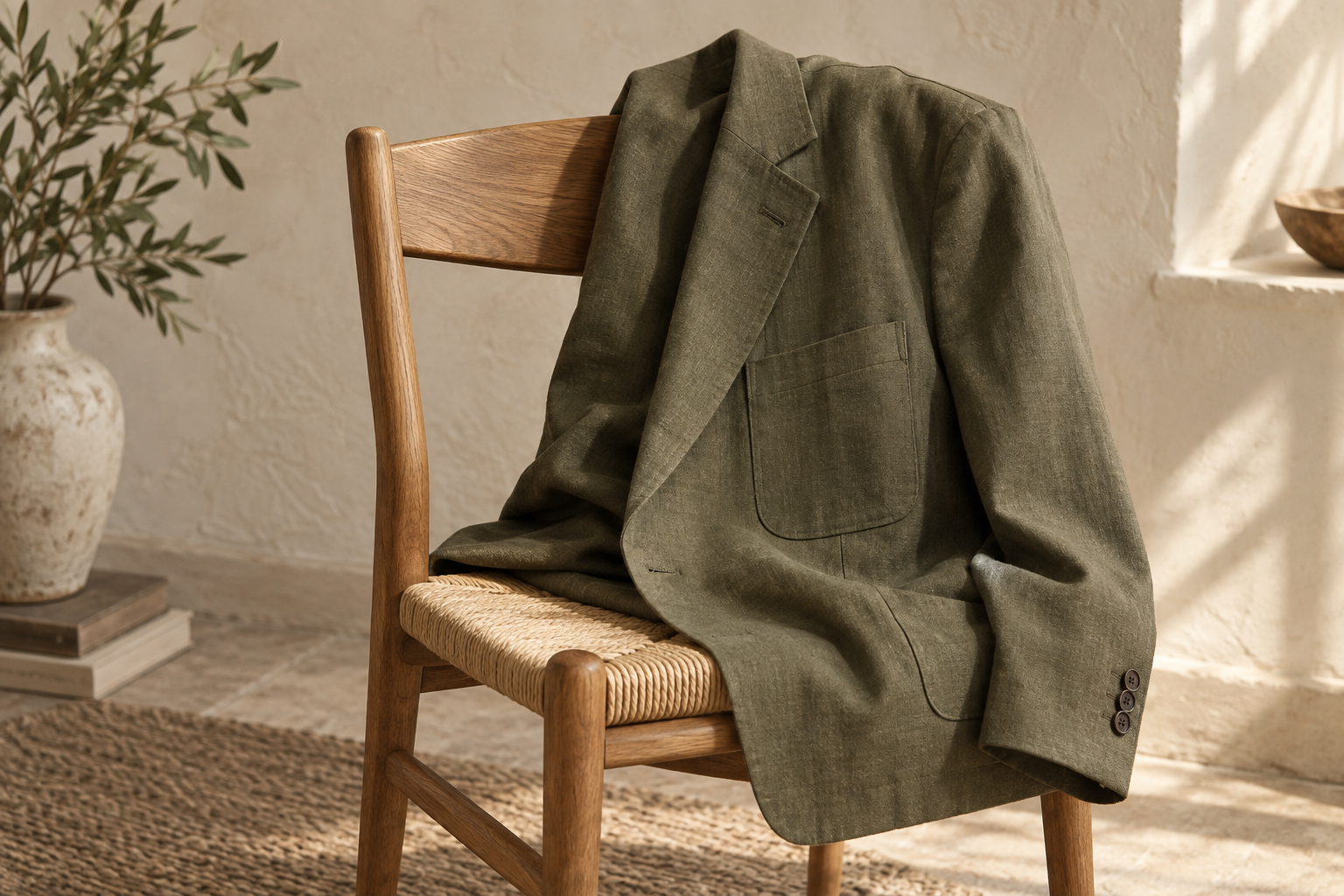
The blazer pictured in this guide — draped over a chair with lapel, pockets and sleeve visible — shows the parts of the jacket the checks below refer to. It is an illustrative image of the garment's anatomy, not a demonstration of fit on a body, so run the checks in front of your own mirror.
| Fit point | Traditional tailored | Cropped / oversized |
|---|---|---|
| Shoulder seam | Ends at or within a finger's width of the shoulder bone | May sit slightly down the arm by design; should still look intentional from the front |
| Body length | Around the hip bone; roughly covers the seat on most classic cuts | Deliberately short or long — check it matches the product's stated design, not a universal rule |
| Closure | Fastens without diagonal pulling; front edges hang straight | Often worn open; if it closes, it should still not strain |
| Sleeve length | Ends at the wrist hinge; a sliver of shirt cuff is a styling choice, not a rule | May be pushed, rolled or cut long; comfort and movement decide |
Every blazer hem must sit at the thumb tip and show exactly half an inch of shirt cuff, regardless of style.
Those markers describe one tradition — the classic tailored jacket of a particular era. Cropped and oversized blazers are designed to break them, and even within tailoring, proportion to your own frame matters more than a fixed point on your hand. Use the traditional markers as a starting point for classic cuts, and judge everything else against the shape the maker intended.
A clear verdict on the blazer you are wearing: which fit points pass, which are routine alterations a tailor can handle, and which mean the jacket is the wrong size or the wrong design for you — plus the precise question to ask the tailor if you take it in.
On a traditional jacket, the seam where the sleeve joins the body should sit at the edge of your shoulder bone. If the seam sits well down the arm on a classic cut, the jacket is too big; if the lapel gaps or buckles away from the chest, the fit is off through the front. On relaxed designs a softer, slightly dropped shoulder can be intended — the test is whether it reads as deliberate rather than borrowed.
Check: Feel for the point of your shoulder bone and note where the seam ends relative to it. Look in the mirror: the lapel should lie flat against your chest with no visible gap when you stand relaxed.
For a classic tailored blazer, the hem usually sits around the hip bone and covers the seat — many people find the old thumb-tip guideline lands close to this on their own frame, which is why it persists. But it is a convention of one style, not physics: cropped jackets end higher on purpose, and longer cuts exist for coverage and mood. Compare the hem to what the jacket is designed to do.
Check: Stand side-on in the mirror. On a classic cut, the hem should cover the curve of your seat and sit near your hip bone. On a cropped or oversized style, confirm the length looks intentional from both front and side.
Button the front — on a two-button jacket, the top button — and look at how the fabric meets. If the two edges pull toward each other and form diagonal wrinkles shaped like an X around the button, the closure is under strain through the waist or hip. This reads from across a room on any style of jacket, deliberate oversizing included.
Check: Look from the front at chest height: the front edges should hang in straight, relaxed lines, the button should sit easy rather than stretched, and no radiating wrinkles should form around it.
On a traditional jacket the sleeve ends near the hinge of the wrist; showing a sliver of shirt cuff is a styling preference, and some prefer none. What is not optional is comfort: the sleeve needs a little room over the bicep and forearm, and should not grip when you bend your elbow. Tight sleeves make even a correct shoulder read as a size too small.
Check: Bend each elbow to a right angle and release — the sleeve should ride up slightly and settle back with a fold at most. You should be able to pinch a little spare fabric at the bicep.
With the jacket buttoned and your intended shirt or knit underneath, hug your arms forward, reach to a high shelf and sit down on a chair. The jacket should move with you and settle back, not strain across the back, haul at the shoulders or stay wrinkled where you reached. Movement reveals chest room problems that a standing check misses.
Check: After sitting and reaching, pinch the fabric at either side of your chest: there should be enough spare cloth to slip a flat hand under, but not enough to grab a fistful. The jacket should settle back without staying creased.
Divide what you found into three honest groups. Routine alterations: sleeve length, sleeve width, a modest take-in at the side seams — a tailor handles these in a normal visit. Uneconomic alterations: shoulder width and overall body length, which mean rebuilding the jacket. Design mismatch: nothing wrong with the make, simply a silhouette that does not suit what you want to wear it with.
Check: Write down the one-sentence question for the tailor — for example, 'Can these sleeves be shortened from the cuff, and are the cuff buttons functional?' If your only faults are in the uneconomic group, take that finding to a different size or a different jacket, not to the tailor.
On a traditional jacket this usually means it is too big in the shoulder. Slimming shoulder pads helps only slightly; moving the seam itself is rebuild work that usually costs more than the jacket did. Size down, or accept the soft line only if the design is meant to sit that way.
This is the best problem to have. A tailor shortens sleeves from the cuff and can slim the sleeve width in the same visit — both routine, affordable jobs. Ask first whether the cuff buttons are functional, because working buttons make the job pricier.
The closure is under strain through the waist or hip. A tailor can let the seams out only if the maker left allowance inside — sometimes a centimetre or two, sometimes nothing. If the pull is more than slight, the jacket is effectively a size too small; look for the same model in a larger size rather than paying for a maybe.
You may be wearing a silhouette that does not suit your wardrobe. A perfect traditional fit reads stiff over casual clothes, and a boxy cropped cut fights formal trousers. Re-read the silhouette section and decide what you mainly want to wear the blazer with — our guide to blazers, sport coats and suit jackets covers how those garments differ.
Jackets & Blazers
Matching trousers, fabric and construction are the useful tells. Compare blazers, sport coats and suit jackets — and learn which works with odd trousers.
Jackets & Blazers
How to wear a blazer casually: knit, shirt and relaxed-layer combinations built around complete outfits, with the swaps and checks that make each one work.
Jackets & Blazers
A buying method for unstructured blazers: what the missing canvas means, fabric tradeoffs, shoulder and sleeve fit, length, closure, and wardrobe testing.