A weekend away fits in carry-on luggage when the wardrobe is planned as a counted system: an inventory built from the itinerary, pieces that recombine, and shoes chosen before clothes.
A smart casual weekend carry-on starts with your itinerary and the bag allowance for your journey. List each outfit, including shoes and weather layers, then reuse pieces where that makes sense. Leave room for essential personal items rather than filling the bag with clothing alone.
Check the bag allowance and the itinerary before choosing clothes
Two sizing realities come before any outfit decision. First, carry-on rules are set by each carrier and change over time — size and weight limits differ, so check your airline's current guidance rather than assuming a universal dimension. Second, the itinerary sets the real demand: count the actual dressing occasions, not the days.
A typical weekend is three occasions — a Friday-evening arrival, a full Saturday, and a Sunday departure — so three outfits is the honest target. The bag allowance is simply the size of container you are solving for. Neither check can be skipped without the whole plan guessing.
Build a counted inventory, not a pile of outfits
The inventory works only if pieces are shared. Aim for a wardrobe where the Saturday trousers serve the Friday evening with a different top, and the Friday shirt reappears on Sunday under a knit. A piece worn once all weekend is a luxury; pack one or two at most.
A three-outfit weekend inventory. Every cell is a piece already counted elsewhere — this is the reconciliation that keeps the bag small.
Occasion
Trousers
Top and layer
Shoes
Friday evening arrival
Heavier dark trousers (worn in transit)
Tee under the merino knit, unstructured blazer
Leather loafers (worn in transit)
Full Saturday
Relaxed trousers — dark jeans or chinos
Collared shirt; the knit over it if evening runs long
The packed dressier pair, or the loafers again
Sunday departure
Heavier dark trousers (second wear)
Tee under the knit, or the shirt if freshened
Comfortable pair for the journey
Fabric choice decides whether repeat wear is plausible. Merino wool, quality cotton knits, and lined or heavier cotton trousers hold their appearance through an evening and an overnight air-dry. Crisp poplin shirts crease hard in a bag and are the wrong choice here unless worn on day one.
Commit to one colour story — navy, grey and off-white, or brown, olive and cream. Any top then meets any trouser, and every piece shares the same belt and shoe colour. Two colour stories in one small bag is how outfits stop combining.
Shoes claim more volume per outfit than anything else in the bag, so they are decided first, not last. Two plans are worth comparing honestly.
One pair of shoes
Worn in transit, packed space freed for clothing and essentials.
Works when every occasion accepts the same clean leather pair.
Choose the dressier pair; add comfortable insoles if the day involves serious walking.
Two pairs
One worn, one packed — the packed pair must still serve every occasion.
Eases the comfort cost of long walking days.
Costs real volume; a third pair is where carry-on plans break.
Neither plan is universally sufficient — the right answer depends on the itinerary's walking, weather and venues. What is universal is the ceiling: more than two pairs on a weekend is the point at which the bag stops being carry-on in spirit as well as name.
Pack essentials and weather cover before optional variety
The packing order matters as much as the list. Essentials and contingency go in first, so the bag cannot silently fill with clothing and leave them no room.
Before the optional extras, confirm space for:
Medicines and any personal or accessibility essentials — never displaced by a minimalism target.
Documents, wallet and devices, charged and accessible.
A compact dopp kit of travel-size items within current liquid rules.
One foldable weather layer — a compact rain or wind layer that claims almost no space.
Enough underwear and socks for three days, plus one belt matching the shoe leather.
Test the closed bag before travel day
The final check happens at home, with time to fix what it finds. Carry-on compliance and carrying comfort are both tested, not assumed.
Close it properly
Zip the bag fully without sitting on it or using compression straps as a substitute for editing the list. If it needs force, the inventory is one piece too big.
Check the weight
Weigh the bag against your carrier's current published limit — weight limits catch weekend packers more often than size does, since shoes and dopp kits are dense.
Carry it
Walk five minutes with the bag as you will at the airport: one hand or both handles, up a step if your route has one. Comfort problems show immediately.
Rehearse the failure
Know your spill alternative before you need it: which garment absorbs the coffee, and what the second-choice top is for each occasion. A plan that survives a stain is a plan.
The broader system for trips longer than a weekend.
BEFORE YOU CHOOSE
Read the room. And the invitation.
Do the arithmetic before packing: a typical weekend is a Friday-evening arrival, a full Saturday, and a Sunday that ends with travel home — three dressing occasions, so three outfits is the honest target, not five hopeful ones.
The maths only works if pieces are shared. The Saturday trousers serve the Friday evening with a different top, and the Friday shirt reappears on Sunday under a knit; a piece worn once all weekend is a luxury, and one or two of those is the limit.
Fabric choice decides whether repeat wear is plausible. Merino wool, quality cotton knits, and lined or heavier cotton trousers hold their appearance through an evening and a hotel-room air-dry overnight; crisp poplin shirts crease hard in a bag and are the wrong choice here unless worn on day one.
Commit to one colour story. Navy, grey and off-white — or brown, olive and cream — means any top meets any trouser and every piece shares the same belt and shoe colour. Two colour stories in one small bag is how outfits stop combining.
Limit shoes to two pairs maximum: one worn in transit, one packed. The packed pair must serve every occasion on the itinerary, so choose the dressier pair and accept that the casual one stays on your feet.
Check current carrier and airport guidance before finalising the bag and any liquids such as travel-size care products, since size and security rules vary by airline and airport and change over time.
A useful outfit formula.
Trousers: two pairs only — one heavier cotton or wool-blend pair in a dark neutral that handles both evening and daytime, and one relaxed pair such as dark, non-distressed jeans or tailored chinos.
Tops: three — a collared shirt or blouse in a fabric that resists creasing, a fine merino or cotton knit, and one tee or casual top that layers under the knit rather than standing alone.
Layer: one unstructured blazer, overshirt, or cardigan in a neutral that works over all three tops; it carries the Friday evening and lifts the Saturday outfit if plans turn dressier.
Shoes: two pairs maximum — clean leather loafers, derbies, or boots that pass an evening venue, worn or packed, with comfortable insoles if the day involves serious walking.
Extras: one belt matching the shoe leather, enough underwear and socks for three days, a compact dopp kit of travel-size items, and one foldable layer for travel itself.
Two starting points.
The Friday-evening arrival look
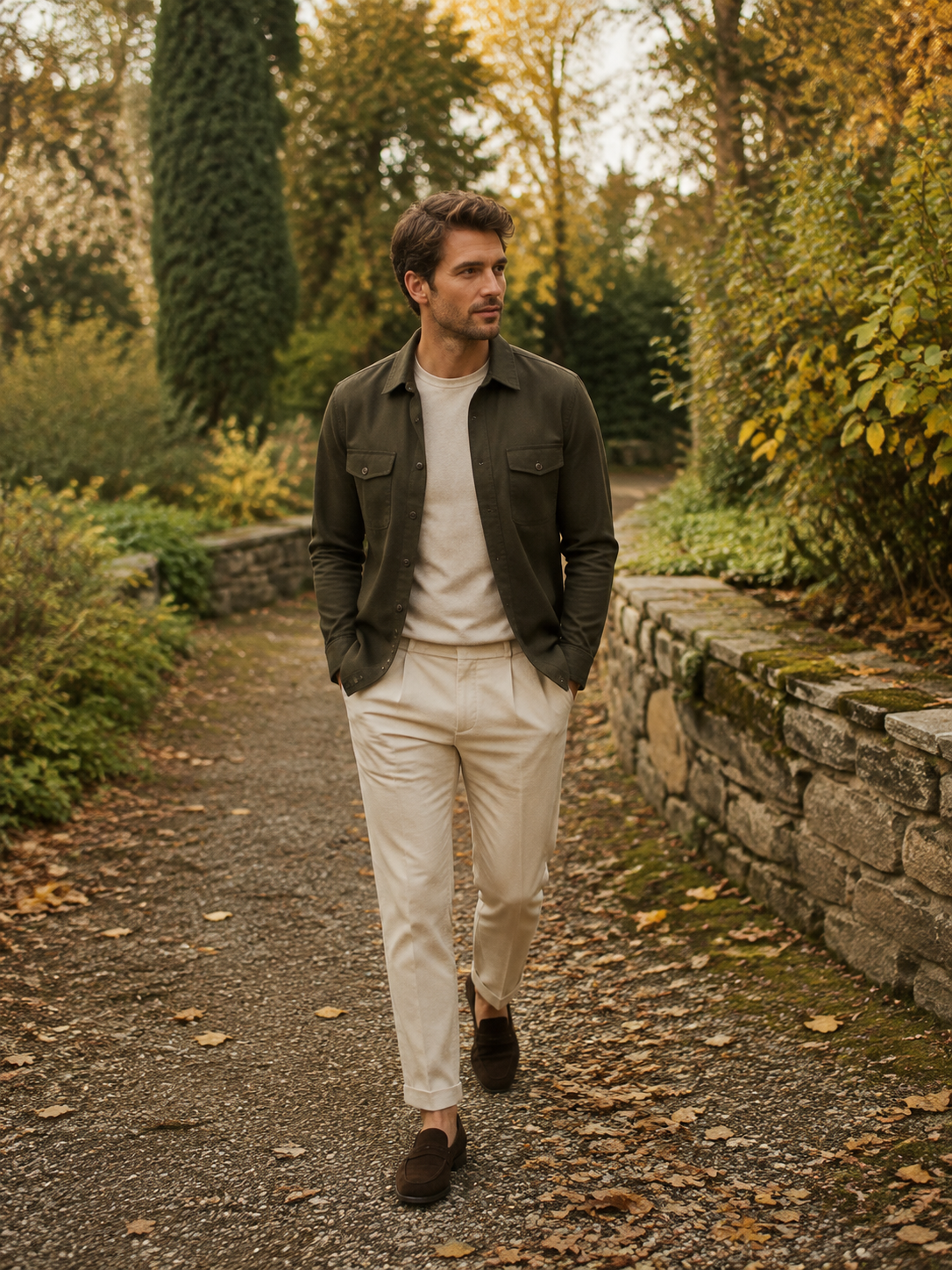
Dark cotton trousers, the merino knit over the tee, the unstructured blazer, and the leather loafers worn in transit so they take no luggage space. Everything travels on your body, the outfit passes a restaurant or bar, and the pieces reappear on Saturday in new combinations.
The full-Saturday look
The second pair of trousers with the collared shirt, sleeves set by the weather, and comfortable shoes. If the day slides into an unplanned dinner, the knit from Friday goes over the shirt and the whole thing reads intentional without returning to the hotel.
The Sunday departure look
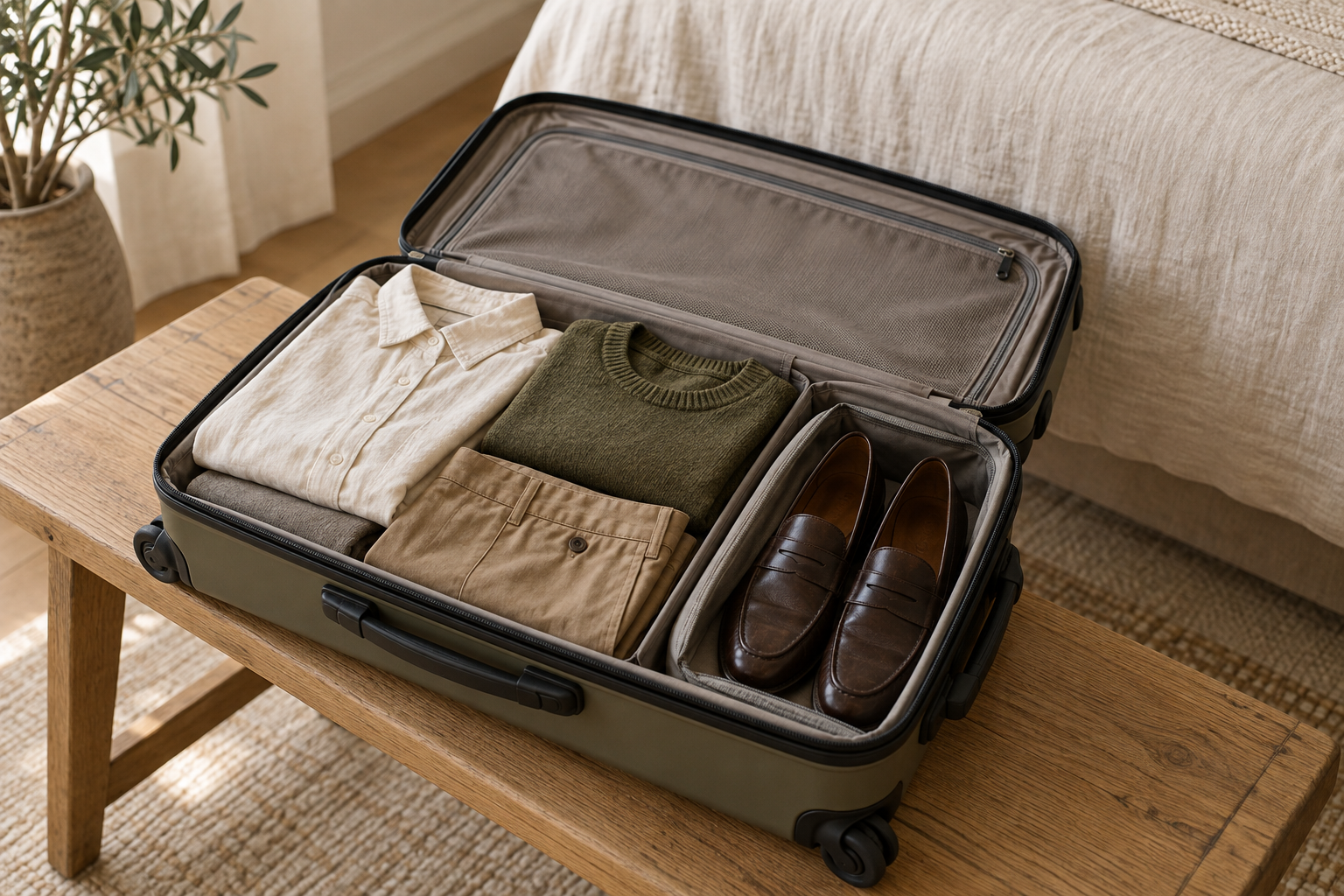
The heavier trousers with the tee under the knit, or the shirt if it has freshened overnight, with the travel-friendly pair of shoes. Repeat wear is invisible here because the combination — same pieces, different pairing — was never worn before the Sunday. The suitcase image is an illustrative packing scene, not proof of a compliant bag size or an exact inventory.
Adjust for the day.
The city-break weekend
Walking distance dominates, so comfort leads: the relaxed trousers do daytime duty, shoes are broken in before the trip, and the blazer stays packed until evening. A foldable compact layer handles changeable weather without claiming much bag space.
The wedding-adjacent weekend
If one event sits above the rest, build the whole bag around it: the dressier shoes and one outfit serve the event, and everything else is planned to recombine with the leftovers. Do not pack a second smart outfit as insurance — the layer and knit are the insurance.
The warm-weather weekend
Swap the knit for a second lightweight top and let the overshirt or a light unstructured jacket do the evening lifting. Linen-blend trousers travel wrinkled, so decide in advance whether that texture reads as deliberate in your destinations' venues.
The trip that extends itself
Build in one grace note: a colour-safe way to wash the tee and knit in a hotel sink, and enough slack in the colour story that a purchased extra top fits the system. Two days can quietly become four, and the wardrobe should bend rather than break.
Leave these assumptions behind.
Packing outfits instead of pieces. Five complete look-by-look outfits fill a carry-on fast; five pieces that recombine into three outfits do not.
Bringing the crisp cotton poplin shirt for day two. It creases in the bag and has no ironing rescue in a standard hotel room; knits and crease-resistant weaves earn their slot instead.
Treating a carry-on as a guarantee. It is a size allowance set by your carrier — until the inventory reconciles against the allowance, nothing is certain.
Two colour stories in one small bag. Navy trousers, a brown-heavy palette, and a black belt mean nothing matches everything, and the combinations collapse.
Packing a third pair of shoes. The space they claim costs more than any outfit improvement, and one dressy pair plus the pair in transit covers a weekend.
Pack a blazer in a carry-on by protecting the shoulders, choosing a fold suited to the jacket, and keeping it on top of the bag. Some creasing is normal.
Dressing for a flight that ends in a smart casual meeting: plan from arrival time, layer for the cabin, and protect a spare top and jacket within real baggage limits.