How to read care labels ↗
The full symbol set explained, with what each wash, dry, bleach and iron marking permits and forbids.
Clothing care
Work from the garment's own label outward: diagnose what actually needs treating, use a permitted method for the fabric and construction in front of you, and store pieces so they keep their shape.
Explore the collectionFIND YOUR STARTING POINT
Care decisions for smart casual pieces come down to three steps in order. This hub works through each one, then routes you to the garment-specific guides where the detail lives.
Care for clothing by reading the garment's label before choosing a cleaning method. Separate dirt and stains from ordinary creases: airing or smoothing a shirt does not necessarily clean it. Check the fabric, trims and construction together, then follow the permitted washing and drying steps rather than applying one routine to every piece.
The sewn-in label is the manufacturer's instruction for that exact garment — its fabric, its dyes, its trims and its construction. General care advice cannot account for any of those specifics. A wash symbol with one bar under it means a gentle cycle, two bars a very gentle one, and a hand symbol means hand wash only; the same tiered logic applies to the drying, bleaching and ironing symbols beside it.
The wash symbol tells you everything — drying permissions come free with it.
Washing and drying are separate permissions. A shirt that survives a gentle wash can still shrink badly in a tumble dryer, which is why labels use a separate square symbol for drying, crossed out when tumble drying is not permitted.
The full symbol set, with worked examples per garment, has its own guide. Start there if you have ever stood in front of a washtub with a square and a circle on it and guessed.
Most care damage starts with a misdiagnosis: a shirt that only needed airing goes through a full wash, or a stained piece gets steamed, which can set the mark rather than remove it. Naming the problem first narrows the treatment to something the label permits. The four common diagnoses behave differently.
| Problem | What it actually is | Typical first step | Stop and reassess if |
|---|---|---|---|
| Stain or dirt | Soiling that airing and brushing will not shift | Treat promptly, with a method compatible with the fibre per the label | The mark spreads, sets or the fabric's colour lifts |
| Odour | Bacteria and trapped moisture, not visible dirt | Air the piece fully, hung with space around it | Odour persists after thorough airing — it needs a proper clean |
| Creases | Deformed fibres from folding or packing | Smooth and hang; steam only if the label permits heat or moisture | The fabric shows shine, water marks or distortion |
| Damage | Pilling, loose threads, holes or stretched shaping | Repair specific problems with garment-specific methods | Repairing it yourself would risk the surrounding fabric |
Take a cotton shirt whose label reads machine wash cold, gentle cycle, no bleach, line dry, warm iron — a common label for smart casual shirting. Each line is a separate instruction, and each exists because washing and drying stress fabric in different ways. Followed together they clean the shirt while protecting the collar, cuffs and buttons, which are the first parts to fail.
Empty pockets, button the body loosely and check the label's temperature line. Pretreat any visible stain at the collar or cuffs with a small amount of detergent worked in gently.
Gentle cycle, cold water, with similar colours. The gentle setting exists to reduce the abrasion that ages collars and cuffs first.
Here that means line drying: reshape the collar, smooth the front plackets and hang from the seam so hangers do not poke the shoulders out of shape.
A warm iron, with steam, on the labelled setting. If the label had banned ironing, hanging to dry would have been the crease strategy instead.
A blazer or lined jacket is a different object from a shirt. Its canvas or fusible interlining, shoulder pads and lining respond badly to machine agitation, and labels on structured pieces typically restrict or forbid home washing for that reason. Their routine care is correspondingly conservative: air after wear, brush surface dust with a soft garment brush, and leave deeper cleaning to the methods the label names.
Steaming is sometimes suggested for structured pieces, but it is not automatically safe. Heat and moisture can distort fused interlining and water-spot some wools, so a jacket label that limits steam should be followed as written, and steaming done lightly, from a distance, only where the label permits. If the label names professional cleaning, a structured garment's own care route ends there.
Home care suits
Professional care suits
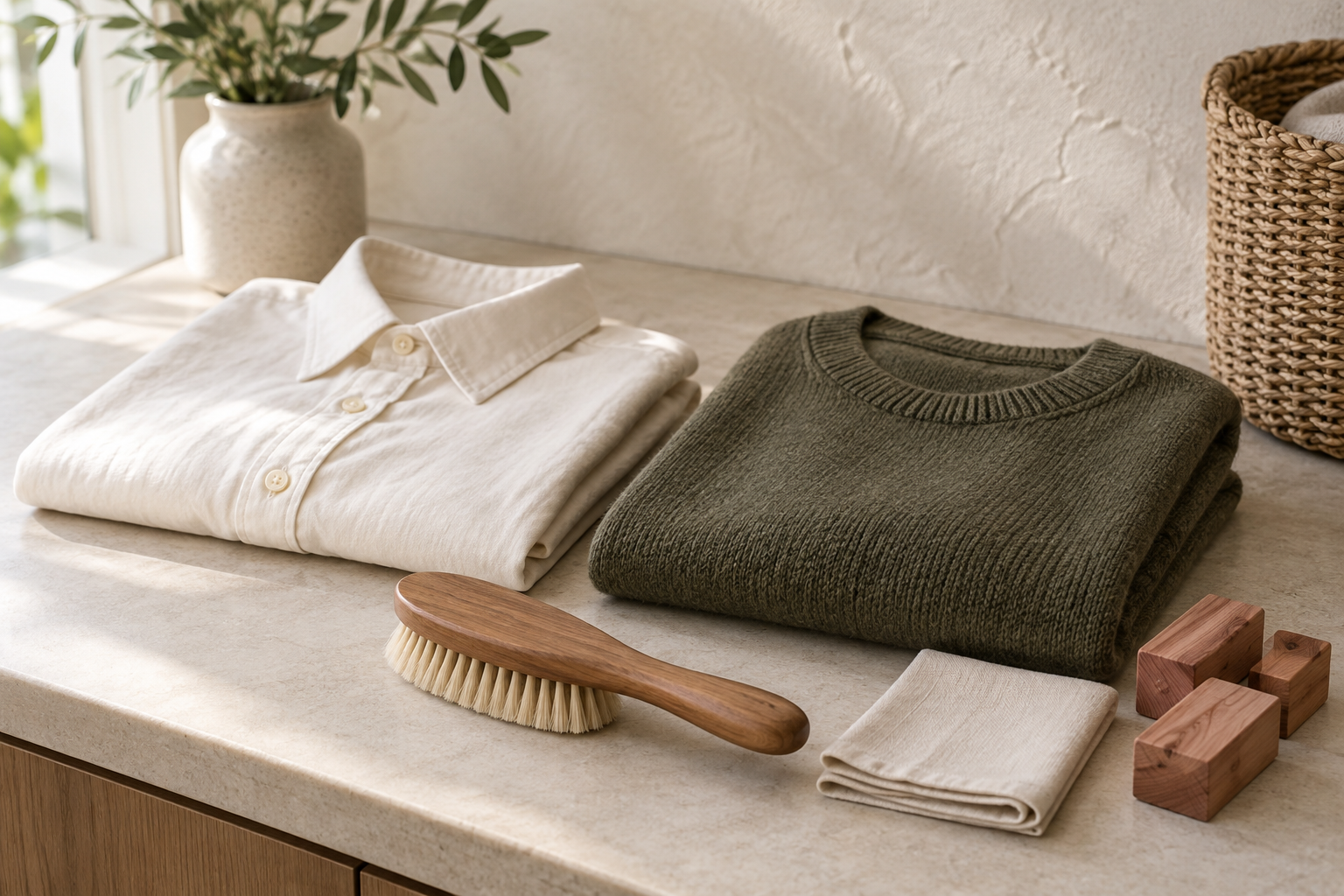
The image on this page shows a folded cream shirt and olive sweater beside a wooden garment brush, a cotton cloth and cedar blocks. It sets out the gentler end of the care toolkit — the brush shown suits sturdy woven and knit surfaces, not delicate or loosely constructed fabrics, and no tool here replaces the garment's label.
A garment worn once and visibly clean often needs airing more than laundering — but that is a judgement about freshness, never a substitute for cleaning a piece that is actually dirty. Airing addresses odour by letting trapped moisture evaporate; it does nothing to soiling. The useful habit is checking honestly which of the two you are dealing with.
Pilling — the small fibre balls that form where a sweater rubs — is a surface problem with a surface fix, and it responds to garment-specific removal rather than aggressive laundering. A pulled thread or a stretched cuff is a different fault: pulling a loose thread tightens the knit and distorts it. Knowing which fault you have decides whether it is a five-minute fix or a job for careful repair.
Storage problems usually trace back to storage shortcuts: pieces put away damp, knitwear folded badly or hanging garments crushed together. None of these are about lifespan promises — they are about how pieces look and smell the next time you reach for them. The checks are quick.
Before a piece goes back in the wardrobe:
Travel compresses care problems into a suitcase: linen creases under pressure, and a packed shirt can arrive looking unlike anything the label anticipated. Packing method and on-arrival wrinkle response each have their own treatment, so this hub routes them rather than duplicating the detail. The same diagnosis rule applies on the road — a creased shirt is not a dirty shirt, and heat applied to soiling can set it.
Some situations are not experiments to run at home, and recognising them is part of the skill. A misread symbol costs a shirt; a botched stain treatment on a structured blazer can cost the garment. These are the stop conditions this hub applies throughout.
Almost any stain can be removed at home if you find the right internet technique.
Some stains respond to home treatment, but technique lists rarely account for fibre, dye, finish and construction — and a failed attempt can make a professional cleaning impossible. Unknown, set-in or valuable pieces belong with a professional assessment first.
The full symbol set explained, with what each wash, dry, bleach and iron marking permits and forbids.
Label-first steaming: which fabrics accept steam, how close to hold, and when to stop.
Hangers, spacing and seasonal storage for structured pieces so they hold their shape between wears.
Why pills form, which removal methods suit which fibres, and how to avoid pulling the knit itself.
Material-aware cleaning for the pair that greys fastest, with the stop conditions that protect the upper.
Travel-specific: folding and rolling methods that reduce creasing before the journey starts.
On-arrival response for creased linen, using what a hotel or host actually has available.
OUR APPROACH
Good style starts with understanding what works for you.
A LITTLE FURTHER READING