From Flight to Meeting: Plan the Outfit and Backup
A flight before a meeting is a wardrobe problem: plan from the meeting's expectations and your real arrival time, travel in the outfit's hard-wearing core, and keep a spare top and essentials accessible whatever the baggage situation.
For a flight before a smart casual meeting, choose a comfortable travel base that can also work on arrival. Confirm the meeting's expectations and how much time you have to change. Keep any essential outfit pieces in accessible baggage, and plan for delays rather than assuming a full refresh stop.
Map the journey: duration, dress code and changing facilities
Three facts shape the whole plan, and none of them should be guessed. How long you will actually be seated — including delays, not just the scheduled flight. What the meeting's code really is, confirmed from the invitation or a short question to the organiser. And what changing facilities genuinely exist on the arrival side.
Timing: build the plan against the meeting minus a delayed landing, not the scheduled arrival. If the gap only works on time, the plan is the gap.
Dress code: organiser guidance overrides any general formula; if there is none, ask one short question rather than dressing for a room you have never seen.
Facilities: a private room, a lounge, or a shared restroom are different plans. Confirm which one your arrival actually offers before deciding how much changing the plan contains.
Build the outfit: wear the core, pack the fresh top
Hours seated change what an outfit can survive. Trousers bag at the knees, waistbands press, and collars soften, so the travelling outfit should be built from the sturdiest pieces in the meeting wardrobe — heavier cottons, knits, and unstructured tailoring — rather than its crispest ones.
The single most useful swap is a fresh top. The shirt or blouse for the meeting travels folded in accessible baggage and goes on after landing, converting the travel outfit in one move. No fabric guarantee makes this unnecessary — creasing is a packing fact, and the fresh top is how the plan absorbs it.
Myth
Wrinkle-free fabrics mean the meeting shirt can just be worn on the plane.
Fact
No fabric guarantees a crease-free arrival. Hours seated, cabin food, and terminal heat all mark a worn shirt. Construction and weave can reduce how visible creasing is, but the reliable plan is the same either way: the meeting shirt waits folded in accessible baggage while the plane gets the hard-wearing base layer.
The travel-to-meeting outfit, piece by piece. Accessible means under the seat with you, not in the overhead bin or a bag that could be gate-checked.
Piece
Role
Where it travels
Meeting trousers in a heavier cotton, wool blend or structured weave
Worn from the start — dark neutrals hide the flight and go straight into the meeting
On the body
Plain crease-resistant base top — quality tee or fine knit
The visible layer in flight, swapped out on arrival
On the body
The meeting shirt or blouse
The single swap that converts the outfit
Folded flat, accessible baggage
Unstructured blazer or knit layer
Cabin warmth in flight; worn in the meeting itself
Worn or accessible baggage
Spare socks and compact care items
The freshen-up kit for one restroom visit
Accessible baggage, packed on top
Dress for the cabin without health claims
Cabins run through temperature swings — often cool in flight, warmer on the ground and in the terminal. A removable layer is not optional. A knit or unstructured blazer over a base top lets you adjust without ever looking either underdressed or overheated.
Seated comfort is a fit and fabric question: nothing that digs when sitting for hours, shoes that slip off and on easily at security, and a cut with enough give to move. Keep the reasoning to comfort and presentation — how the clothes behave — rather than any claims about what flying does to the body.
Protect the jacket and essentials within real baggage limits
A jacket survives a flight better carried than crushed. Wear it through the terminal, hang it where hanging is offered, or lay it flat on top of the bag's contents — folded into a tight ball is the one method that reliably loses. Our blazer packing guide covers the fold in detail.
Before leaving for the airport, confirm:
The meeting shirt, spare socks and care items are in the bag that stays with you, on top.
You know your carrier's current size and weight rules for that bag, and it fits them.
Nothing meeting-critical depends on overhead bin space remaining.
The care kit works without a private room: brush, hand-smoothing, and travel-size items within current security rules.
You have checked current carrier and airport guidance for anything liquid rather than guessing.
When there is no changing room, and when the flight is late
The plan must survive its worst ordinary day: a shared restroom and a clock. Anything requiring a full change, an iron, or twenty private minutes is not a plan — it is a hope with a schedule.
The ten-minute turnaround
In one restroom visit: change into the packed shirt, swap the travel top into the bag, firm-smooth the trousers' crease, brush the jacket, and check the mirror under real light.
The no-facilities fallback
If there is no space to change at all, the travel base already reads smart casual: fresh socks, jacket brushed, shirt collar and cuffs smoothed by hand at a counter. Presentable is the target; the packed shirt waits for the first real opportunity.
The delayed-flight version
A late landing deletes the buffer first. The kit lives at the top of the bag, the change is rehearsed to minutes, and the organiser is told early if the arrival slides — a plan that only works on time was never a plan.
The arrival check
Ninety seconds at the arrival end protects the whole plan. Run it before leaving the terminal, while fixes are still free.
Final check, on arrival:
Shirt changed or collar and cuffs hand-smoothed; travel top bagged, not stuffed in a pocket.
Jacket brushed and shoulder seams settled back into place.
Trousers' crease re-set with a firm smooth; shoes wiped and fastened.
Mirror check under real light — yours, not the cabin's.
Clock confirmed against the real remaining time, not the hoped-for one.
Hours seated change what an outfit can survive. Trousers bag at the knees, waistbands press, and collars soften, so the travelling outfit should be built from the sturdiest pieces in the meeting wardrobe — heavier cottons, knits, and unstructured tailoring — rather than its crispest ones.
Cabins run through temperature swings: cold in flight, warm on the ground and in the terminal. A removable layer is not optional. A knit or unstructured blazer over a base top lets you adjust without ever looking either underdressed or overheated.
Wrinkles are a packing problem before they are a fabric problem. The shirt or blouse for the meeting travels folded in accessible baggage, ideally re-laid flat on arrival. No fabric guarantees a crease-free arrival; the fresh top is the plan, not a fabric promise.
Be honest about time-to-freshen. Between the gate and the meeting there is often a taxi, a lobby, and perhaps ten minutes in a shared restroom — and some arrivals offer no changing space at all. Anything requiring a full change, an iron, or a private room is a plan that will fail; the kit must work in one restroom visit, or without one.
Do not bank on a fixed gap between landing and the meeting. Delays are ordinary, so plan the change to fit the short version of the timeline and tell the organiser early if the arrival slides.
Rules on liquids and what goes through security change, so check current carrier and airport guidance when planning the personal item — liquid limits and bin procedures vary and are not worth guessing at.
A useful outfit formula.
Trousers: the meeting trousers themselves, in a heavier cotton, wool blend, or structured weave that resists knee-bagging — dark neutrals hide the flight and go straight into the meeting.
Base top: a plain, crease-resistant layer — a quality tee or fine knit under the main layer — so the visible shirt stays folded in the bag until arrival.
Travelling layer: an unstructured blazer, cardigan, or overshirt that matches the meeting outfit's register, thick enough for a cold cabin and smart enough to be worn in the meeting itself.
Shoes: the meeting shoes if they are broken-in leather that polishes quickly, otherwise clean leather trainers in transit with the meeting shoes wrapped in accessible baggage — never brand-new shoes discovered painful at the gate.
Extras: a spare pair of socks and the meeting shirt folded flat in accessible baggage, plus a compact freshen-up kit — travel-size items within whatever current rules allow, a travel brush, and a folded spare top as last-resort insurance.
Two starting points.
The menswear travel outfit
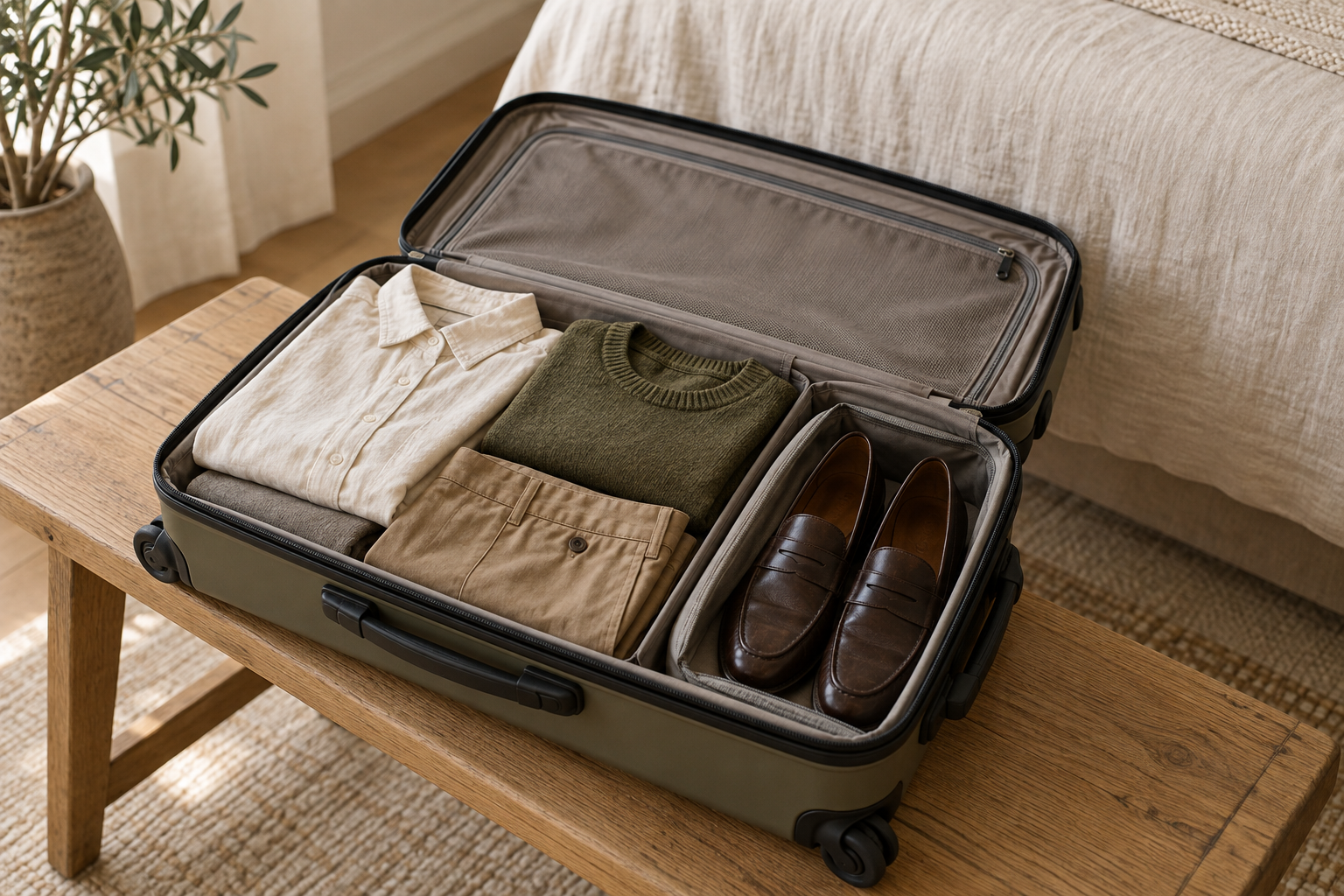
Navy heavier-cotton trousers, a grey merino crew neck over a plain tee, and an unstructured navy blazer, with dark brown leather derbies already broken in. On arrival: swap the crew neck for the packed shirt, run a brush over the jacket, and the meeting look is assembled in minutes. The suitcase image is an illustrative packing scene, not proof of what fits under a seat or how a garment survives a flight.
The womenswear travel outfit
Structured crepe or heavier jersey trousers, a fine knit, and a blazer in the meeting's colour story, with low leather shoes worn in transit. The packed blouse and a fresh pair of socks convert the outfit after landing without a full change of clothes.
The ten-minute turnaround
In a restroom before the meeting: change into the packed shirt, swap the tee into the bag, re-do the trousers' crease with a firm hand-smooth, brush the jacket, and check the mirror under real light. Everything else — shoes, trousers, layer — travelled on the body and was chosen to survive it.
Adjust for the day.
The red-eye before a morning meeting
Sleep quality decides the outfit, so bias further toward knits and soft-structured tailoring, and treat the packed shirt as the whole plan. Pack the freshen-up kit at the top of accessible baggage, and plan against airport facilities on arrival rather than assuming a hotel room.
The long-haul flight
Hours seated demand the softest version of the plan: knit-based travelling clothes and comfortable shoes in transit, with the complete meeting outfit folded in accessible baggage. Where a genuine change is possible — a hotel or lounge with space — plan it deliberately, but keep the restroom-only version viable in case that access falls through.
The short-haul day return
The meeting and the flight home share one outfit, so pick pieces that read smart in the room and stay comfortable on the plane: structured knit over shirt, no tie, and shoes that survive both. The bag carries only care items and a spare layer for the return leg.
The meeting straight from the airport
Cut the plan to what one restroom visit can achieve: travelling clothes that are already most of the meeting outfit, the packed shirt as the single swap, and a buffer planned into the arrival time. Anything more ambitious will be abandoned in the taxi.
Leave these assumptions behind.
Wearing the meeting shirt on the plane. Hours seated, cabin food, and terminal heat undo it; the shirt's job is to wait folded in accessible baggage, not to fly.
Treating the overhead bin or a gate-checked bag as safe storage for meeting-critical pieces. Full bins and gate checks are ordinary; the shirt and socks ride under the seat.
Assuming a fixed gap between landing and the meeting. Delays are ordinary, so the change must fit the short version of the timeline.
Planning a freshen-up routine that needs a hotel, an iron, a steamer, or twenty private minutes. If the plan does not survive one shared restroom and a clock, it is not a plan.
Ignoring cabin temperature and dressing in a single layer. Cold cabins and warm terminals both happen on the same journey, and a shivering or sweating arrival shows before any fabric crease does.
How to cover a weekend trip with carry-on luggage: check the allowance first, build a counted inventory that recombines, and choose shoes before clothes.
How to choose travel shirts you can wear without ironing: compare knit, textured and easy-care construction, read the care label for what you can manage on the road, and run a packing test at home before you commit.