A SIMPLE STARTING POINT
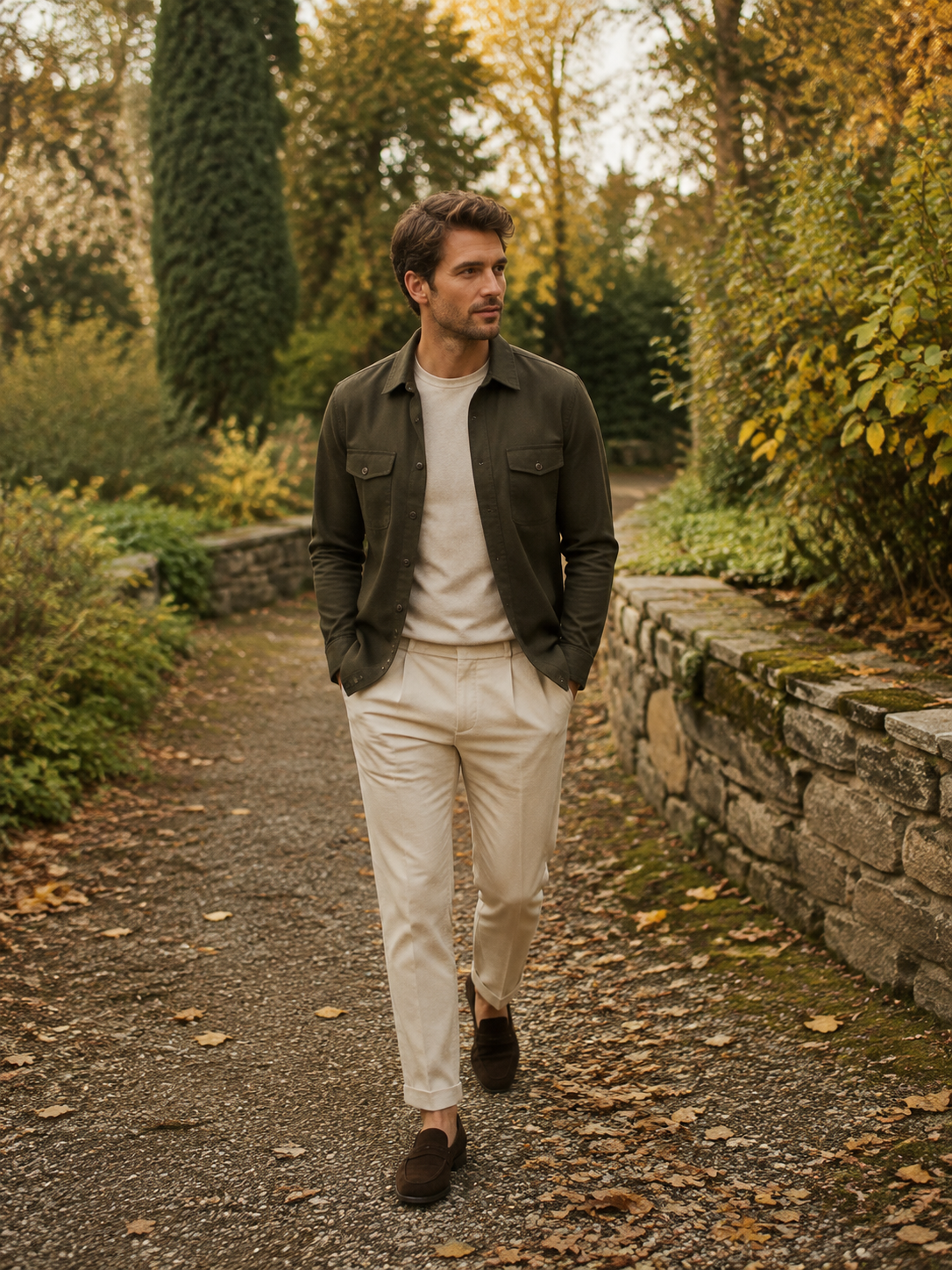
Ease, with intention.
Build a smart casual travel wardrobe by matching clothes to your itinerary, laundry access and venue rules. Choose pieces that work in several combinations, then count complete outfits rather than relying on a universal packing number. Leave room for dirty clothing and weather changes; a compact wardrobe still needs to meet the actual demands of the trip.
This guide gives you a repeatable way to get dressed. Read the short version of each step here, then follow the deeper guides when you want more detail.
01
Write the trip grid before you choose anything
A travel wardrobe fails when it is packed for an imaginary trip. List each day of yours in two columns: what you will do, and how smart it needs to look. That grid, not a generic piece count, decides what earns space in the bag.
| Day | Daytime demand | Evening demand |
|---|---|---|
| Day 1 | Travel and walking with luggage | Casual dinner near the hotel |
| Day 2 | Sightseeing, lots of walking, transit | Smart casual dinner reservation |
| Day 3 | Museums and café sitting | Nothing planned; buffer day |
| Day 4 | Departure, one more walk | None |
THE SHORT VERSION / 4 STEPS
Write each day of the trip with its daytime and evening demand.
Mark which days involve heavy walking, transit or weather exposure.
Note where you could realistically wash and dry something, and how long drying takes.
Check any venue with a dress rule before you finalize the list.
02
Choose a palette from what you already own
A travel wardrobe works or fails on color coordination. Pick two neutrals and one light shade you already own and like together, such as navy and olive with cream. Every top must look deliberate with every bottom, because on the road you will not remember which shirt matched which trousers.
- Navy bottoms and a navy blazer frame cream, white and olive tops equally well.
- Olive works as a softer alternative to black and pairs with both denim tones and cream.
- Cream or light grey tops keep the palette bright without a separate day and evening set.
You must pack only plain neutrals and avoid patterns entirely for a capsule to work.
What matters is that each piece pairs with at least two others. A striped or checked shirt is fine if you confirm it works with every bottom and layer in the grid.
THE SHORT VERSION / 3 STEPS
Write down two neutrals and one light shade you already own and like together.
Hold each candidate item next to every other candidate before packing, not just one partner.
Remove anything that creates only one possible combination.
03
Let the layers set the formality
The fastest way to make one outfit feel dressier is a structured layer on top. An unstructured blazer or a fine merino crew turns the same trousers and top from sightseeing into dinner. Bring two layers in the palette so you can vary the pairing instead of wearing the same look every evening.
Structured layer (blazer)
- Lifts any outfit to dinner-standard in one move
- Works over a knit, a polo or a collared shirt
- Choose one in a neutral that matches both bottoms
Knitted mid-layer
- Packs smaller and survives a case better
- Must look presentable on its own when the blazer comes off
- Hand-washable options can extend the trip if the label allows
THE SHORT VERSION / 4 STEPS
Choose one blazer or smart jacket in a neutral that matches both trousers and shoes.
Add one knitted mid-layer in a second palette color.
Try every top under every layer at home, checking sleeve length and shoulder fit.
Wear the bulkiest layer, usually the jacket, on the journey to free up bag space.
04
Pick shirts that earn their space
Shirts take the most space and crease the fastest, so choose fabrics that recover from folding and colors that work under every layer you bring. Knitted polos, Oxford cloth and mid-weight jersey tops tend to travel better than crisp poplin. Darker and mid-tone shirts also forgive a long day of wear better than bright white.
THE SHORT VERSION / 3 STEPS
Choose one collared shirt smart enough for a nice dinner, in navy, grey or olive.
Add one or two knit or jersey tops in the same palette for daytime.
Check each fabric's care label before you go, since washing rules vary and some travel shirts need a cool wash.
05
Count outfits honestly, then pack
With a fixed palette, count the distinct outfit combinations against your day grid rather than trusting a piece count. State your laundry assumption out loud: if the totals only work because you plan to wash something, confirm the label allows it and the drying time is realistic. If you are flying, check your airline's current carry-on size and weight limits before finalizing the bag.
The worked four-day plan below assumes no mid-trip washing. It repeats garments across days, but no full outfit appears twice, and every listed item maps to a day in the grid at the top of this guide.
- Lay every piece on the bed and count the distinct outfit combinations.
- Match each combination to a slot in the trip grid; cut anything with no slot.
- Pack shoes in bags at the base of the case, then pack shirts using a fold or roll chosen per fabric.
- Leave space for dirty clothing separation and possible purchases rather than packing to the zipper.
- Re-check liquid limits and bag dimensions against your airline's published guidance before you leave.
THE SHORT VERSION / 5 STEPS
Lay every piece on the bed and count the distinct outfit combinations.
Match each combination to a slot in the trip grid; cut anything with no slot.
Pack shoes in bags at the base of the case, then pack shirts using a fold or roll chosen per fabric.
Leave space for dirty clothing separation and possible purchases rather than packing to the zipper.
Re-check liquid limits and bag dimensions against your airline's published guidance before you leave.
SEE THE IDEA AT WORK
A worked four-day outfit plan
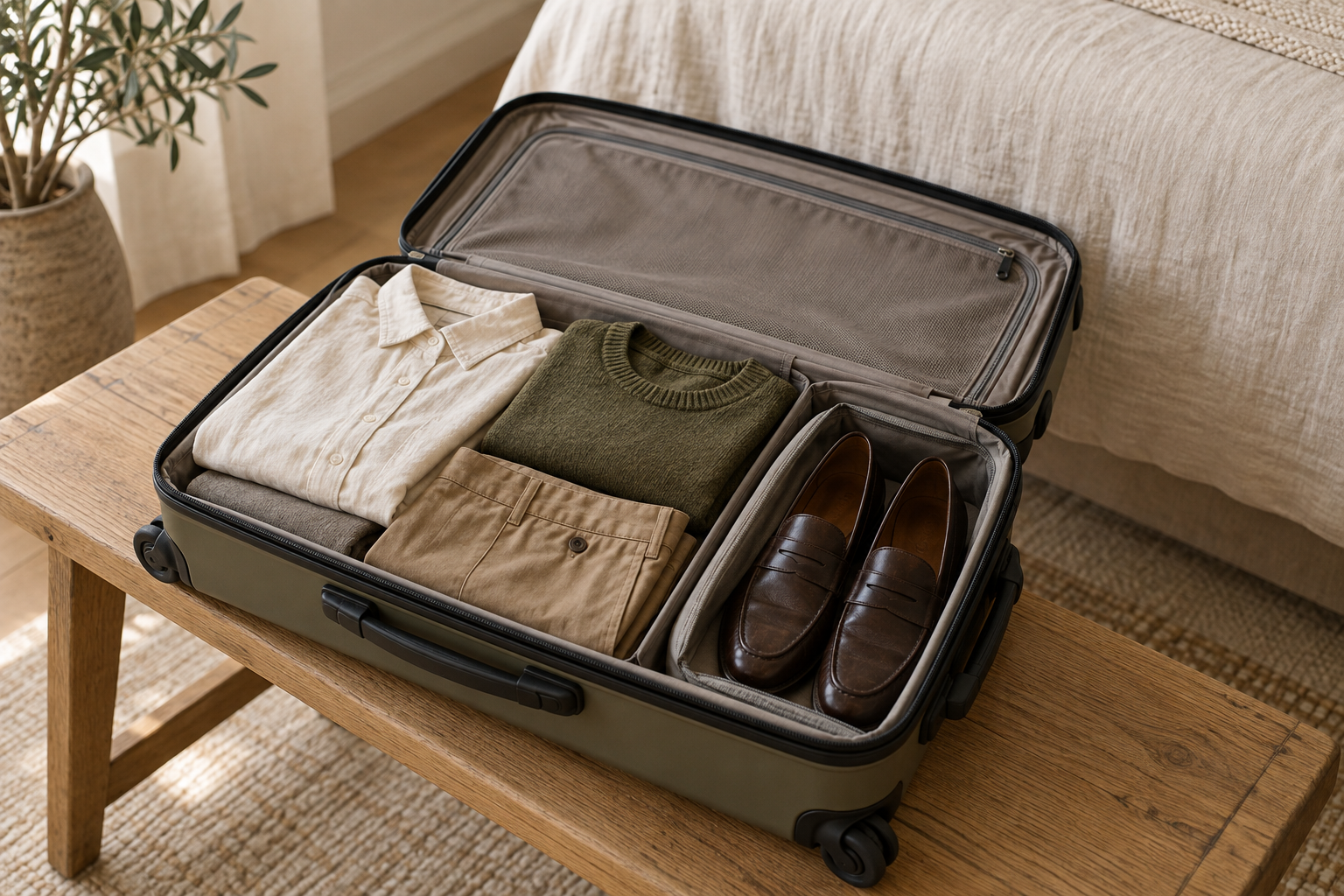
This sample itinerary is hypothetical: a four-day city trip with walking, transit and dinner reservations, packed with no mid-trip laundry. Garments repeat across days but no full outfit repeats exactly, and the counts reconcile with the table above.
- Day one, travel day: dark jeans, white tee, olive overshirt, trainers worn in transit.
- Day two, sightseeing: olive chinos, Oxford shirt sleeves rolled, trainers, overshirt worn if the weather turns.
- Day two, evening: same olive chinos and Oxford shirt, cream merino over the shirt, leather sneakers or loafers.
- Day three, day: olive chinos, cream merino, trainers.
- Day three, dinner: dark jeans, Oxford shirt, navy blazer, dressier shoe.
- Day four, departure: dark jeans, cream merino, navy blazer over the top, comfortable trainers.
- Failure backup: the overshirt covers a changed forecast; a packed spare tee covers a spilled shirt on any day.
| Piece | Why it earns its place | Wears in the 4-day plan |
|---|---|---|
| Unstructured navy blazer | Lifts any top and trouser combination to dinner standard; worn on travel day to save space | 3 (travel day, day 3 dinner, departure) |
| Olive chinos | Softer than black, pairs with every top in the palette, dresses up or down | 3 (day 2 day and evening, day 3) |
| Dark straight jeans | Read as smart in a dark wash and hold up to more wears between washes | 3 (travel day, day 3 dinner, departure) |
| Cream merino crew | One of the few tops that looks deliberate with both navy and olive bottoms | 3 (day 2 evening, day 3, departure) |
| Oxford shirt in mid-tone | Oxford cloth creases less visibly than poplin and works tucked or untucked | 2 (day 2 day and evening) |
| White or cream tee or knit | Covers the casual daytime slot and layers under the overshirt | 2 (travel day, day 3) |
| Leather sneakers or loafers | One dressier shoe covers every evening in the plan | 2 evenings, packed otherwise |
| Comfortable trainers | Worn in transit to save bag space and handle the heavy walking days | Worn day 1, day 2 day, day 4 |
| Lightweight overshirt | Works as a jacket in mild weather and a mid-layer in cold weather | 2 (travel day, day 2, weather backup) |
A last look in the mirror.
A MOMENT BEFORE YOU GO
0 of 10 ready
SMALL ADJUSTMENTS
When it feels almost right.
Packing one outfit per day instead of mixing pieces?
Outfit-per-day packing doubles your bag for no benefit. If your palette is tight, three tops and two bottoms give you six distinct combinations, which covers most short trips comfortably.
Trusting a universal piece count, like six-to-eight pieces for any trip?
The right number depends on your itinerary, laundry access and how many evenings need the dressier layer. Count complete outfits against your own day grid; a five-day promise that silently assumes washing will happen is the version that fails.
Bringing a shoe for every occasion?
Shoes are the heaviest, bulkiest items in any bag. One dressier pair worn every evening plus the trainers you travel in will handle almost any smart casual itinerary, so a third pair is rarely justified.
Packing the fragile, crease-prone favorites?
Crisp poplin and delicate fabrics look wrinkled after a day in a case. Favor Oxford cloth, knitwear and jersey, and check each care label before you leave, since some fabrics need washing methods a hotel sink cannot provide.
Still wondering?
How small can a smart casual travel wardrobe go?
It depends on the itinerary and laundry access rather than a fixed number. For a four-day city trip with dinners, roughly eight core pieces plus underwear covers the grid above if the palette is tight and every item works in at least two outfits.
Can I wash clothes mid-trip instead of packing more?
Often yes, but check each garment's care label first. Knitwear and many travel-oriented shirts handle a gentle hand wash and overnight drying, while structured blazers and most wool trousers do not wash well in a sink, so plan those pieces to last the whole trip.
Does this work for a cruise with formal nights?
The core wardrobe covers most smart casual venues on a cruise, but check the cruise line's current dress guidance for its main dining rooms, as expectations vary by line and by venue, and some evenings sit a step above smart casual. Our smart casual cruise outfits guide covers those dressier evenings in detail.
How do I keep it all within carry-on limits?
Wear the bulkiest items, the blazer and the trainers, on the journey, and check your airline's current carry-on size and weight limits before you pack, since they differ between carriers and fare types. Fold or roll shirts according to fabric and space rather than by rule.