Build the travel wardrobe itself ↗
The step-by-step capsule construction this hub sets up: choosing and combining a small wardrobe around your own itinerary.
Occasion hub
Plan travel clothes around the itinerary, available laundry and each venue’s rules. List the walking days, journeys and dressier bookings before packing, and repeat pieces only when their condition allows it.
Explore the collectionFIND YOUR STARTING POINT
Travel wardrobe planning is really itinerary planning. List the walking days, the journeys and the dressier bookings before you choose a single item, then check what laundry you will realistically have access to. A small bag works best when its contents cover real activities rather than imagined outfits.
Smart casual travel outfits are decided by three things before style enters the picture: what the itinerary actually contains, where and when you can wash or freshen clothes, and what each venue on the schedule expects. Get those three answers first and the packing list mostly writes itself. This page works through that method, then handles cruises separately, because their dining expectations are stated in advance but vary by line, ship and venue.
A packing list built from “four days in Lisbon” will overpack and underdeliver. The same trip written as an activity grid shows you what each day really demands: distance on foot, one meal with stated requirements, a dressier booking, and whether anything can be washed overnight.
| Day | Daytime activity | Evening | Laundry access |
|---|---|---|---|
| 1 | Travel day plus two hours of city walking | Casual dinner, no stated dress code | None |
| 2 | Long museum and old-town walking day | Free — rest or wander | Hotel sink; quick-dry items only |
| 3 | Short walk, long lunch | Booking notes “smart dress please” | None |
| 4 | Travel day home | — | — |
Day 3 is the day that changes the bag: it is the only one where an evening venue has stated a requirement, so it sets the dressiest outfit. Days 1 and 2 set the shoes. Everything else is repetition, which is exactly what you want.
The usual advice is to pack a fixed number of pieces that multiply into “15 outfits”. That arithmetic is only honest if every combination is one you would actually wear and every piece survives its second outing in good condition. Count combinations from your activity grid instead, and stress-test the count against one piece getting dirty.
| Piece | Worn on | Second-day condition | If it gets dirty on day 2 |
|---|---|---|---|
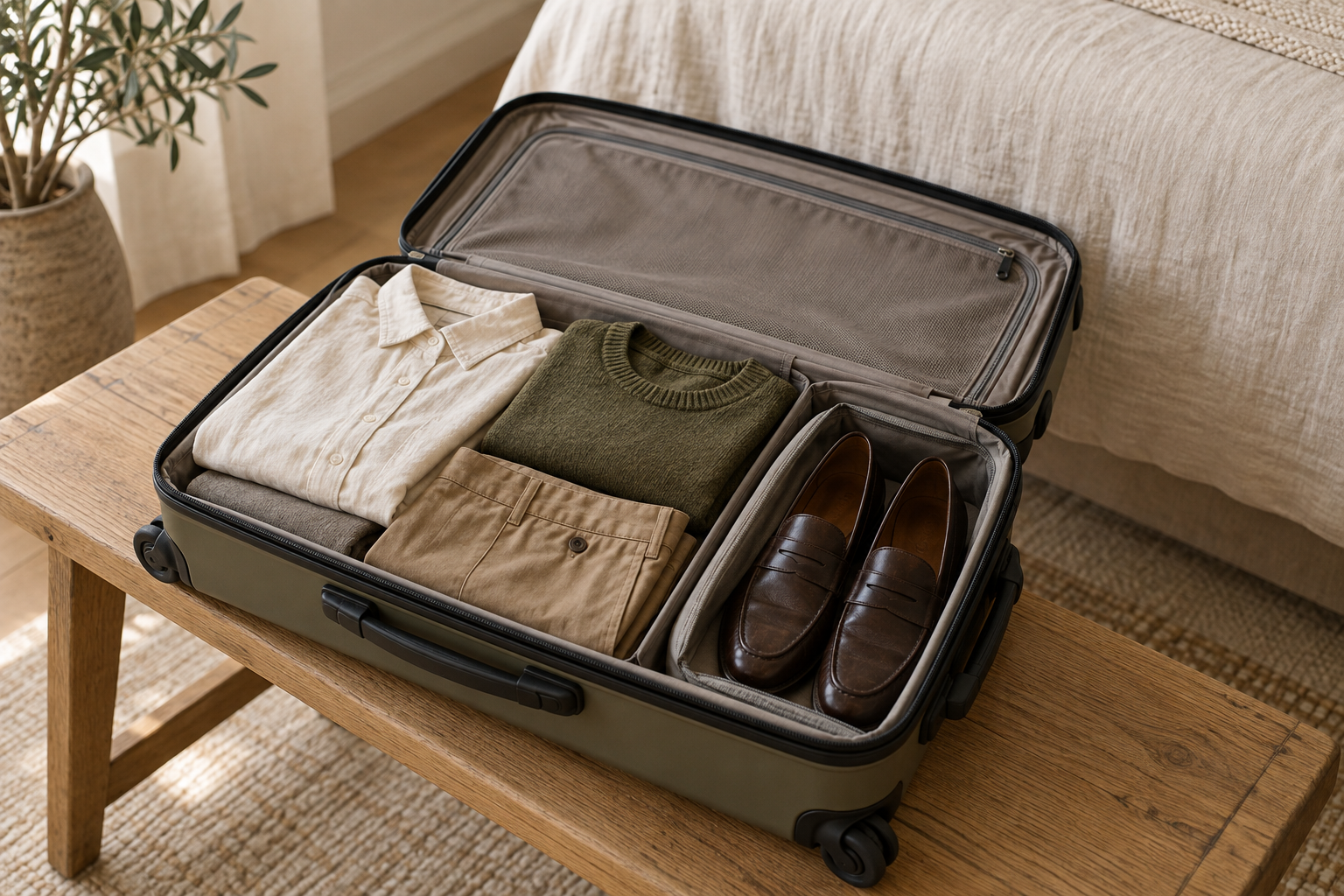
| Olive sweater | Days 1 and 3 | Fine — knit holds up between wears | Day 3 falls back to the cream shirt |
| Cream shirt | Days 2 and 3 (backup) | Check collar and creasing after day 2 | Sink-wash the night before, if fabric allows |
| Tan trousers | Days 1–3 | Brush and air overnight | No substitute packed — day 3 booking makes this the risk to avoid |
The last row is the finding that matters: the grid exposed a single point of failure before the trip, not during it. The fix is either a second pair of bottoms or a deliberately relaxed fallback for the day-3 booking. That decision — not a universal capsule count — is what makes a small wardrobe sufficient for your trip.
Shoes are where travel packing fails most often, because one pair gets asked to do two jobs. Separate the jobs explicitly: walking suitability belongs to the daytime grid, and evening appearance belongs to the dressiest booking you marked.
Walking-first pair
Evening-first pair
Layers follow the same split. A fine knit or overshirt handles planes, air conditioning and cool evenings, while a packable rain layer is a weather decision, not a style one. Check the forecast for your destination rather than packing for the season in theory.
Repeat wear is a plan only if the garment will genuinely look presentable the next time. That depends on the fabric’s drying time, what care the care label permits, and how the piece travels in the bag. Check those three things rather than hoping.
For every piece you intend to wear more than once, confirm:
Shirts deserve special attention because they show wear fastest at the collar and cuffs. If ironing on holiday is not realistic, choose fabrics that recover on their own — our guide to travel shirts without ironing compares the options.
Cruise dress expectations are unusual because they are stated in advance — but they are not uniform. The line sets the broad tone, individual ships and even individual restaurants adjust it, and special evenings carry their own suggestions.
All cruises have the same dress code, so one packing list works for any sailing.
Requirements vary by cruise line, by ship, by venue and by special evening. Main dining rooms, buffets and specialty restaurants on the same sailing can each differ, so the requirements for your specific booking are the only ones worth planning around.
Once you have the specific requirements, the cruise becomes a normal itinerary problem: mark the dressier evenings, count combinations across the sailing, and plan laundry around what the ship actually offers. Our cruise outfits guide walks through that in detail.
The step-by-step capsule construction this hub sets up: choosing and combining a small wardrobe around your own itinerary.
Fabric choices that look considered on their second and third wear, for trips where an iron is not part of the plan.
How to fold and stow linen to limit creasing, and what to expect when it creases anyway.
Reading your line, ship and venue requirements, and building evening outfits for a specific sailing.
OUR APPROACH
Good style starts with understanding what works for you.
A LITTLE FURTHER READING