Jackets & Blazers
How a Blazer Should Fit: Length, Sleeves and Closure
Check shoulder, jacket length, sleeve length, chest room and closure one at a time. What a blazer should do off the rack and what a tailor can fix.

Outfit inspiration
A blazer and skirt can match, contrast or sit close in colour without being identical. Start by trying the layers together and checking movement at the waist and hips, then choose the coordinated or varied read you prefer, with shoes chosen for the setting.
Begin hereInspiration
A blazer and skirt can match, contrast or sit close in colour without being identical. Start by trying the layers together and checking movement at the waist and hips. Then choose whether you want a coordinated or more varied appearance. An ivory knit, midi skirt and soft blazer offer one starting formula, with shoes chosen for the setting.
None of the three structures is automatically correct — each buys you something different. Run them against the setting you are dressing for rather than against a rule about what matching pieces permit.
A true matching suit
A deliberate contrast or tonal pairing
A near-match in similar-but-not-identical colours is always a mistake, and a matching skirt suit is automatically safe for any office.
Neither holds universally. A close tonal pairing can read as deliberate when the fabrics agree or the difference is clearly intentional — check the combination on, in daylight, before judging it. And formal permission comes from the workplace, not the garment: verify what your own office expects rather than assuming a suit settles the question everywhere.
Each row is a complete outfit with the match-or-contrast decision and the footwear built in. Pick the row that matches your skirt shape and the day you are dressing for.
| Look | Match decision | Waist and hem notes | Shoes and extras |
|---|---|---|---|
| Navy wool blazer with matching pencil skirt | True suit — same fabric, same dye lot, hem at the knee | A white shirt tucked or worn neat under the jacket keeps the front clean | Black leather pumps |
| Charcoal blazer over a black pencil skirt | Deliberate contrast — clearly distinct tones, checked together in daylight | A fine ribbed black turtleneck keeps the jacket-to-skirt transition narrow | Black pumps or low heels |
| Black structured blazer over a burgundy a-line midi | Contrast in colour and structure — tailoring above, swing below | Tuck the cream blouse: the a-line has no waistband of its own, so the tuck shows where the skirt begins | Heels or pointed flats to match the tailored top half |
| Unstructured beige blazer over a pleated sage a-line midi | Soft-shouldered contrast — both halves stay casual enough to agree | Jacket ends at the high hip, above where the pleats open; a white fitted tee keeps the middle tidy | Ballet flats or clean white sneakers |
| Navy unstructured blazer with a mid-blue denim midi | Texture-led contrast — matte wool against denim | Keep the blazer soft and unlined so the top half does not outweigh the denim | White leather sneakers and a striped breton |
| Black cropped blazer over a dark-wash raw-hem denim skirt | Intentional mismatch — the raw hem gives the tailoring a counterpoint | The crop lifts the jacket clear of the skirt's waistband, keeping both layers visible | Grey marl t-shirt and ankle boots |
The fuller the skirt, the more the jacket's length and cut matter. A narrow pencil skirt continues the jacket's line, so most hem positions work; a swinging or pleated skirt moves under the jacket, so the jacket needs to end clear of the fullest part of the pleats rather than fighting them.
Tucking is an alternative, not an obligation. If a tucked waistband is uncomfortable seated, wear the top untucked with the jacket open and check the mirror for where the layers stack — the open-front line often gives the definition the tuck would have.
The skirt and the jacket are tested by different motions, so test them separately. The skirt is a seated question; the closure is a standing and moving one.
Two separate checks:
The matching navy suit or the charcoal-over-black contrast, with pumps or low heels. Treat the outfit as a proposal, not permission — check your own workplace's expectations before relying on any version of it.
Swap to the denim midi and an unstructured blazer, letting texture replace colour contrast, and settle the register with white sneakers or ankle boots. The striped breton or grey marl tee keeps the top half as casual as the bottom.
The pleated sage midi with the beige blazer moves from desk to dinner with a shoe change alone — ballet flats by day, heeled boots at night.
Where to go next
Every jacket and blazer guide on the site.
The midi-skirt decisions behind the denim and sage looks above.
Which jacket structure you are actually holding.
The dress-code context behind the office adaptations.
1 look to explore
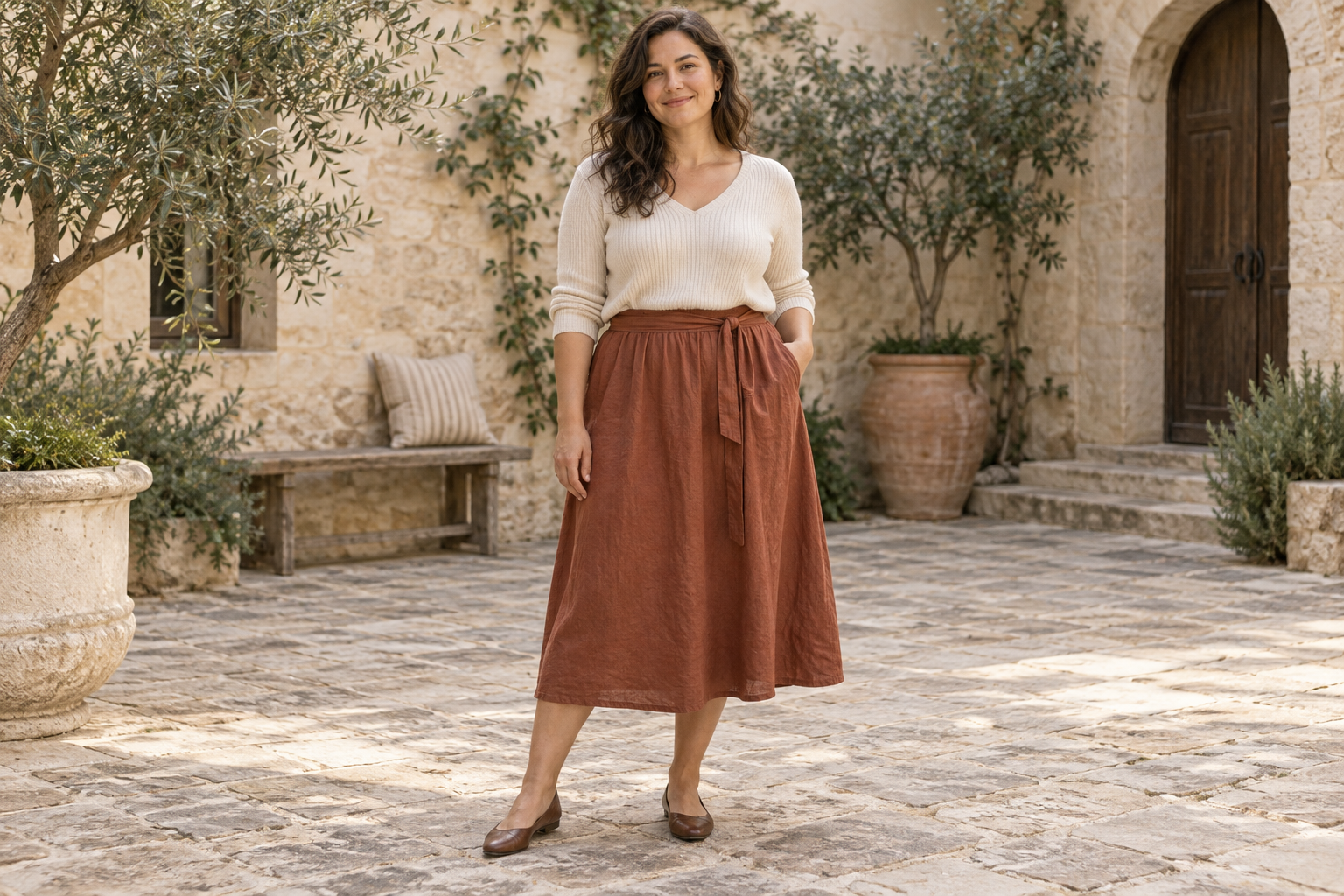
A woman in an ivory knit top, rust midi skirt and brown flats in a stone courtyard. The image shows the skirt-and-knit starting formula described in the opening — it is a generated illustration, not a photograph of a finished blazer outfit, and no blazer appears in it. Picture the soft blazer layered over the knit per the table above, with the shoes kept visible.
Jackets & Blazers
Check shoulder, jacket length, sleeve length, chest room and closure one at a time. What a blazer should do off the rack and what a tailor can fix.
Jackets & Blazers
Matching trousers, fabric and construction are the useful tells. Compare blazers, sport coats and suit jackets — and learn which works with odd trousers.
Jackets & Blazers
How to wear a blazer casually: knit, shirt and relaxed-layer combinations built around complete outfits, with the swaps and checks that make each one work.