Shirts & Tops
Blouse vs Button-Down Shirt: Choosing a Smart Casual Top
How blouses and button-down shirts differ in fabric, neckline, and layering, with clear criteria and scenarios for choosing between them.
Style how-to
A tuck looks deliberate when it matches the waistband, the blouse fabric, and the way you move. Here is how to pick the right tuck and get it to stay put.
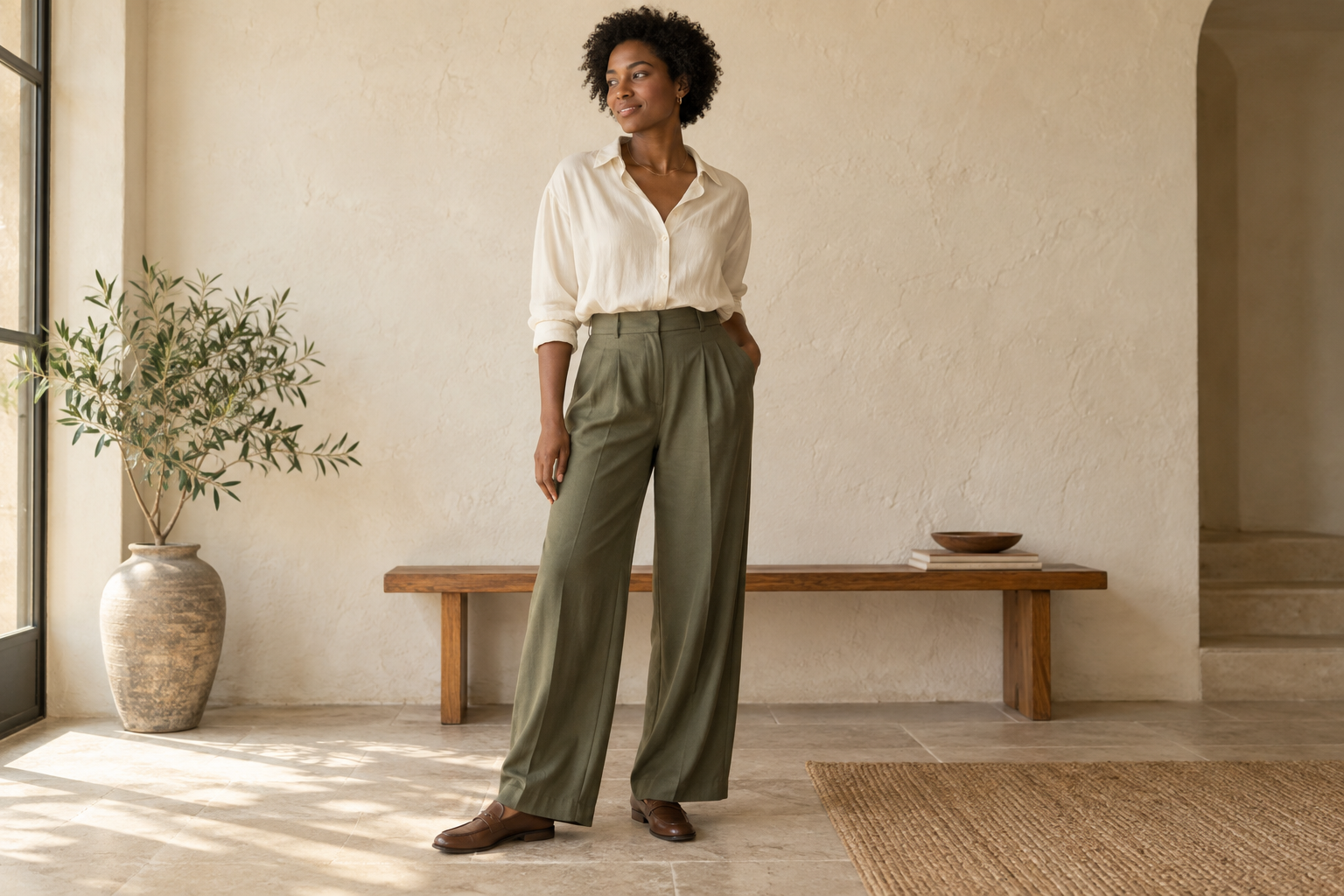
Begin hereAn illustrative finished look: a cream blouse with a smooth, even tuck into high-waisted trousers. This image shows an outcome, not step-by-step proof of the method.
How-to
Choose a blouse tuck by checking the top's length, the waistband and the shape you want. Start with a full or front tuck, smooth any uncomfortable bunching, then sit and reach to see whether it stays in place. Leaving the blouse untucked is also a valid option when the garment or your preference suits it better.
| Method | Best when | What it needs | Watch out for |
|---|---|---|---|
| Full tuck | You want a clean, sharp waistline and the blouse is long enough | A hem several centimetres below the waistband and a firm, fairly simple band | Bulk at the hips and a stiff, over-tight look if pulled too snug |
| Front or half tuck | The hem is short, the waistband is thick or detailed, or the fabric is fluid | Only the front section tucked; the loose sides help weigh the tuck down | An unkempt read if the tucked section is too deep or twists to one side |
| Untucked | The hem releases when you lift your arms, or the blouse is cut to be worn out | A hem length that flatters loose — usually around mid-hip — and a clean waistband | Nothing, if the length suits you; forcing a tuck here is the mistake |
Silk and satin are the same fabric, and slippery blouses can never hold a tuck.
Silk is a fibre and satin is a weave — you can own a polyester satin, a silk-charmeuse satin, or a matte silk that tucks quite happily. Fluid fabric does make a tuck harder to hold, but tucking higher and more evenly, or choosing a front tuck, usually solves it. The fibre name on the label does not decide the outcome.
A blouse tucked into a skirt or trousers with a smooth waistline, no billowing at the hips, and a silhouette that still looks intentional after sitting, reaching, and walking — or an honest decision that this particular blouse reads better untucked.
A firm, structured waistband with belt loops supports a full tuck. A thick knit waistband or one with heavy detailing suits a front tuck, which keeps the fabric away from the hardware. If the blouse hem sits only a few centimetres below the waistband, a full tuck will not hold; a front or half tuck is the realistic choice.
Check: Hold the blouse hem at the waistband and raise both arms overhead. If the hem pulls out on its own, you do not have enough length for a full tuck.
Tuck a fastened blouse, not an open one. Fastening first lets the placket lie flat and keeps the tuck symmetrical. That way the fabric does not twist or shift to one side as you work it under the waistband.
Check: Look at the placket in the mirror. It should run straight from collar to waistband with no drift to either side.
For a full tuck, work the hem under the waistband a section at a time, distributing the fabric evenly rather than bunching it at the back. Then press the blouse flat over the hip area with your palms so excess fabric sits smoothly instead of poufing at the sides.
Check: Turn sideways to the mirror. The line from waist to hip should follow your body; any pouf means fabric needs redistributing, not more tucking.
A tuck pulled skin-tight looks stiff and can pull the waistband out of position. Once tucked, lift the blouse a centimetre or two away from the body at the waist and let it settle, so a small amount of air and drape remains. This matters most in fluid fabrics.
Check: You should be able to pinch a small fold of fabric at the front without the tuck releasing. If you cannot, loosen it.
Crisp cotton and oxford cloth tend to hold a full tuck on their own, while silk, satin-weave and viscose blouses slip more and often need tucking higher and more firmly at the back. These are tendencies, not rules — a matte silk can behave like cotton, and a soft cotton poplin can escape. Very fluid fabrics may simply refuse a full tuck; that is the fabric, not your technique.
Check: Bend forward and back up. A stable tuck should return to place; a slippery one that half-escapes needs the front-tuck treatment instead.
If you wear a belt, thread it after tucking and position it so it presses the tuck flat rather than sitting on top of a ridge of fabric. Then sit down, stand up, reach overhead, and twist to each side. Re-smooth anything that shifted, and note whether the tuck fundamentally holds.
Check: After the full movement test, the mirror should show roughly the same line you started with. Repeated full escape at any point means this blouse and this tuck are not a match.
If the hem releases every time you lift your arms, no tucking technique will fix it — there is not enough fabric to work with. Tuck it only for short, low-movement occasions, use a front tuck that is meant to sit loosely, or wear the blouse untucked with trousers that have a clean waistband. Accepting the untucked option is a valid answer.
Bulk usually means too much fabric gathered in one place, or a blouse that is simply too big for a tuck. Redistribute the excess evenly around the waistband and smooth over the hips before belting. If the blouse still forms a ridge, it is cut too generously through the body — a side or front tuck hides bulk better than forcing a full tuck.
Slippery fabrics and soft waistbands are the usual culprits. Tuck into the firmest waistband you own, tuck higher and more evenly, or switch to a front tuck where the loose side's weight helps anchor the tucked section. If it still escapes within an hour of normal movement, the honest fix is to stop fighting it and style that blouse untucked.
Shirts & Tops
How blouses and button-down shirts differ in fabric, neckline, and layering, with clear criteria and scenarios for choosing between them.
Shirts & Tops
A step-by-step fit check for a button-down blouse: shoulders, bust, waist, sleeves, length, and movement, with simple ways to verify each.
Shirts & Tops
Casual Oxford shirt outfits you can recreate: three complete looks with the hem, tuck and shoe decisions explained, plus open-layer versus buttoned wear and season variations.