
Shirts & Tops
How a Short-Sleeve Shirt Should Fit
A step-by-step fit guide for short-sleeve shirts: intended cut, sleeve opening, shoulder, chest room, hem coverage, camp collars, and the sit test.
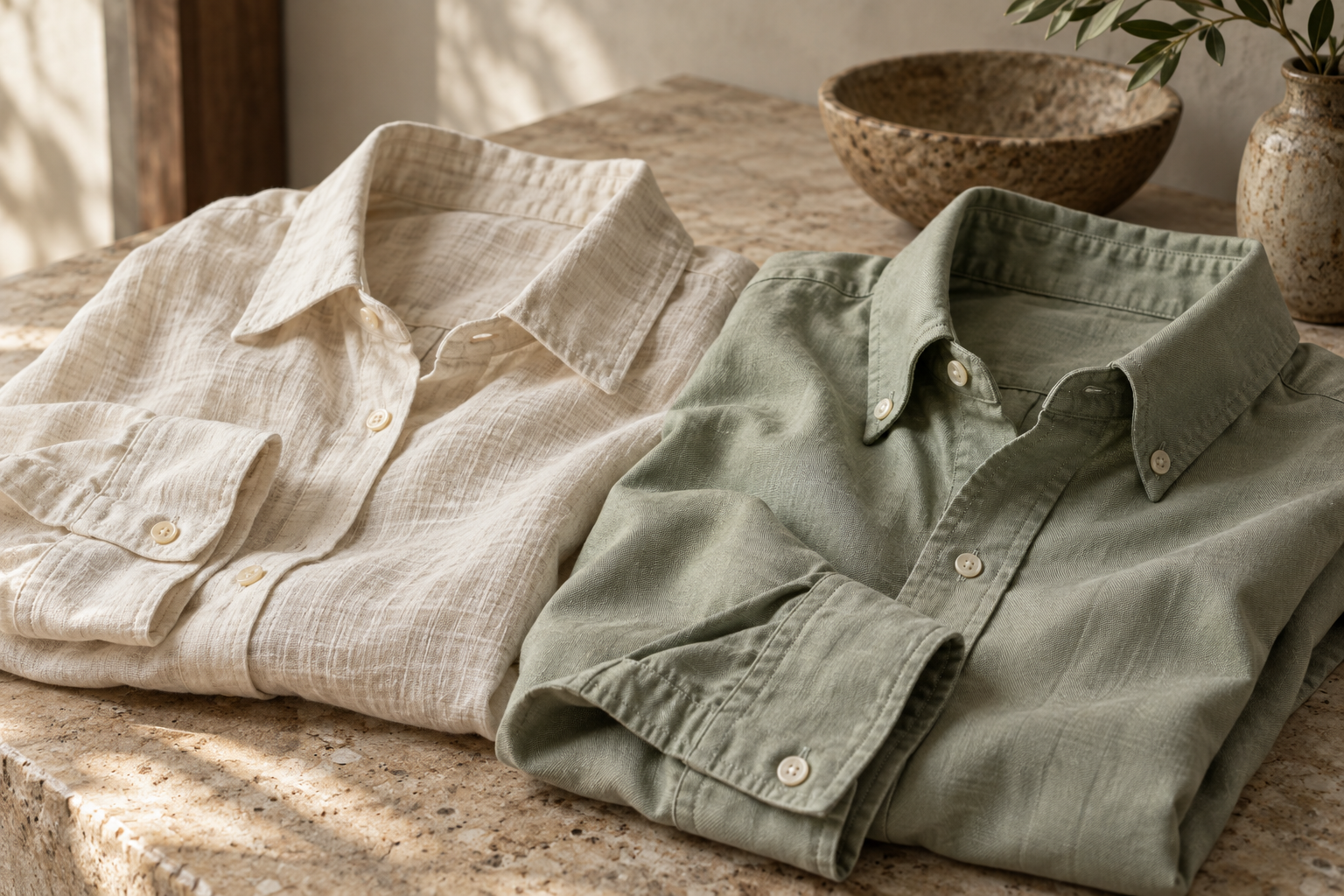
Fit guide
An untucked shirt lives or dies on hem length and body room. These checks take a mirror and a chair, not a tailor.
Begin hereHow-to
An untucked shirt should give you the coverage and movement you want without pulling at the buttons or needing constant adjustment. Check it with the trousers you plan to wear, both standing and seated. Hem shape and intended cut matter, so use waistband coverage and comfortable movement rather than one length rule for every shirt.
There is one universal rule: the hem must hit mid-fly, and the side pinch must be exactly two to three inches.
Maker cuts vary widely — curved hems, dropped shoulders and boxy cuts are often deliberate. Waistband coverage and comfortable movement are the checks that work on every body and every shirt.
An untucked shirt that covers your waistband standing, seated and with your arms up, skims the body without billowing or pulling, and still looks deliberate after an hour of normal movement.
Before any measuring, work out what the shirt was designed to do. Shirt tails with a deep curved hem are cut to anchor inside a waistband; straight or gently curved hems are usually meant for untucked wear; and some modern shirts are deliberately long or boxy with dropped shoulders as a style choice.
Check: Look at the hem shape and any maker description. A curved tail points you to tucking; a straight hem or an explicitly boxy cut tells you which set of markers below applies.
Stand straight and look at where the hem sits relative to your waistband. On a classic-cut shirt, the front hem should cover the waistband without falling several inches below it; deliberately long cuts can sit lower, but they should still look like a top layer, not a dress.
Check: Raise both arms overhead. If the hem rides up above the waistband and exposes skin or belt at the sides or front, the shirt is too short to wear untucked with those trousers.
An untucked shirt should skim the body. Too much cloth and it billows at the waist; too little and it pulls when you move. How much room is right depends on your build and the cut, so judge by visible strain and pull lines rather than a fixed pinch measurement.
Check: Facing the mirror, buttoned: no button gapes across the chest or stomach, and you can cross your arms or reach forward without the back restricting you or the placket dragging sideways.
On a classic-cut shirt, the shoulder seam sits at the edge of the shoulder bone and the cuff ends at the wrist bone. Dropped-shoulder and boxy designs intentionally push the seam down the arm, so apply the conventional markers only to shirts cut along traditional lines.
Check: For a classic cut, feel for the bony point of your shoulder and confirm the seam sits on or within a finger's width of it; the cuff should meet the wrist bone with your arms relaxed. For a dropped-shoulder design, just confirm the drop matches the maker's intent and the cuff still ends at the wrist.
Sitting is where untucked shirts fail: hems ride up, plackets gap and cloth bunches at the waist. Sit in a chair in your normal posture for a full minute before judging.
Check: After sitting, the hem still covers the waistband at the sides, no button strains across the stomach, and the shirt settles back smoothly when you stand.
If the shirt fails, the fix depends on the failure. A hem that reads like a nightshirt points to a tuck, not a tailor; a body that billows may need a different size or a slimmer cut; sleeves past the wrist bone need a different size, since shortening sleeves is one of the more involved alterations.
Check: Match each failure to its remedy below and decide: wear it tucked, swap the size or cut, or leave the shirt for outfits where its cut is the right one.
A hem well below mid-fly usually means the shirt was cut to be tucked, with a long curved tail. Tuck it into trousers with a clean belt, or look for a shirt described as suitable for untucked wear. A tailor can shorten a hem, but re-shaping a curved tail is a bigger job than most shirts justify — ask for a quote before committing.
Extra cloth pooling around the waistband is the classic sign of a boxy body on a shirt that was not meant to be boxy. Check the shoulders before sizing down: if a smaller size pulls at the seam, a slim-cut shirt in your normal size is usually the better answer than sizing down a regular cut. If the boxiness is the design, it is a styling choice, not a fitting failure.
Pull lines, button gape or back restriction when you reach mean the body is too small, whatever the tag says. Sizing up fixes the pull but may widen the rest of the shirt; if the shoulders then droop past the bone, the cut simply does not suit your build and a different cut is the honest fix.
Sleeves past the wrist bone make the whole shirt look oversized. A single cuff turn is a fair stopgap on casual cotton shirts, but if two turns are needed the sleeve is genuinely too long. Shortening sleeves with a placket is a real alteration, so weigh the tailor's quote against replacing the shirt.
Shirts & Tops
A step-by-step fit guide for short-sleeve shirts: intended cut, sleeve opening, shoulder, chest room, hem coverage, camp collars, and the sit test.
Shirts & Tops
How polos and button-down shirts differ in fabric, collar behavior, and formality, plus fit checks specific to each so either one sits right on you.
Shirts & Tops
How to test a white shirt for opacity before and after buying: weave density, fabric weight, weave types, underlayers, fit, and the daylight window test.