Linen vs cotton shirts ↗
How linen and cotton differ in heat, creasing and formality, and which one suits your setting and season.
Clothing guide
Choose a smart casual shirt or top by checking the setting, the fabric and how it fits when you move — then follow the link to the specific guide.
Explore the collectionFIND YOUR STARTING POINT
Smart casual shirts and tops are chosen with three checks, not a rulebook: the setting you are dressing for, how the fabric behaves, and how the top fits when you move. Look for pulling at the buttons, unwanted sheerness, and a hem that works with your trousers or skirt. A collar is one option among several, not the only way to make a top suitable for the occasion.
Start with the setting, because it decides how much structure the top needs. Then run three checks: no pulling at the buttons, no unwanted sheerness in daylight, and a hem that works with your trousers or skirt. A collar is one option, not the only way to make a top suitable for the occasion.
Four families cover almost every smart casual top: the button-up shirt, the blouse, the polo and the knit. Each does a slightly different job, and the right starting point depends more on the day's setting than on any style rule. The comparison below is deliberately practical — what each is good at, and what to watch for.
| Top family | Reaches for it when | Watch for |
|---|---|---|
| Button-up shirt | You want the most structured option; it layers under knits and jackets cleanly. | Pulling across the chest or at the buttons, and a hem that will not sit straight either tucked or untucked. |
| Blouse | You want a softer line than a shirt but the same level of polish, with no collar needed. | Sheer or slippery fabrics: run the opacity check and check seams sit flat on the shoulder. |
| Polo | Warm weather or relaxed settings where a full shirt feels like too much. | Thin, stretchy knits that lose shape; a collar that curls after washing. |
| Fine knit or sweater | Cooler days, or when you want a quieter outfit that still reads considered. | Fabric too thick or too slouchy to layer, and necklines that stretch out. |
A smart casual top must have a collar.
A collar is one way to add structure, not a requirement. A fine knit over a plain tee, a knit polo or a well-cut blouse all read smart casual; what matters is that the fabric holds a deliberate shape and the fit passes the movement checks below.
If you are torn between a polo and a button-down for a specific setting, the decision usually comes down to how structured the rest of the outfit is and how warm the day is. The polo vs button-down comparison walks through that choice in detail.
Two properties describe a shirt fabric: the fibre it is made from and the way it is woven. The fibre — cotton, linen, polyester or a blend — tells you part of the story, such as how it handles moisture. The weave, such as oxford or poplin, decides much of the rest: how crisp the cloth feels, how quickly it creases and how much light it blocks.
This is why a label that only says "100% cotton" cannot predict comfort. A cotton oxford and a cotton poplin behave differently enough that most people notice immediately — one is textured and forgiving, the other smooth and dressier. Check both the fibre and the weave name before you judge a shirt on a hanger.
The linen vs cotton decision changes most with weather and how sharp the room is: linen wins on hot, relaxed days, cotton on cooler or smarter ones. For the weave choice, the oxford vs poplin comparison covers crispness, creasing and care in detail.
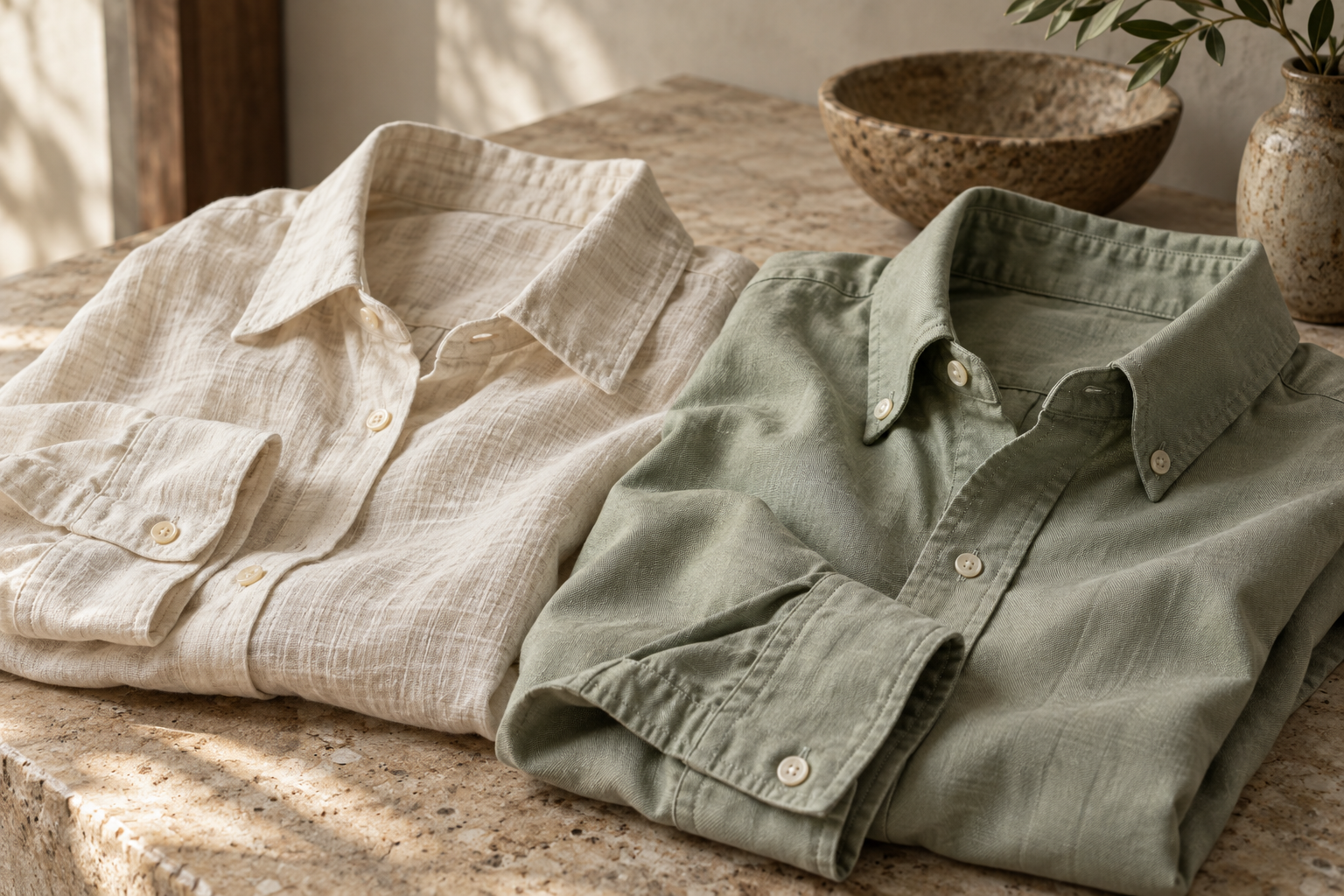
A note on the picture on this page: it shows folded ivory and sage shirts arranged on a limestone surface. It is an illustrative generated image — it cannot demonstrate weave, opacity or fit, which is why the checks below are written as things to do with the actual garment in your hands.
Sheerness is the most common reason a pale or finely woven top fails a smart casual setting, and shop lighting hides it. The reliable check takes two minutes and uses daylight, because daylight shows what office and restaurant lighting will soften but not erase.
The worn daylight inspection:
White shirts deserve this check more than any other colour, and the fabric choice matters as much as the colour. The guide to choosing a white shirt that is not see-through compares weaves and weights specifically for that problem.
A top that looks right standing still can fail the moment you reach for a coat or sit at a table. The movement check finds fit problems that a mirror pose misses. Run it on your body, buttoned up, before you commit to a size or a hem decision.
Three checks that take under a minute:
Then decide the hem question: tucked or untucked. A shirt with a short, even hem and a straight body usually reads intentional untucked; a long shirt-tail hem is made to be tucked and often looks unfinished hanging out. Where the line sits matters too — an untucked hem that ends mid-fly reads neater than one at the crotch.
The untucked shirt fit guide gives the hem and length specifics for shirts, and the button-down blouse fit guide covers the same ground for blouses, where drape replaces the placket as the thing to check.
Under a jacket or sweater, a shirt gains three new failure points. The collar should sit flat inside the jacket's collar without bunching at the neck. The body should be slim enough that no fabric pools at the sides when the jacket closes. The tail should be long enough to stay tucked when you sit and reach.
Test the full stack: put the jacket on, button it, then sit and reach as before. If any layer fights another, the thinnest fix usually wins — a finer knit, or a shirt with less body. The jackets hub covers collar, weight and fit choices for the layer itself.
Fabric, opacity, fit, layer. If a top passes all four checks for your setting, it is a smart casual top — whatever the label calls it.
This page gives the checks; the guides below apply them to the decisions people actually face. Start with the one that matches the question in front of you rather than reading all six in order.
How linen and cotton differ in heat, creasing and formality, and which one suits your setting and season.
The weave differences that decide crispness, creasing and how formal a cotton shirt reads.
How to choose a white shirt that is not see-through, with the daylight worn test and the weaves that pass it.
When a knit polo does the job of a shirt, and when a button-down is the better call — with fit checks for both.
How long an untucked shirt should be, and the hem and body shapes that read intentional rather than unfinished.
How a button-down blouse should fit through the shoulder, bust and hem, and the drape checks to run in the mirror.
How collar choice, fabric weight and fit decide whether a shirt sits cleanly under a jacket or bunches at the neck and waist.
OUR APPROACH
Good style starts with understanding what works for you.
A LITTLE FURTHER READING
Trends in Practice
Where linen shirts beat cotton and where they don't: breathability, wrinkles, formality, weight, seasons and care, with scenarios for choosing between them.