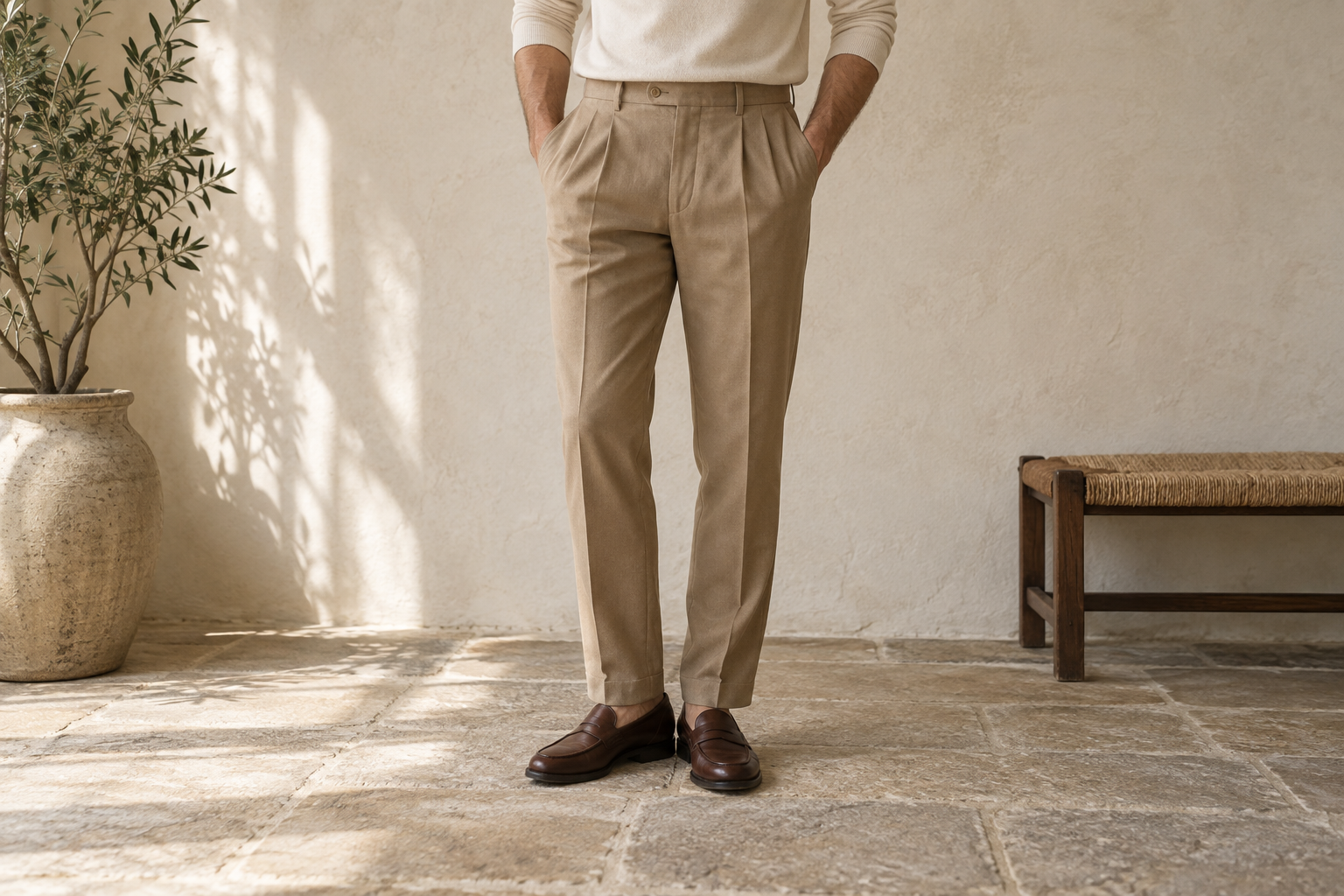
A gap at the waistband is a clue, not a verdict. Work out where the fabric is standing away from your body and why, then match the fix to the actual cause.
Diagnosing and fixing a trouser waistband that gaps
A trouser waistband can gape because the cut, the size or the fabric does not match how you wear it. First notice whether the gap stays at the back, appears with movement, or grows during the day. Check the hips and seat before sizing down: reducing the waist size can make an already tight lower section less comfortable.
Name the symptom before choosing a fix
Four patterns cover most waistband complaints, and they are read differently. A true gap stands away from your body at the back; pocket flare opens at the pocket mouth; rolling is the waistband folding over; and end-of-day looseness is fabric that has stretched and stayed stretched. Sorting your symptom into one of these is the whole first move, because a fix aimed at the wrong pattern cannot work.
Four symptoms, four different starting points
Symptom
What you observe
First thing to check
Back gap
Waistband fits the front but stands away behind, enough to catch a hand
Waist-to-hip proportion against the cut, and whether it closes seated or worsens
Pocket flare
Pocket openings gape and the front buckles when you sit or reach in
Whether the flare is the pocket's construction or fabric standing off the hip
Waistband rolling
The waistband folds over during wear instead of standing upright
Where the trousers sit relative to where you bend, and the waistband's structure
Gaps by afternoon
Snug in the morning, loose by evening, recovers after washing
The fabric's recovery — whether it springs back after a gentle stretch
Myth
Pocket flare proves the trousers are too big — if the pockets gape, you should size down.
Fact
Pocket mouths can gape because of pocket bag shape, pocket placement or a stiff facing, even when the circumference is right. Treat flare as one clue to check, not proof of excess fabric.
What a tailor can realistically do, and what to confirm about seam allowance before committing.
Open the symptom that matches. Start there.
Gap at the back waist
Possible cause: The waistband follows the front of your body but stands away behind, often deep enough to catch a hand or fold into a smile-shaped opening when you sit. The usual driver is a mismatch between the waistband's cut and your hip-to-waist shape: a straighter back draft can gap on a curvier back, and a curvier draft can gap on a straighter back too. Being worn lower than the position it was cut for produces the same symptom on the right size.
Try first: Confirm the symptom first: stand, sit and walk, and note whether the gap stays constant. A belt closes a shallow, even gap. A lasting fix usually means reshaping at the centre back seam — but how much can be taken in depends on the seam allowance in that particular garment, so have it checked before you count on the result.
Gaping at the side pockets
Possible cause: The waistband stands away near each pocket opening, the pocket bags gape, and the front buckles when you sit or reach in. Pocket construction is a common contributor: stiff facings, wide pocket bags or low-set openings gape on their own, even when the circumference is correct. Excess fullness over the high hip or a straight waistband on a curvier body can add to it, which is why the circumference check and the pocket check are done separately.
Try first: Test which contributor you have: hold the pocket mouths closed with a hand and see whether the rest of the waistband sits correctly — if it does, the pockets, not the size, are the issue. A belt often makes true hip fullness worse by gathering rather than removing fabric. Side-seam or pocket adjustment by a tailor is the usual route, scoped to what the seams allow.
Waistband rolls or folds over
Possible cause: The waistband is collapsing rather than gaping — folding over at the point where your body bends. This is usually about support and position rather than circumference: a soft, unstructured waistband folds easily, and a waistband worn at or below where you bend has nothing to rest on. Diagnose it by wearing the trousers higher for a day and seeing whether the rolling follows the height or the fabric.
Try first: First try wearing the trousers higher, where the waistband has a shelf to rest on. If rolling persists, a firmer or partially structured waistband — or a tailor adding internal grip or interfacing — can help on some garments. On casual cuts, some folding is part of the design, and no fix should promise otherwise.
Fits in the morning, gaps by afternoon
Possible cause: The trousers hold their shape early and lose it through wear. The waistband stretches with movement and body heat, and fabrics with poor recovery — some loose-weave and relaxed cottons among them — stay extended once stretched. The late-afternoon gap is recovery failure, not a morning measurement error, so re-measuring your waist will not find it.
Try first: Reduce how far the fabric must stretch: a waistband that sits snugly where you wear it, or a construction with some give built in, changes the daily picture. Care-label washing can restore some fibres temporarily, but fabric that consistently relaxes during wear will usually keep doing so. Plan around the behaviour rather than expecting a permanent cure.
Different causes need different fixes.
Most waistband gaping traces back to a mismatch between the trouser's cut and your proportions rather than a single wrong measurement. Waistband sizing assumes a relationship between waist and hips — a straighter draft suits a straighter hip-to-waist line, a curvier draft suits a more pronounced one, and bodies rarely match either exactly. Position and fabric matter too: a waistband worn below the point it was cut for can gape even when the size is right, and relaxed weaves expand with wear and stay expanded. Which of these dominates your pair decides which fix below will work — usually the cut and the wearing position, not the number on the label.
Make one small change.
Before buying anything new, try a belt — properly, not as a cinch. Choose one wide enough to fill the waistband's channel, snug enough that the waistband follows you when you sit, and positioned so the trousers sit at the height they were cut for. A belt closes a small, even gap honestly, but its limit is that it compresses fabric rather than removing it. If the excess is concentrated at the back — deep enough to fold over the belt line when you sit — the belt gathers the seat into folds, and the options below are the real candidates.
Work on the part that needs it.
Alteration at the center back seam
Many trousers carry spare seam allowance at the centre back specifically so the waist and seat can be reshaped later. A tailor opens the waistband and back seam, takes in a curve that follows your shape, and re-closes both. How much can come out — and whether a dart-like curve is added for a flat seat — depends on the allowance and construction in your particular pair, so ask them to assess it before you expect a number.
Choosing a size when waist and hips disagree
When a pair fits the hips but gaps at the waist, prefer the size that fits the larger measurement and have the waist taken in — taking in is a routine job, while letting out depends on fabric that may not exist. Buying small to clear a large waist is not a version of this: a waistband that is too tight cannot be let out on promise, and the pressure it causes sits with you all day. If a pair is between sizes at the waist, prefer the smaller excess rather than a deficit.
Waistbands with built-in give — check before relying on one
Some trousers include an elastic panel or shirring at the back waist, common in smarter casual and travel cuts. It can absorb day-to-day fluctuation, but it is not a guaranteed cure: a thin shirred channel often loses snap faster than a wide, anchored panel, and tired elastic recovers nothing. Read the construction, stretch it in the shop, and treat the feature as a comfort aid rather than a fit solution.
When to stop adjusting.
If the gap persists after a belt and a competent alteration — or the trousers cannot be altered because the back seam allowance is too narrow, the waistband is fully shirred, or the fabric has no recovery left — the problem is the cut, not the size. A waistband can only be reshaped so far before the balance of the whole trouser is disturbed: seat, crotch and leg all relate to the waist. When a pair needs a large reduction at the waist, or gaps again within weeks of alteration, stop spending on fixes and replace it with a cut drafted for your waist-to-hip proportion. Repeated alteration of the same fault is the clearest sign the pattern and your body are a mismatch.
Measure where a rise actually sits, compare high, mid and low rise on the body, and test sitting comfort before deciding what belongs in a smart casual wardrobe.
A step-by-step way to choose warm-weather trouser fabric — linen, cotton, tencel, wool blends, and synthetics — using two checks you can do in the shop.