Trousers & Pants
How to Choose Trouser Rise
Measure where a rise actually sits, compare high, mid and low rise on the body, and test sitting comfort before deciding what belongs in a smart casual wardrobe.
Warm-weather fabrics
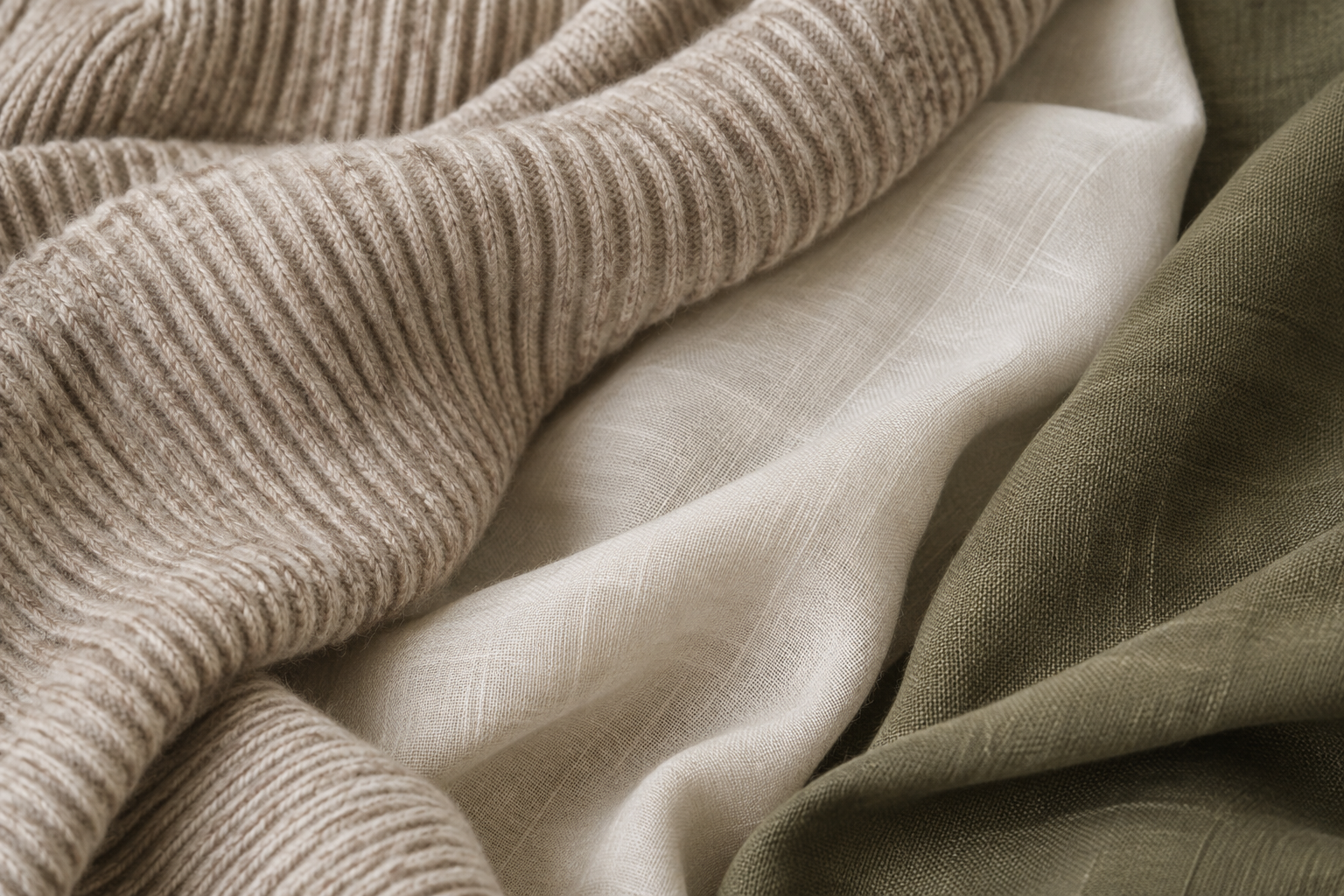
Heat changes what a trouser fabric has to do: breathe, drape, and recover. Compare the whole fabric and construction rather than choosing by fibre name alone, then verify any candidate with checks you can do in the shop.
Begin hereHow-to
For warm-weather trousers, compare the whole fabric and construction rather than choosing by fibre name alone. Weight, weave, lining and fit all affect how a pair feels. Start with a light pair that gives you room to move, then check opacity and the care requirements — a linen label by itself does not guarantee a cooler garment.
The fibre is what the yarn is made of — linen, cotton, lyocell, wool or polyester. The weave is how those yarns are interlaced: an open, porous weave moves air far more readily than a dense, closed one of the same fibre. The weight is how much cloth there is per unit of area, which you feel as heft when you lift the trouser over your arm.
Because the three vary independently, fibre names are a starting point rather than an answer. A featherweight, tightly woven cotton can feel hotter than a loosely woven heavier linen, and a polyester-rich lining can undo an airy outer cloth. Judge the assembled garment, then use the label to explain what your hands and eyes found.
No family ranks automatically above another for heat; each earns its place under specific conditions. Use the table to shortlist against your own day, then verify the individual pair in hand.
| Family | Choose it when | Accept the trade |
|---|---|---|
| Linen | Relaxed and holiday settings where creases read as texture, and airflow matters more than a pressed line | Creases the moment you bend a knee; the wrinkle is behavior, not a defect |
| Cotton (poplin or twill) | You need a composed silhouette and a pressed line that survives a workday | Holds sweat longer than linen; lighter cottons still crease, just less dramatically |
| Lyocell blends (TENCEL™ is a brand of lyocell) | You want fluid drape and a soft, cool hand, usually blended with cotton or linen for structure | Lyocell-dominant cloth can relax at knees and seat and cling rather than fall |
| Lightweight wool, tropical-style weaves | Long days where a sharp line must survive — traditional hot-climate tailoring relied on it | Higher price, and many such trousers want dry cleaning or gentle handling |
| Synthetic blends | Travel and easy care, with a small elastane share for stretch | A high polyester share can feel clammy in still air and may pill where thighs rub |
Natural fibres are always cooler, and synthetics always run hot.
Weave and weight often matter more than fibre name. An open-weave cotton can outperform a dense linen blend, and a small synthetic share adds durability or stretch without dominating how the cloth feels. The dominant fibre and the construction together decide.
Two pairs in the same cloth can feel completely different once lining and cut enter. A full synthetic lining traps a layer against your skin however breathable the outer fabric is, and a close cut removes the air gap that lets a loose trouser ventilate. Compare the two settings below before deciding what to prioritise.
Office day, mostly sitting
Humid walk, mostly moving
If you can see light through the fabric, it is breathable.
The hold-to-light check measures weave density and opacity, not airflow or cooling on your body. Use it to screen out dense, closed weaves — then treat any conclusion about comfort as a hypothesis to confirm by actually wearing the trousers.
Before buying, score the candidate pair honestly against the four costs below. Comparing against a pair you already own and wear makes the trade concrete rather than theoretical.
Rate each trade as acceptable or unacceptable for where you will actually wear them:
Where this decision goes next
Once you have chosen the cloth, this covers the styling decisions — what sits above linen and which footwear holds the look together.
If the warm-weather outfit needs a jacket too, apply the same weight-and-weave logic to the layer that goes on top.
The parent guide to every trousers decision on this site.
You will be able to compare actual fabric weight, weave, opacity and care needs in the shop or online — knowing what linen, cotton, lyocell (including TENCEL™ branded fibre), tropical-weight wool blends and synthetic blends each do conditionally, and verifying any candidate with an opacity and hand-feel check instead of relying on the fibre name alone.
Linen is the classic warm-weather fibre: it is crisp and cool to the touch, absorbs moisture comfortably, and gets softer with every wash. It is equally classic for creasing the moment you bend a knee, and its wrinkles are best treated as texture rather than a defect. Choose linen for relaxed and holiday settings where the crease reads as character; think twice for long office days if a pressed line matters to you.
Check: Bend a corner of the fabric sharply between your fingers: a deep, immediate crease is linen — or a heavy linen blend — behaving normally.
Cotton holds a pressed line and a cleaner silhouette than linen, which makes it the choice when the trousers need to look composed. Poplin — smooth and plain-woven — reads dressier and is often cut into lighter summer tailoring; twill — with its subtle diagonal ridges — is slightly heavier and hardier, closer to a chino. The trade is moisture: cotton holds sweat longer against the body than linen, and lighter cottons crease too, just less dramatically.
Check: Look at the weave in even light: poplin shows a fine, flat, almost porcelain surface, while twill shows faint parallel diagonal lines running across the cloth.
Tencel is a brand name for lyocell, a wood-pulp-based fibre prized for fluid drape and a smooth, cool hand — it makes trousers that move elegantly and feel soft against the skin. Its weaknesses are recovery and structure: lyocell-dominant fabrics can relax at stress points like the knee and seat, and the fluid drape can cling rather than fall. It works best blended with cotton or linen, where it softens the other fibres' stiffness without dominating the cloth.
Check: Hold a corner of the fabric up and let it fall: a liquid, curtain-like fall with a cool, faintly slippery hand suggests lyocell is doing the draping; check the label for the blend proportions.
It sounds backward, but lightweight wool — often in open, tropical-style weaves or blended for durability — is a strong warm-weather choice, and it is what much traditional hot-climate tailoring used. Wool absorbs moisture vapor without feeling wet and resists wrinkling far better than linen or cotton, so it holds a pressed line through a full day. The open weave supports airflow; the cost is price and care, since many such trousers want dry cleaning or gentle handling.
Check: Feel for a soft, springy, slightly dry resilience rather than cotton's flat smoothness, and look for an open, porous weave — then confirm the fibre content on the label.
A little elastane adds comfort stretch, and modern blends can be durable and quick-drying, which earns synthetics a legitimate place — especially for travel. A high polyester share can feel clammy against the skin in still, humid air and may pill where thighs rub, which is why the share matters more than the category. Treat the percentage as information: small amounts of stretch fibre are useful, while synthetics as the dominant fibre are a deliberate choice best justified by the use case, not the price.
Check: Read the label percentages and locate elastane or polyester's role: up to a few percent elastane is comfort; a majority synthetic content means you are choosing easy care over maximum airflow.
Whatever the label says, the cloth itself tells you more. Hold the fabric toward a lamp or window to inspect the weave: an open, airy construction passes visible light between the threads, while a dense, closed weave blocks it. Treat this as a screen for weave density, not proof of cooling — airflow on your body is only confirmed by wearing them. Then handle the cloth: it should feel cool or neutral and fall from your hand rather than standing stiff or feeling slick.
Check: You can see faint light through the weave when it is lifted toward a lamp or window, and the fabric falls from your open hand without springing back or feeling plasticky — knowing this measures density, not guaranteed breathability.
The weave is probably denser than the fibre choice suggested — a tightly woven cotton or a polyester-heavy blend can insulate despite a natural-sounding label. Run the opacity check on your existing pair to compare, and next time prioritise open weaves, lighter weights and a lining-free leg. A lining swap or a looser cut can also rescue a pair you otherwise like.
Some creasing is the price of airy construction, and no care routine removes it entirely from pure linen. If it bothers you, move toward cotton poplin or a tropical-weight wool blend, which hold a line far better. Alternatively, embrace a looser cut where the crease reads as drape rather than disorder.
This is a recovery problem, common in lyocell-dominant fabrics and soft, low-twist weaves that relax under repeated bending. Look for a blend where cotton or linen carries the structure, or a small amount of elastane for snap-back. Hang the trousers between wears so the fibres can settle before you wear them again.
Trousers & Pants
Measure where a rise actually sits, compare high, mid and low rise on the body, and test sitting comfort before deciding what belongs in a smart casual wardrobe.
Trousers & Pants
Diagnose where and why a trouser waistband gaps — back, pockets, or by evening — and find the fix that matches, from belts to a simple alteration.
Trousers & Pants
Ponte is a fabric, leggings are a cut — the categories can overlap. How to inspect structure, opacity and waistband so you can pick the right pair for the setting.