Jackets & Blazers
How a Blazer Should Fit: Length, Sleeves and Closure
Check shoulder, jacket length, sleeve length, chest room and closure one at a time. What a blazer should do off the rack and what a tailor can fix.
Buying guide
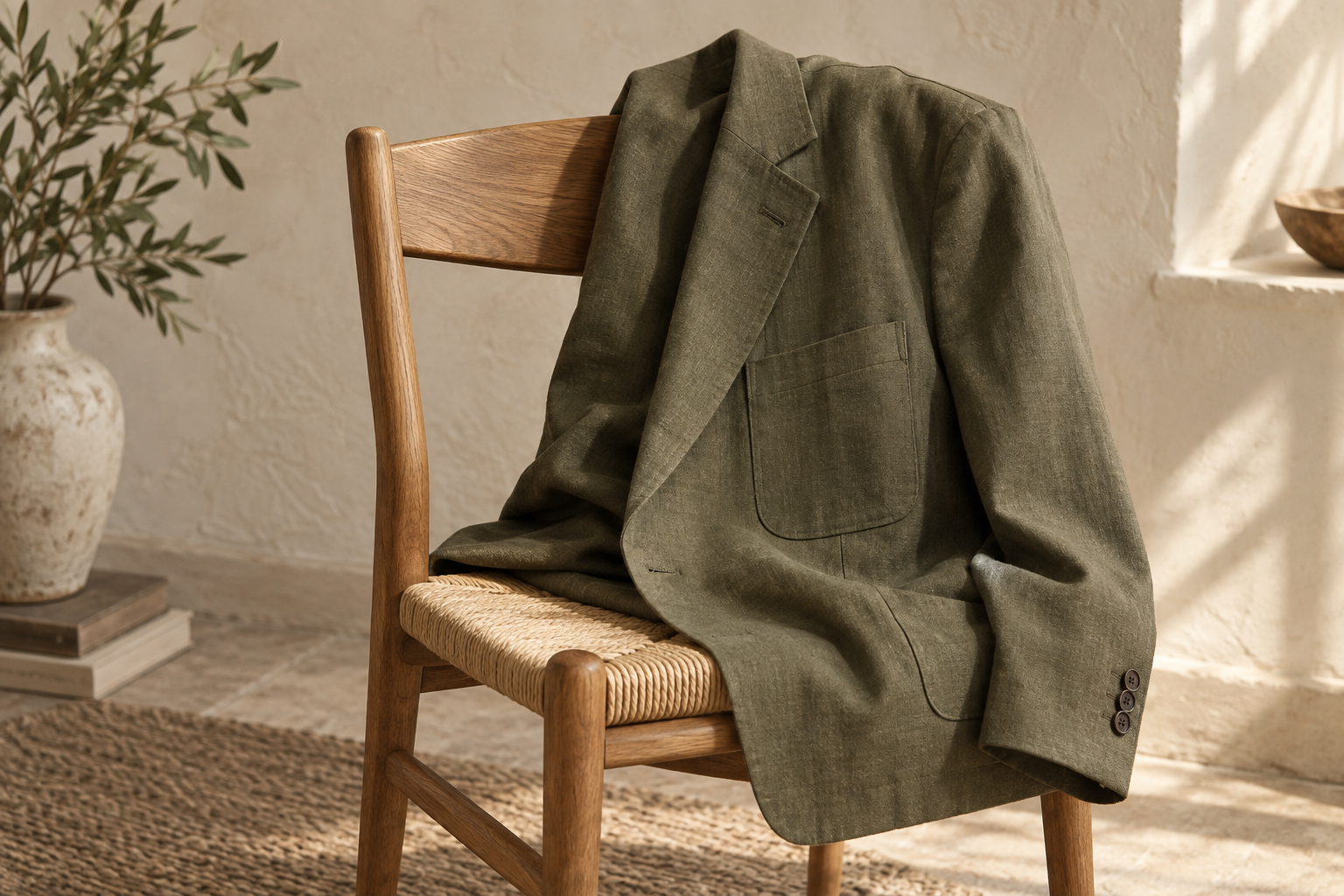
A summer blazer is chosen by comparing weight, weave, lining and fit together — not by trusting a fabric name. This guide works through the checks in order and finishes with a decision for the day you will wear it.
Begin hereHow-to
For a hot-weather blazer, compare the fabric, lining and fit together. A lighter, less restrictive jacket may be more comfortable, but no fabric name guarantees a cool result. Try it over the shirt you plan to wear and consider whether the venue allows you to remove it — humidity, activity and time outdoors change the decision.
Cloth weight is quoted in grams per square metre (GSM) or ounces per yard, and reputable mills publish it. A jacket described as "lightweight" without a number tells you nothing comparable, so ask the maker or the shop for the figure before you rely on it.
Where no figure exists, compare directly: drape two candidate jackets over your hand and feel which cloth weighs more, then fold each over a finger to feel how thickly it sits. Weight is one input, not a verdict — a mid-weight open weave can wear cooler than a thin but densely woven cloth.
Choosing the trousers for the same weather
The same weight-and-weave logic applied below the waist, so the suit reads as one decision.
No fibre guarantees a cool result; each offers a tradeoff you accept. Use the table to match the cloth to the wrinkle level, formality and maintenance you can live with.
| Cloth | What it does for you in heat | What you accept in return |
|---|---|---|
| Linen | Open, crisp weave; the classic hot-weather look, and it dries quickly | Creases at elbows and back within the hour — the rumple is part of the look; usually needs careful cleaning |
| Open-weave wool (fresco, hopsack) | Airy structure with more recovery than linen; wrinkles less sharply and reads tailored | Can read slightly dressier than linen; weave openness varies by mill, so verify on the bolt or the jacket |
| Wool–linen or wool–cotton blends | Split the difference: some of linen's airiness with more of wool's recovery | Blend proportions vary widely between makers — judge each cloth on its own hand and crease behaviour |
| Light cotton | Cool in the hand, washable in some makes, casual in character | Creases readily and reads least formal; heavier cottons can be denser than they feel |
Hold the cloth up to a light: if you can see a glow through it, air will flow through and the jacket will be cool.
Visible light through a stretched cloth shows the weave is open, not that a given jacket keeps you cool. Airflow against your body depends on weave, lining, fit, humidity and activity, and no shop-floor light test measures it. Use opacity checks for what they show — sheerness and weave openness — and treat cooling as something to verify by wearing the jacket in real conditions.
Structure holds a jacket's shape, and layers hold warmth against the body. A soft, unpadded shoulder, a thin or absent chest piece and a lightly lined body usually wear lighter than a fully built jacket — but every lining is different, so inspect rather than assume.
Unlined or part-lined body
Fully lined body
The squeeze check: pinch the shoulder seam between finger and thumb. You should feel cloth and little else — no firm pad, no thick wadding. Inside, look for how far the lining extends and whether the exposed seams are finished neatly enough to wear against a shirt.
If soft construction is the priority
The full method for soft-shouldered jackets — canvas, shoulder and packing behaviour — beyond the warm-weather question.
Summer cloth is unforgiving: a close fit that works in flannel can strain across the button in linen. Take half a step looser through the chest and upper arm so the jacket skims rather than moulds, then judge opacity in daylight, since shop lighting hides sheerness.
The same jacket succeeds or fails on the setting. An indoor event with air conditioning and a cloakroom is a different purchase from an outdoor ceremony in still humidity, so name the day before you name the jacket.
A warm-weather blazer whose fabric weight you have compared in real units, whose weave and lining you have inspected on the garment, and whose fit works over the shirt you will actually wear — chosen for a specific setting where you know whether you can take it off.
Ask the seller for the fabric weight in GSM or ounces per yard, and write it down. If no figure exists, drape two candidate jackets over one hand and compare them directly. Weight is an input, not a verdict — read it together with the weave.
Check: You can state a number with a unit, or you have physically compared the candidate against a second jacket of known weight.
Look for open weaves — fresco, hopsack, plain-woven linen — where the cloth shows an audible tooth and visible texture. Run the scrunch test: squeeze a fistful of sleeve and let go. Wool-blend cloth springs back with faint traces; pure linen stays heavily creased, and that rumpled look is part of linen rather than a defect.
Check: You know the weave name or have scrunch-tested the sleeve, and you accept the crease behaviour you saw.
Squeeze the shoulder seam — you want cloth and little else, no firm pad. Look inside: note how far the lining reaches, what the lining cloth is, and whether the exposed seams are finished neatly. Do not treat every lining as a sealed barrier or every unlined body as automatically cooler; judge the actual garment.
Check: You have seen the interior, identified the lining coverage and cloth, and the seams are finished enough to wear against a shirt.
Button the jacket over the shirt you plan to wear and sit down: no X-shaped pull at the fastening, and a flat hand slips inside the chest without dragging the jacket. Then check opacity in daylight near a door or window, since shop lighting hides sheerness in pale, open cloths.
Check: Seated, the front shows no pulling; standing in daylight, the cloth's sheerness is one you are comfortable with.
Name the venue, the rough conditions and whether you can remove the jacket once there. Humidity, activity and time outdoors change the decision more than any label. Buy the jacket that works when you can hang it up — or one you are content to carry when you cannot.
Check: You can say, in one sentence, where you will wear it, whether it comes off, and why this jacket suits that day.
Pure linen and light cotton do this, and beyond a point no pressing between wears keeps up. Move to an open-weave wool or a wool–linen blend, which keeps much of the texture while recovering its shape overnight on a hanger.
Check what changed: a full lining in a basic synthetic, a closer fit than you tested, or a still, humid day. Compare the lining cloth and coverage before blaming the outer fabric — and reuse it as a data point for the next decision.
Lift the outfit with what sits beneath and below: a proper collared shirt, dark tailored trousers and leather rather than suede or canvas. A soft-shouldered jacket in a darker solid reads considerably sharper than the same cut in pale linen.
Treat the jacket's summer claims as unverified and decide accordingly. Either inspect it in person with the checks above, or buy from a maker who publishes cloth specifications.
Jackets & Blazers
Check shoulder, jacket length, sleeve length, chest room and closure one at a time. What a blazer should do off the rack and what a tailor can fix.
Jackets & Blazers
Matching trousers, fabric and construction are the useful tells. Compare blazers, sport coats and suit jackets — and learn which works with odd trousers.
Jackets & Blazers
A buying method for unstructured blazers: what the missing canvas means, fabric tradeoffs, shoulder and sleeve fit, length, closure, and wardrobe testing.