Midi skirt outfit combinations ↗
Six complete looks with proportion, shoe and swap guidance.
Clothing
Check the setting, how the garment moves and the shoes you want with it — then decide between a dress and a skirt-and-top combination.
Explore the collectionFIND YOUR STARTING POINT
Choose a smart casual dress or skirt by checking the setting, how it moves and the shoes you want to wear. Try sitting and walking before deciding on coverage or length. A midi skirt, shirt dress or another silhouette can work; the useful question is whether the complete outfit suits your plans and feels secure.
The one-piece dress is simple: nothing to coordinate, nothing to tuck, one decision made. A skirt-and-top combination trades some of that simplicity for flexibility — swap the top and the same skirt serves different settings.
| Route | Strengths | Trade-offs | Best when |
|---|---|---|---|
| Dress | One decision; a defined silhouette; easy to layer a jacket over. | Less adaptable if the day changes; fit must work at the waist and hip together. | The setting is known — a wedding, a dinner, a booked event. |
| Skirt and top | Pieces recombine across the week; easier to adjust fit at the waist; layers separate cleanly. | Two decisions to get right; the tuck or waist treatment needs to look deliberate. | Your plans vary, or you want one garment to do more jobs. |
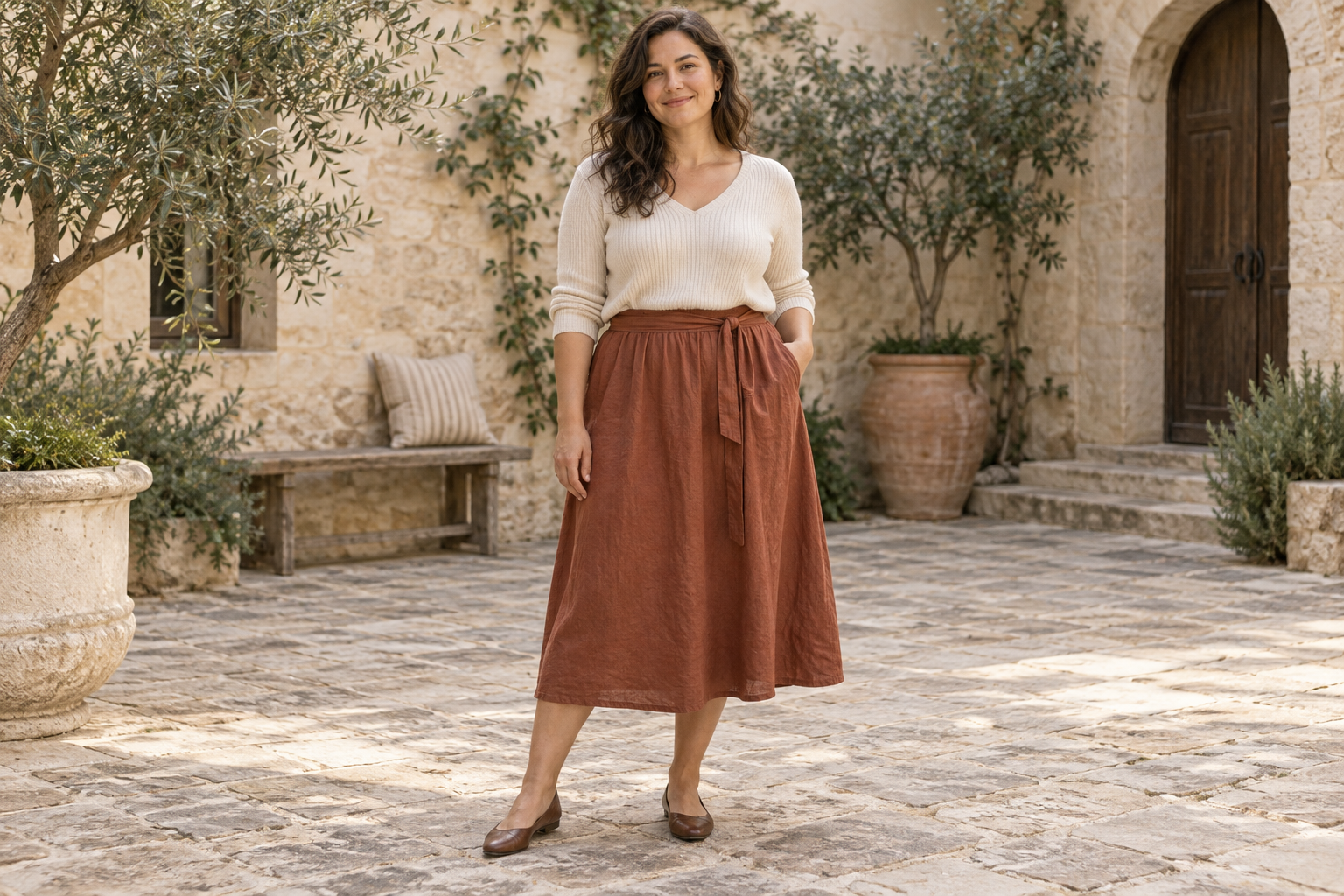
Neither route is more “smart casual” than the other. The midi skirt in the photo works because the top, waistband and shoes were decided together — the same reasoning applies to a shirt dress or any other silhouette.
This is the check that separates a garment you will wear from one that stays on the hanger. Coverage here is a practical question, not a moral one: what matters is whether you can move through your actual day without thinking about your clothes.
Sit on a real chair, not just look in the mirror. Note where the hem lands and whether the waistband digs or rolls when you are seated.
Lift both arms as if reaching for a shelf. On wrap styles and shirt dresses this is where gaping shows at the fastening.
A stride that lifts the hem more than you expect, or a lining that rides up, will be a problem on every walk — better to know now.
Check zips, buttons and wrap ties with your own hands. A fastening you can operate quickly and confidently is part of the garment working.
A wrap dress or wrap skirt always needs something underneath, so it is never truly done.
Wrap closures vary enormously — some stay put through a whole day, others shift with every step. Sit, reach and walk in the specific garment; that tells you more than the wrap label does.
A defined waist — from a waistband, a belt or a wrap tie — gives the outfit a clear shape and anchors a tucked top. A looser shift or A-line line trades that definition for ease and airflow.
Defined waist
Loose line
Choose by preference and by fabric weight, not by a rule about body types. The same person can want a belted shirt dress for a wedding and a loose midi for a weekend market — both are smart casual when the rest of the outfit is considered.
Pair the hem with shoes you actually want to wear. Ballet flats, loafers, low boots and clean sneakers all sit comfortably under midi and knee-length hems; heels are one option among several, not the finishing qualification.
Rather than balancing fabric weights against each other by rule, start from the shoes and layer you will genuinely wear, then check the whole outfit in a mirror together. Comfort and deliberateness usually agree more often than styling folklore suggests. If heels are not for you, the guide to smart casual shoes without heels covers flat options in detail.
Most dress and skirt questions have already been worked through in detail on their own pages. Follow the problem you actually have.
Six complete looks with proportion, shoe and swap guidance.
Belted, relaxed and layered routes, with shoe pairings.
Diagnose the gap at the bust or waist and fix the cause, not the symptom.
Flat options that still read dressy with dresses and skirts.
The most common partner for skirts and sleeveless dresses. Fit, collar choice and tucking decide how formal the pairing looks.
A structured layer sharpens a soft dress or skirt — from unstructured blazers to cardigans, and when each is appropriate.
Footwear sets the tone for any dress or skirt outfit. How to match shoe style to hem length and fabric — flat options included.
The setting where dresses and skirts carry the most weight, with dress-code notes and complete outfit formulas.
OUR APPROACH
Good style starts with understanding what works for you.
A LITTLE FURTHER READING