Smart casual dinner outfits in depth ↗
The direct guide to smart casual for a dinner booking: outfit formulas, what to do when the venue states no code at all, and how to adjust for the room once you arrive.
Occasion hub
Evening dressing sits in a narrow band: polished enough for the restaurant, relaxed enough to enjoy yourself. Start from the venue and the booking, then build an outfit that survives the journey, the chair and the whole evening.
Explore the collectionFIND YOUR STARTING POINT
Figuring out what to wear for dinner and going out starts with two questions, not a rulebook: what kind of place are you going to, and what does the evening involve besides sitting at a table? A neighbourhood bistro, a dressy hotel dining room and a theatre supper all ask for slightly different versions of the same smart casual base. This page shows you how to judge the setting, builds two complete outfits you can copy or adjust, and lists the checks to run before you leave the house.
What to wear for dinner and going out depends mostly on the venue and the plan around the meal — not on a universal dress code. The reliable method is simple: check the booking for anything the venue has stated, picture the setting, pick a starting outfit, then test it sitting down. Adjust everything here to the actual place you are going, because a bistro and a hotel dining room reward slightly different choices.
Most restaurants do not publish a dress code, and most staff will not turn anyone away for neat, clean clothes. But some do state restrictions, and those are the only rules worth planning around. The confirmation email, the booking widget's small print and the venue's own website are the three places a restriction actually appears.
An expensive menu means a formal dress code.
Menus price food, not rules. If nothing is written down in the confirmation, the small print or the venue's own site, there is no stated dress code to plan around.
Three dinner settings cover most bookings, and each nudges the same base outfit in a different direction. Think of it as one formula — a neat top, tailored bottoms or a dress, and shoes with some structure — with a dial you turn up or down.
| Setting | Starting outfit | Turn it up (dressier) | Turn it down (more relaxed) |
|---|---|---|---|
| Casual restaurant or neighbourhood bistro | Dark jeans or chinos, fine-knit jumper or shirt, clean leather sneakers or loafers | Swap jeans for tailored trousers; add a blazer | Swap the shirt for a good-quality plain tee under the knit |
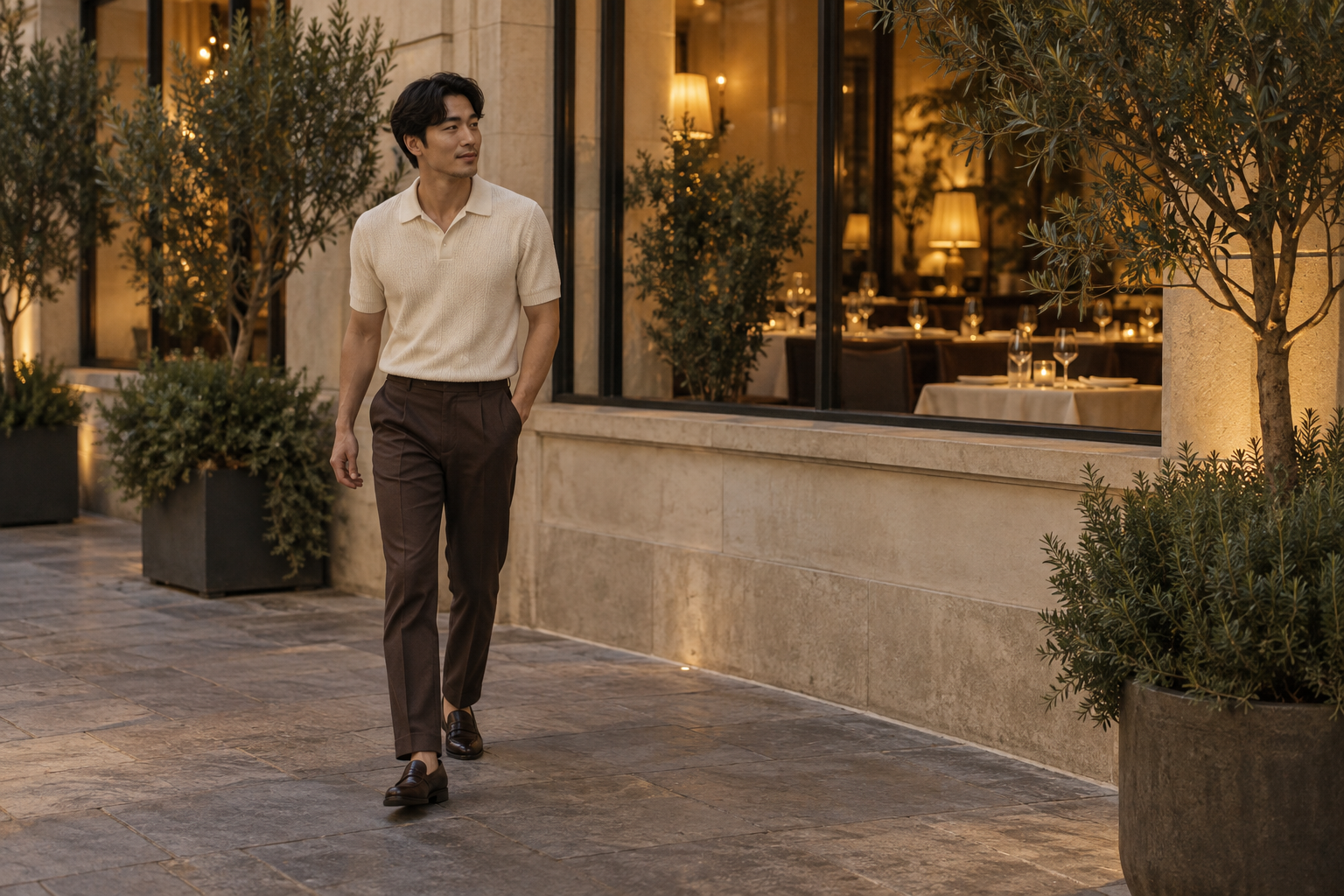
| Dressier dining room or hotel restaurant | Tailored trousers, button-up shirt or knit polo, loafers or heeled shoes, light layer | Add a blazer or structured dress; choose darker, smoother fabrics | Drop the blazer for a fine merino jumper; keep the trousers tailored |
| Theatre followed by supper | Midi dress or tailored trousers with a shirt, comfortable dress shoes, a coat or wrap you can check or carry | Choose a heavier fabric and a darker palette so it reads evening rather than office | Choose flats you can stand and walk in for long intervals; keep the top tailored |
Two things separate these settings in practice. Fabric first: a smooth, heavier knit reads dressier than a slouchy cotton one, even with the same silhouette. Structure second: collars, blazers and structured dresses signal effort in a way a soft tee cannot, which is why they belong at the dressier end.
Shoes follow the same logic. Loafers or heeled shoes lean dressy, clean leather sneakers lean relaxed, and both are acceptable at many casual restaurants but rarely stated as guaranteed anywhere.
A complete outfit means every slot is filled: top, bottom or dress, shoes, and a layer. Layers matter at dinner more than people expect, because restaurants run warm once you are seated and cold the moment you step outside. Here are two worked builds, one at each end of the dinner range.
Does the job of a shirt without feeling office-formal. If you don't own one, a plain button-up shirt with the top button open does the same work.
Cut cleanly enough to sit anywhere from a bistro to a smarter room. Dark, undistressed denim works on the same terms.
Closed, structured and clean-finished, so they pass at both ends of the casual-dinner range.
Handles the walk there and the draughty table by the door, and comes off easily once you are seated.
Keeps the outfit comfortable for a long seated meal. A knee-length dress replaces the whole top-and-bottom pairing if you prefer.
A clean line at a length you can sit in for hours. The skirt and knit pairing is the comfortable core of the dressier look.
Practical for standing at the bar and walking between places, still polished enough for a dressier room.
Supplies the structure a dressier room reads as effort. A structured cardigan in a dark colour borrows most of the same effect.
Substituting pieces you already own is easier if you match the role each item plays rather than the item itself. The top needs a collar or a fine knit — something with a deliberate shape rather than a stretched tee. The bottom needs a clean line: tailored trousers, dark denim without distressing, or a skirt at a length you can sit in comfortably.
Shoes need closed structure and a clean finish. The layer is the piece people skip most often, and it is the one that decides whether you enjoy the walk home, so include it even if the evening looks mild when you leave.
Dinner is one of the few occasions where you spend two or three hours mostly seated, often in a chair with arms and a table at waist height. An outfit that looks right standing up can fail that test. Run this check in front of a mirror — standing, then sitting.
Four checks, two minutes, before you walk out:
Two last checks happen at the door, not in the mirror. First, the walk: if the plan involves ten minutes on foot, a hilly route or standing at a bar before the table, wear shoes you have already walked in and choose a coat that works over the whole outfit.
Second, the weather. Leather soles and rain do not mix, a heavy knit becomes a liability on a warm evening, and an outer layer you would rather leave at home still has to come with you if the forecast says otherwise. Checking the weather the morning of the booking gives you time to swap the layer or the shoes instead of improvising at the restaurant.
Many dinner plans start at the end of a working day, and a full outfit change at the office is not always possible. Two specific swaps carry a daytime outfit most of the way to dinner.
A complete change is the better call when the daytime outfit depends on visible work-gear — a lanyard, heavily creased trousers, or shoes chosen purely for a commute. No swap fixes those, and trying to restyle around them usually looks like exactly what it is. If the evening is the dressier kind of dinner, changing the trousers or dress as well as the shoes takes about the same effort as two disappointing swaps and lands far better.
If you remember one thing: re-read your booking confirmation for anything the venue has stated about dress, then look outside. The confirmation tells you the only enforced rules; the weather decides whether your layer is warm enough for the walk and whether leather soles are a mistake in the rain. Everything else — the fabric, the structure, the shoes — you have already settled by picking a setting-appropriate outfit and testing it in a chair.
The direct guide to smart casual for a dinner booking: outfit formulas, what to do when the venue states no code at all, and how to adjust for the room once you arrive.
Smart casual shoes without heels: loafers, flats and clean leather sneakers that look considered and survive an evening on your feet.
How to wear a blazer casually so it adds structure to a dinner outfit instead of turning it into office wear.
What smart casual, smart and casual actually mean on an invitation, and how to interpret a venue that states no dress code at all.
OUR APPROACH
Good style starts with understanding what works for you.
A LITTLE FURTHER READING