
A SIMPLE STARTING POINT
Ease, with intention.
Plan five smart casual work outfits by checking your calendar first, listing the clothes that are ready to wear — shoes and layers included — and assigning a complete outfit to each day. Write the five outfits down before Monday so each morning is execution rather than decision. Repeating a comfortable piece is fine; the useful test is whether the plan fits your meetings, weather and laundry schedule.
This guide gives you a repeatable way to get dressed. Read the short version of each step here, then follow the deeper guides when you want more detail.
01
Audit the actual week, not the average week
Five outfits are not five copies of one formality level. A real week mixes ordinary office days with whatever this particular week holds — one client meeting, a long-haul travel day, two days working from home, or none of those — and each demand pulls the outfit differently. Look at the calendar before the wardrobe, and mark what each day actually asks for.
If the week has no client meetings and no dress-code events, say so in the plan. A week of internal days justifies five collared, comfortable outfits and not five suits — planning to the week you have is the whole method.
THE SHORT VERSION / 4 STEPS
Label each day from the calendar: client-facing, internal-only, travel-heavy, at-home, or genuinely unlabelled.
Circle the highest-stakes day — it gets the best outfit, and the rest of the plan can be built around it.
Check the weather forecast for anything that changes footwear or layers, and note it against the day.
Confirm laundry status: anything worn last week that cannot go again joins the wash list before it enters the plan.
02
List what is actually ready to wear
Write the inventory down rather than holding it in your head, and count it — including shoes and any seasonal layer. The example below is a hypothetical capsule, not a shopping list: nine listed pieces, of which the overcoat is optional and seasonal. Any list works as long as the count is honest and every piece is clean and wearable today.
| Piece | Role in the plan | Status |
|---|---|---|
| Charcoal cotton chinos | Trouser, lighter of the two | Ready |
| Navy wool-blend trousers | Trouser, smarter of the two | Ready |
| White oxford shirt | Top, worn alone or under knit | Ready |
| Light blue poplin shirt | Top, worn alone or under knit | Ready |
| Dark green merino crewneck | Knit layer, worn over a shirt or alone | Ready |
| Navy unstructured blazer | Outer layer for the highest-stakes day | Ready |
| Brown leather derbies | Smart shoe | Ready |
| White minimal leather sneakers | Relaxed shoe | Ready |
| Grey overcoat | Seasonal outer layer | Optional — weather decides |
THE SHORT VERSION / 4 STEPS
List trousers, tops, layers, shoes and outerwear in two columns: ready now, and needs washing or repair.
Mark anything seasonal — such as a coat — as optional, so it never blocks the plan.
Check each top works with more than one trouser; a piece that pairs with nothing is a costume, not part of a capsule.
Count the total and say it out loud — the example below is nine pieces, and yours might be seven or twelve.
03
Assign a complete outfit to every day
Now assign, shoes included, because shoes are where morning plans quietly fail. Give the highest-stakes day the full formula — blazer, best shirt, leather shoes — and give the most comfortable valid combination to the longest or most casual day. Write all five in a note on Sunday evening where the morning version of you will actually look.
Repeating a piece within a week — or wearing it two days running — is a planning failure. A serious wardrobe rotates everything.
Repeats are how small wardrobes work. The honest test is care, not novelty: anything worn next to the skin for a full day goes to the laundry before it returns, while a knit worn over a shirt can usually be aired overnight and worn again. Schedule around hygiene and the laundry drying time, and a repeated shirt or shoe is simply a working wardrobe.
In the worked week below, the white oxford appears on Monday and again on Wednesday under the merino. That is deliberate: it comes off on Monday night, is washed, and is dry by Wednesday. If your laundry cannot turn a shirt around that fast, the contingency chapter shows the swap.
THE SHORT VERSION / 5 STEPS
Assign the blazer outfit to the highest-stakes day first, and check it does not consume a piece another day needs.
Fill the remaining office days with top-and-trouser combinations that match each day's labelled demand.
Give the at-home or travel day the sneaker combination, keeping one collared layer available for surprise calls.
Write all five outfits — shoes and outer layer included — in a note you will actually read on a weekday morning.
Set both shoe pairs where they can rotate, so polishing and drying time never ambushes the plan.
04
Rehearse the two failures that actually happen
Plans fail in two predictable ways: a piece becomes unavailable, or the weather changes. Test both now, while replacements are free, and confirm every substitute comes from the same inventory — if a fix requires buying something, the capsule needs repairing, not the plan.
| Disruption | Substitute outfit | Why it holds |
|---|---|---|
| Light blue poplin unavailable (laundry) | Navy blazer, white oxford, charcoal chinos, brown derbies | Every piece is in the inventory; the blazer restores the formality the poplin lost. |
| Cold snap on a sneaker day | Green merino over the light blue shirt, navy trousers, derbies, grey overcoat | The optional overcoat earns its place the moment the forecast turns; the shoe swap needs no new purchases. |
THE SHORT VERSION / 4 STEPS
Remove one top mentally — say Thursday's light blue poplin is still damp on Thursday morning.
Replace it from the inventory: the navy blazer over the white oxford with the charcoal chinos and derbies covers a client-grade Thursday without the poplin.
Now change the weather: a cold snap adds the grey overcoat over any day's outfit, and rain pushes the sneakers day towards the leather shoes.
Note both substitutes next to the written plan, so Thursday-morning you executes instead of improvises.
SEE THE IDEA AT WORK
The example capsule, counted once
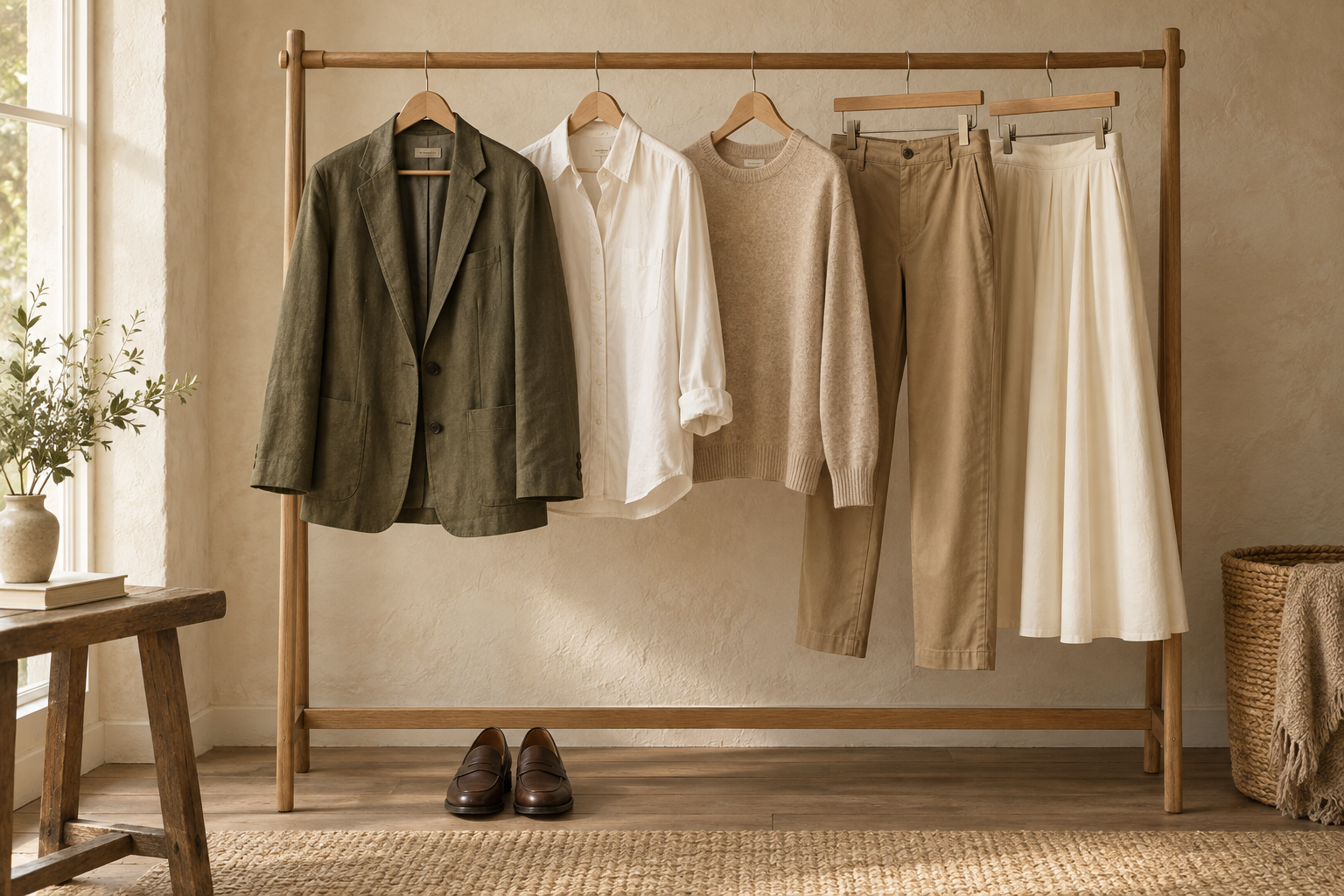
The illustration shows the kind of rail this plan assumes — neutral shirts, knitwear and trousers — not these exact garments. The counted list is the plan: two trousers, three tops, one blazer, two shoe pairs, and a grey overcoat marked optional and seasonal. Nine listed pieces produce the five outfits above and both contingencies, and every named item appears in the inventory. When one piece wears out or the laundry slips, the contingency swaps absorb the gap — which is what the capsule is for.
- Charcoal cotton chinos, tailored leg
- Navy wool-blend trousers
- White oxford button-down shirt
- Light blue poplin shirt
- Dark green merino crewneck knit
- Navy unstructured blazer
- Brown leather derbies
- White minimal leather sneakers
- Grey overcoat (optional, seasonal)
| Day | Outfit (every piece is in the inventory) | Why it works |
|---|---|---|
| Monday | Navy blazer, white oxford shirt, charcoal chinos, brown derbies | Sets the week's register and covers any Monday meeting nobody mentioned on Friday. |
| Tuesday | Light blue poplin shirt, navy wool-blend trousers, brown derbies | Sharp but lighter than Monday — the collar holds the formality without the jacket. |
| Wednesday | Green merino crewneck over the white oxford (washed after Monday), charcoal chinos, white sneakers | Midweek comfort that still reads considered; the shirt collar keeps the shape honest. |
| Thursday | Light blue poplin under the green merino, navy trousers, brown derbies | The same pieces recombine into a layered outfit for a cooler or client-heavy day. |
| Friday | Green merino alone, navy wool-blend trousers, white sneakers | The relaxed end of smart casual that still survives an unexpected video call. |
A last look in the mirror.
A MOMENT BEFORE YOU GO
0 of 8 ready
SMALL ADJUSTMENTS
When it feels almost right.
Why do my five outfits all end up looking the same?
Because they were chosen morning by morning from the same comfort default rather than assigned against the calendar. Assign the blazer day, the sneaker day and the layered day deliberately, and the week stops converging on one formula.
How small can the inventory really be?
Smaller than most people expect — the example here is nine pieces, one of them an optional coat, and some weeks need fewer. What matters is not the count but the mixing: each top working with more than one trouser, and shoes assigned as deliberately as shirts.
What breaks the plan most often in practice?
Shoes and laundry. Plans are written as outfits and forgotten as shoe rotations, and one shirt that did not dry quietly removes two combinations. Both are solved the same way: check shoes and wash status before the plan is final, and keep a rehearsed substitute.
Still wondering?
How far ahead should I plan the five outfits?
One week ahead is the practical answer: the calendar is knowable, laundry is still fixable, and the ten minutes it takes is the entire cost of the system. Planning further ahead mostly plans around weather you cannot predict.
Should a work-from-home day get a real outfit in the plan?
Yes, a lighter one from the same inventory — trousers with a clean line and one collared layer, so a surprise video call or an errand never finds you in yesterday's clothes. It does not need shoes assigned unless you will leave the house.
Do I need a fixed two- or three-colour palette for the capsule to work?
A shared palette makes mixing easier, which is why the example sticks to charcoal, navy, green and neutrals. But it is a helpful habit, not a requirement — the test is whether every planned combination actually works together, and your own eye over the written plan is the check.
How do I keep five outfits from feeling repetitive over months?
Change one variable at a time rather than rebuilding: swap the knit's colour, or the sneaker day's shoe, and every existing combination refreshes. The inventory method stays identical while its contents drift with the season.