Skip to content

Find your next good read.

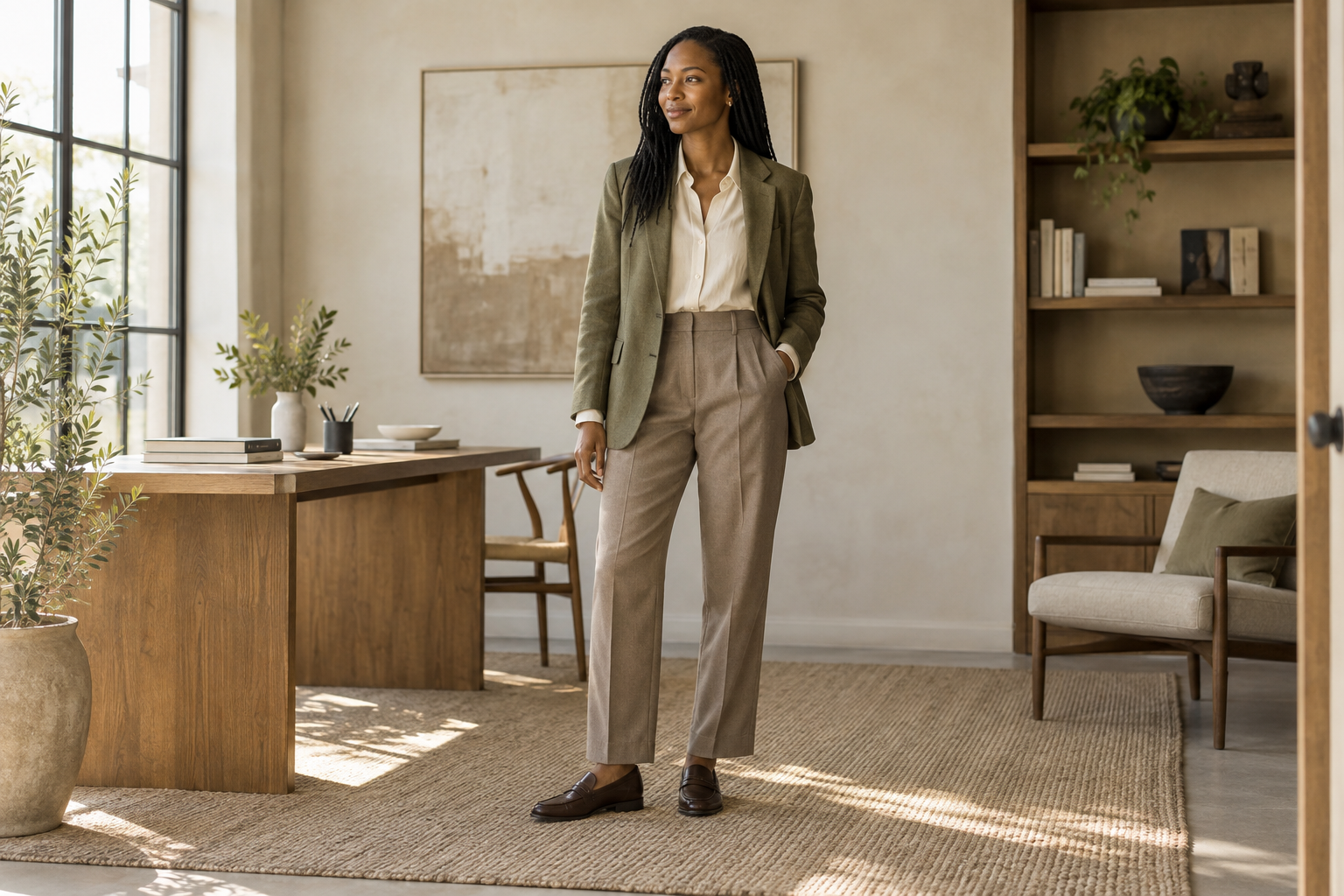
Woman in an olive blazer, cream shirt and taupe trousers with brown loafers in a sunlit office.

Occasion guide

What to Wear for a Smart Casual Video Call

A video call shows only what your camera sees, so the working method is simple: dress for the meeting's expectations, then sit down in front of your actual camera and check what it shows. This guide covers the preview routine, how patterns and colours behave on webcam, and three complete outfits with comfortable lower halves.

Begin here

Occasion advice

Dressing for a work video call

For a smart casual video call, choose an outfit that meets the meeting's expectations, then check it in your actual camera preview. Lighting, framing and movement change how clothing appears. Sit, stand and adjust the camera before the call so you are comfortable if the view changes.

Match the outfit to the meeting, not to the camera

The call sets the bar, not the technology. A routine internal stand-up, a client review and a board presentation can all be video calls, and they do not ask for the same outfit.

  • Internal and routine calls: a pressed collared shirt or fine knit with dark trousers covers almost every case.
  • Client-facing or presentation calls: add an outer layer — a blazer or structured cardigan reads as preparation through a webcam lens.
  • No idea what to expect: the collared base plus a layer within reach is the lowest-risk default, and the layer can go on mid-call if the tone turns formal.

Check your frame, light and background before choosing colour

Every camera crops, compresses and re-lights your clothes differently, so the preview on your own machine is the only evidence that counts. Check it once when you set up and again whenever the desk or the season changes.

  1. Open the preview

    Start your meeting software's camera preview and look at what is actually in frame — some setups show head and shoulders, others reach the waist or lower.

  2. Sit and stand in view

    Lean, reach and stand where you would during the call, and see how much of the outfit each position reveals.

  3. Face the light

    Put a window or lamp in front of you, not behind you — backlighting turns any outfit into a silhouette, while front light flatters almost everything.

  4. Look at the background

    A busy background competes with the top layer; a plain wall or a blurred background lets the clothes read.

Myth

Patterns are banned on video calls — only plain solids are safe.

Fact

Bold, larger-scale patterns usually survive a webcam without trouble. The risk case is narrow: very fine stripes, small checks and herringbone can shimmer or crawl on some cameras, because the pattern's detail approaches the camera's resolution. Keep those fine weaves for lower-stakes calls unless your preview shows them holding still — which is exactly what the preview is for.

Test neckline, microphone and movement

On camera, the neckline is the frame's centre of attention, and headset or laptop microphones sit close to whatever you wear at the collar. A minute of movement testing catches problems a mirror will not.

Before the call:

  • The collar or neckline sits neatly when you sit in your normal posture, not just when you stand straight.
  • Nothing scrapes or brushes against the microphone — scarves, chains and stubbly knit collars all show up as noise.
  • Reaching forward to a keyboard or notebook does not pull the collar out of shape or expose more than you intend.
  • The top layer is comfortable buttoned or open, so you can adjust for temperature without leaving the frame.

BEFORE YOU CHOOSE

Read the room. And the invitation.

  • Your camera, room and position — not the dress code — decide what other attendees see, so check the actual frame before judging any garment. Two desks in the same flat can produce very different pictures.
  • Webcam compression flattens contrast and detail: low-contrast pairings like grey on grey can merge into one block, and very fine patterns can shimmer on some cameras. What looks subtle in a mirror can read muddier on screen.
  • Lighting does more work than clothing. A window or lamp in front of you makes almost any reasonable outfit read sharp; a window behind you turns you into a silhouette no shirt can fix.
  • Below the frame, dress for the interruption rather than the audience: trousers and shoes that make standing up, stretching or answering the door a non-event.

A useful outfit formula.

  1. A collared shirt in a solid mid-tone — light blue, white or ecru — pressed at the collar and placket, because the collar carries most of the frame.
  2. A merino or cotton crewneck worn over the collar, close enough to the neck that the collar points stay visible; skip it in warm rooms.
  3. An outer layer for presenting or client-facing calls: a dark unstructured blazer or a fine-knit cardigan, both of which read as shoulder structure through a compressed image.
  4. Trousers in a matching or darker tone than the top layer, smart enough that standing up mid-call is unremarkable.
  5. Pattern at any scale you have tested in your own preview — solid tops are the safe default, but bold patterns often hold fine, and the preview, not a rule, decides.
  6. One pair of leather shoes kept near the desk for the calls that turn into lunches or office visits.

Two starting points.

Woman in an olive blazer, cream shirt and taupe trousers with brown loafers in a sunlit office.

The client-facing call

A cream collared shirt under an olive blazer, with taupe tailored trousers and brown loafers — the illustration shows the clothing combination, not what any camera will render. The blazer's shoulder line survives compression, and the whole outfit is complete, so walking to the kitchen or standing to stretch changes nothing. Swap the blazer for a fine-knit cardigan on warmer days.

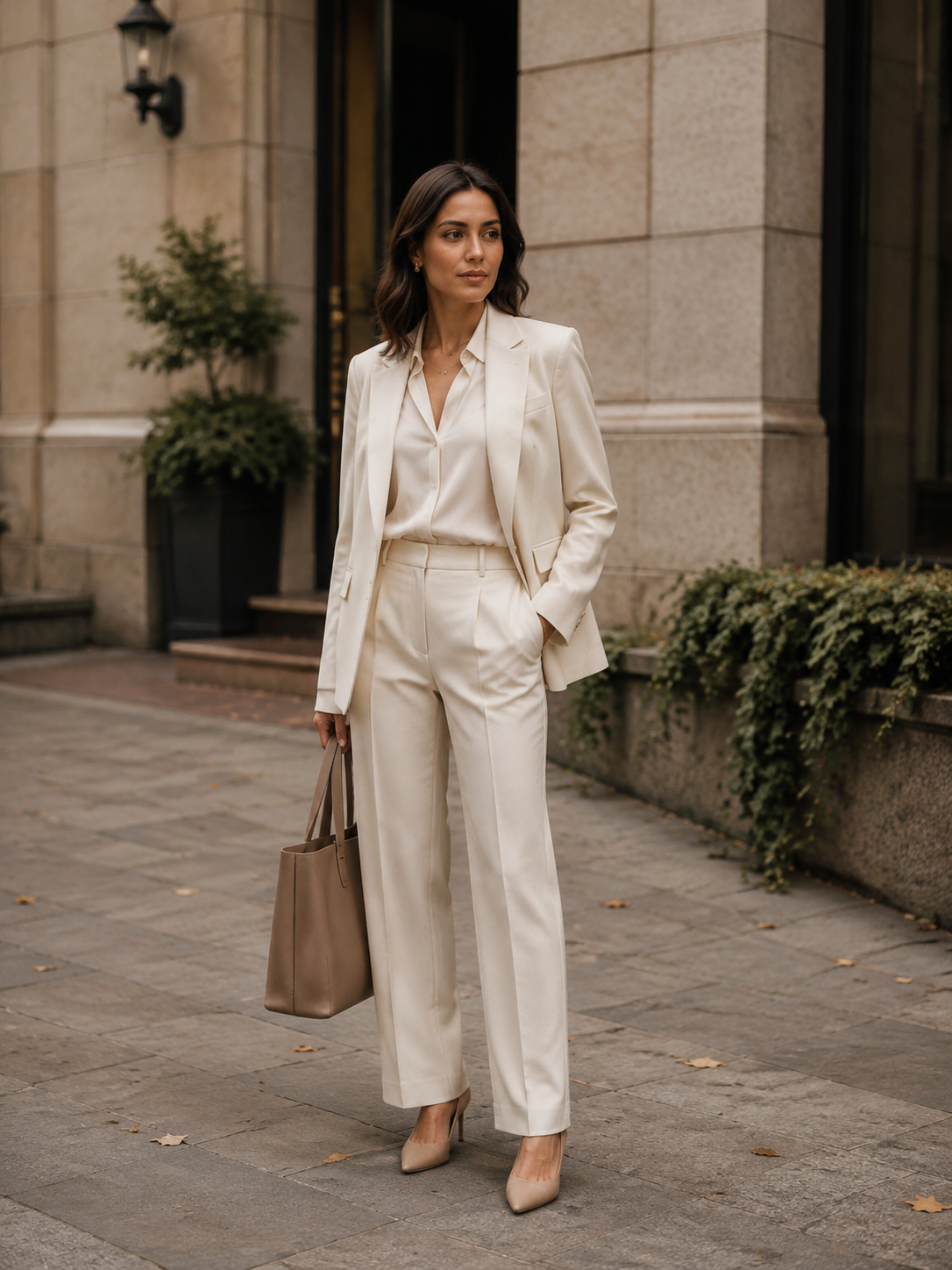
Cream tailored suit with relaxed trousers and a canvas tote

The everyday internal call

A light blue oxford with the top button open, under a navy merino crewneck so just the collar shows, with dark grey chinos. The visible layers say considered; the rest costs nothing extra. When the room runs warm, the knit comes off and the shirt still holds the frame.

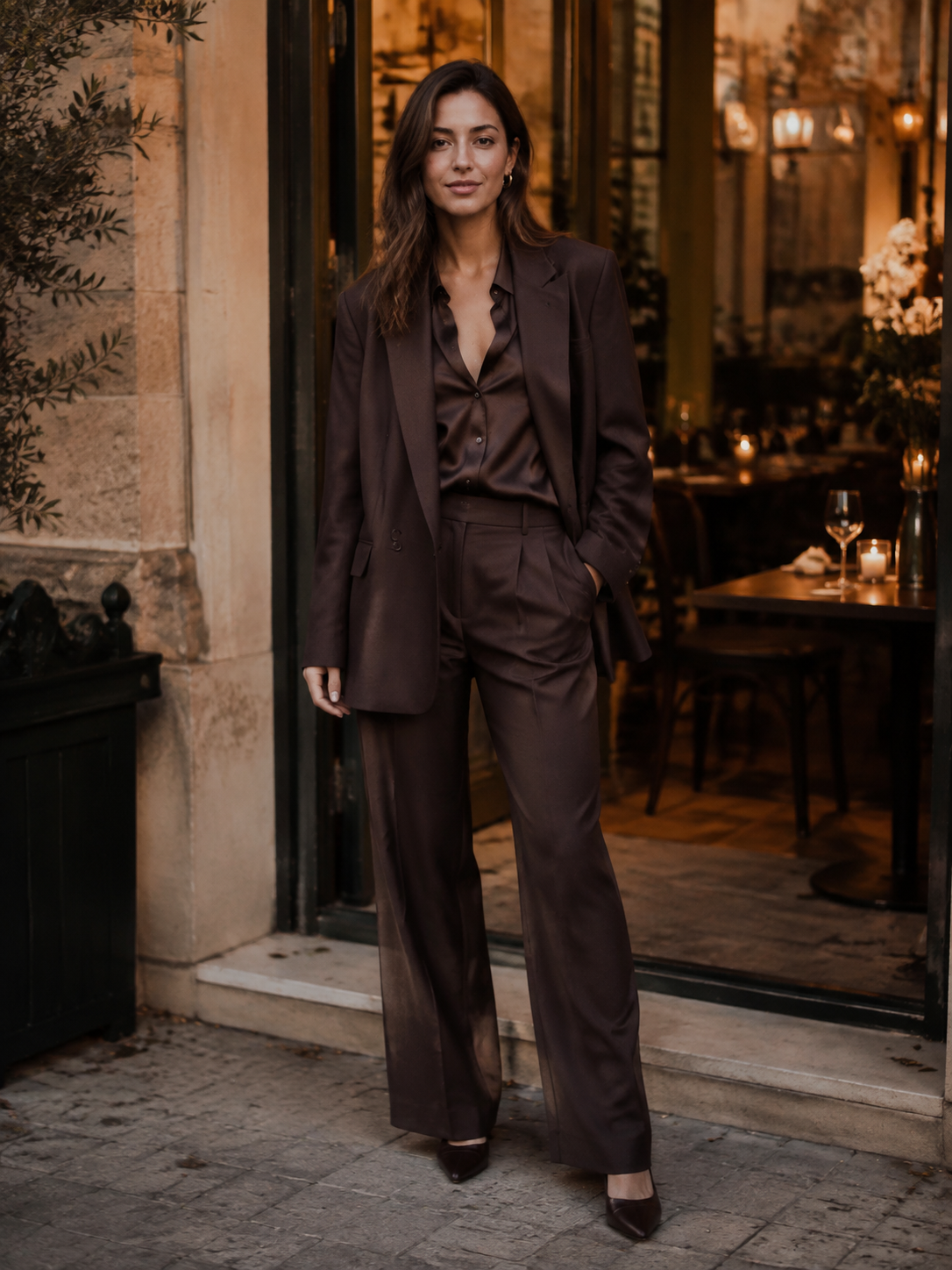
Chocolate brown tailoring and a silk-style shirt in a warmly lit restaurant

The after-hours call

A dark green fine-knit polo with a soft, neat collar, over dark tailored trousers. Evening calls tolerate a deeper palette, and a knit polo reads deliberate without a full collar's stiffness. It also goes straight to dinner or drinks if the call ends socially.

Adjust for the day.

Back-to-back all-day calls

Comfort outranks impression by hour four, so build the base layer for endurance: a soft cotton shirt rather than stiff poplin, a crewneck with no scratchy seams at the collar, and trousers with a clean line and an easy waist. Settle on one solid colour story in the morning and no mid-day change is needed.

Presentation day

When you are the one on screen, add the outer layer and test the lighting in advance — a window at your face is free production value, a window at your back is fatal. Sit slightly further back so the frame catches your shoulders; a tight head crop undersells the person talking.

The hot home office

Dress for the temperature, because overheating shows on camera before anything else does. A short-sleeve collared shirt in a solid colour carries the same framing power as a long-sleeve one, and a fine-gauge cotton polo needs no layer at all. If you want the neckline structure, a sleeveless knit vest over the shirt does that with your arms free.

The office-switch day

Calls from home followed by an afternoon in the office need an outfit built for both from the start: collared shirt under a merino crewneck, dark chinos, leather shoes. Pack the blazer if the afternoon has meetings and no wardrobe reset is required.

Leave these assumptions behind.

  • Judging the outfit in the mirror instead of the preview — the mirror has different light, a different crop and no compression, so it can flatter a top that shimmers on screen or bury one that would read well.
  • Sitting with a bright window behind you — no outfit survives a backlit silhouette, and colleagues read the setup rather than the shirt. Turn the desk or close the blind; the fix costs nothing.
  • Choosing low-contrast tonal layers like grey on grey or navy on black — compression can flatten them into one block, so the layering effort disappears even though it looked good in the room.
  • Treating the call as a torso-only event and then needing to stand — a doorbell, a stretch or a call that moves outside exposes the difference. Keep trousers and shoes that make standing up a non-event.

Keep exploring.

Work & Interviews

How to Plan Five Smart Casual Work Outfits

Plan five smart casual work outfits in one sitting: audit the calendar, list a counted capsule including shoes, assign an outfit to each day, and rehearse the two most likely disruptions.