Relaxed tailoring was the story of the men's red carpet at the 2026 Oscars — the 98th Academy Awards, held in Los Angeles on 15 March 2026. The most-quoted verdict came from GQ, whose writers ranked Stellan Skarsgard first among twelve men, praising what they called an 'exquisitely proportioned' Zegna tuxedo with wide-legged trousers. That ranking is one magazine's opinion, not an award, and this piece is a retrospective look at it rather than fresh news. But the reasoning GQ gave is worth unpacking, because it points at something you can test on your own clothes: relaxed tailoring works on proportion, not on looseness alone.
01 / THE DEVELOPMENT
The idea in focus.
02 / OUR INTERPRETATION
What it means in practice.
This is a retrospective read, written six months after the ceremony, and the useful part is not who won an imaginary contest. It is the pattern that both GQ's praise and GQ's criticism point at: relaxed tailoring succeeds when the volume is confined to one part of the outfit and something nearby — a shoulder, a lapel, a clean hem-to-shoe line — stays tailored. That is testable on ordinary clothes this week: if a full Zegna drape is remote, wear a straighter trouser cut with a little more width than usual, with the jacket you already own and a shoe with some visual weight. If the experiment fails — it may, because proportion is personal — the reliable fix is the anchor, not more volume: sharpen the shoulder or clean up the hem before loosening anything else.
A subjective verdict can still teach something observable: volume reads as a choice when one part of the outfit stays tailored.
A magazine ranking, not an award
First, what actually happened. GQ published 'The 12 Best-Dressed Men at the Oscars 2026, Ranked' on the night of the ceremony, 15 March 2026, written by Eileen Cartter and Yang-Yi Goh.
- 1st — Stellan Skarsgard, in a Zegna tuxedo with wide-legged trousers, which GQ described as exquisitely proportioned.
- 2nd — Michael B Jordan, in a militaristic Louis Vuitton jacket with slim trousers.
- 3rd — Paul Mescal, in a soft, cardigan-like Celine jacket.
No academy votes on this. It is two editors' taste, argued with confidence — which is exactly why it needs attributing every time it is repeated.
What the photographs show — and what they cannot
Strip the verdict back to what is observable in the red-carpet photographs. Skarsgard's trousers are visibly wide through the leg and fall with a long, clean line to the shoe, and the jacket keeps a defined shoulder and a structured tuxedo lapel.
What a photograph cannot show is fabric weight, how the suit felt after four hours, or whether the trousers moved well when he walked to the stage. GQ's writers also credit his placement to a 'months-long run' of wide-legged suiting across the whole awards season — context a single carpet photo does not carry. Keep that separation whenever you borrow from any red carpet: observe the silhouette, do not invent the construction.
| You can see | You cannot see |
|---|---|
| Trousers cut wide through the leg, falling in a long line | The cloth's actual weight or drape in hand |
| A structured shoulder and tuxedo lapel on the jacket | Internal canvas, padding or construction |
| A clean break where the trouser meets the shoe | Whether the wearer was comfortable or could move easily |
Why the proportion worked, in GQ's telling
GQ's own explanation for the ranking was about fit rather than invention, and the instructive contrast sits at the bottom of their list. In their telling, Skarsgard's look relaxed one thing — the trouser width — while the jacket kept its tailored skeleton: shoulder, lapel, a clean break at the shoe.
Chalamet's criticised look, by their account, paired looseness with more looseness and finished with heavy boots, so the eye had nothing measured to hold on to. Note the framing: this is a preference argued well, not proof of a correct answer. Two editors at another outlet could order the same twelve men differently, and Esquire produced its own list of the night with its own choices.
Volume reads as deliberate when something nearby stays sharp — the observation, not a rule.
Three ways to try the idea with clothes you own
A Zegna tuxedo on a red carpet says little about a high-street wardrobe, so the translation matters more than the original. The idea under test: relax one axis, keep a second one tailored, and let the shoes finish the line.
Wider trousers with the jacket you have
Take the straightest trousers you own, wear them with your usual blazer, and look at where the extra width sits — at the leg, not at the shoulder. Why: if the shoulder stays neat, the volume looks chosen.
A relaxed jacket with ordinary trousers
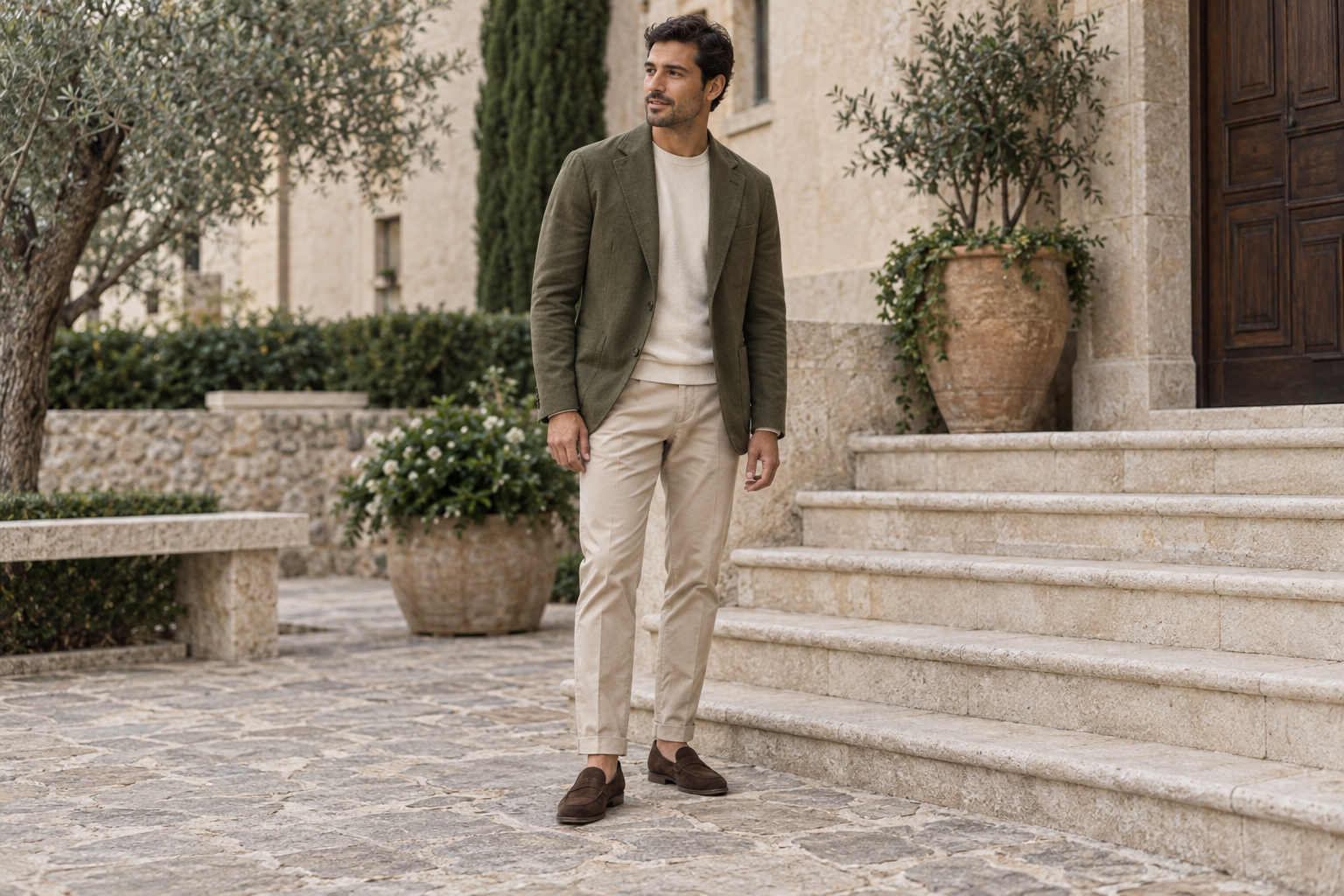
Swap in the slouchiest jacket you own — softer shoulder, longer body — over straight trousers and a plain knit. Why: the trousers act as the tailored anchor, echoing the one-relaxed-element pattern.
A dressier evening version
If you have occasion wear, try a dark wide trouser with a fitted shirt or fine knit and a leather shoe with some visual weight. Why: it echoes the red-carpet proportion without buying a tuxedo.
Try each of these as a single change to an outfit you already wear, not as a shopping list. Useful substitutions: no blazer needed for the first test — a structured chore jacket or an unlined knit blazer behaves the same way. If all your trousers are slim, the second test is the cheaper place to start, because a relaxed top layer is easier to borrow or buy secondhand than a good wide trouser.
A mirror-and-movement check, not a ruler
You do not need half-inch rules to judge the result — you need a phone and ten minutes. Photograph the outfit from the front and the side, then sit down and walk a few paces before looking again.
- Photograph front and side, standing, in the light you would actually wear it in.
- Sit, stand, walk — then re-photograph and check the hem and seat.
- Change exactly one piece and repeat. Two changed pieces tell you nothing about either.
- Judge the photographs, not the mirror: the camera flattens the silhouette the way distance does.
What you are checking is whether the volume sits where you wanted it and whether the silhouette survived sitting. If the trousers pool heavily at the ankle once you stand up, the hem, not the width, is usually the thing to adjust. A tailor can shorten a wide trouser to a clean break for far less than a new pair costs.
What one red carpet cannot tell you
Three honest limits before you act on any of this. First, tuxedos are occasion-specific: a black-tie silhouette proves nothing about what belongs in a weekday outfit, which is why everything above translates the pattern rather than the outfit.
Second, red-carpet photographs capture a standing pose under professional lighting; they conceal movement, seat and weather, so 'it photographed well' is weak evidence that it wears well. Third, and most important, one magazine's ranking of one night cannot establish a trend. GQ's writers themselves justify their pick partly by Skarsgard's whole-season record, and other outlets ranked the same evening differently — treat the verdict as a well-argued data point about proportion, not a rule about width.
FROM THE STORY TO YOUR WARDROBE
Take the useful part.
Sources & further context.
- The 12 Best-Dressed Men at the Oscars 2026, Ranked — GQ (Eileen Cartter and Yang-Yi Goh), 15 March 2026
The subjective ranking discussed here; source for the placements, the Zegna/Skarsgard description and the Chalamet criticism.
- The Best-Dressed Men at the Oscars 2026 — British Vogue (Laura Hawkins), March 2026
A separate outlet's gallery of the same night, included to show that verdicts differ; it does not feature Skarsgard.
- All the Best-Dressed Men at the 2026 Oscars — Esquire, March 2026
A third outlet's list of the same evening, cited as evidence that the rankings are opinion, not fact.
- The 98th Academy Awards — Oscars.org
The Academy's own record of the ceremony date and venue: Sunday, 15 March 2026, Dolby Theatre at Ovation Hollywood.