Overshirt Outfits You Can Build from Existing Clothes
An overshirt works as an outer layer over a top or as a middle layer beneath a coat. Decide its job first, then check the whole combination — each look below is a complete outfit with the check that confirms it.
Wear an overshirt as your outer layer over a top, or as a middle layer if it fits comfortably beneath a coat. Decide its job first, then check the whole combination. An open overshirt with chinos is one option; buttoned over a light top with trousers is another.
Decide the layer role before you choose anything else
Every overshirt question becomes simple once you name its role. As the outer layer, it is the last thing you put on and nothing has to fit over it. As a mid-layer, it sits between a top and a coat, and thickness becomes the limiting factor.
Three roles, three different requirements
Role
What it replaces
What it demands
Open outer layer
A casual jacket or cardigan
A top beneath that stands on its own
Buttoned mid-layer
A sweater or fleece under a coat
Slim layers beneath and a coat that still closes over it
Buttoned outer layer
A blazer on a mild day
A crisp collar or cuff showing, to read as deliberate
Open over a tee with chinos: the easiest starting point
Worn open, the overshirt behaves like a light jacket and forgives almost everything. Wear it over a plain t-shirt or fine knit with chinos or straight jeans. Because the front stays open, the layers beneath stay visible — so the tee has to be an outfit, not an afterthought.
Pick the base layer first
Choose a plain, clean t-shirt or thin crewneck in a colour that works with the trousers on their own. If the overshirt came off midday, the remaining outfit should still hold up.
Add chinos or straight jeans
Mid-weight chinos keep the look smart casual; washed straight jeans take it to the weekend end. Either way, hem them so the ankle shows a clean line above the shoe.
Choose footwear for the setting
Clean white leather sneakers or suede chukka boots both work. Loafers push the same outfit toward the office-adjacent end without changing anything else.
Check the layer roles
Look in the mirror and name them: overshirt is the outer layer, tee the base, trousers and shoes the finish. If the tee sags or shows a print through the overshirt, swap it before anything else.
Works well open
A checked or washed overshirt as the one patterned element
A rollneck in cold weather, filling the open front at the neck
Quiet trousers that let the overshirt carry the outfit
Struggles open
A patterned tee underneath, competing with a checked overshirt
Trousers in a loud colour when the overshirt is also strong
A hem so long it swamps short-rise trousers
Buttoned over a shirt or fine knit: the tailored version
Buttoned, the overshirt reads closest to tailoring — but only over thin layers. A white oxford shirt with the collar sitting clean above the placket does most of the work; a fine-gauge knit does the same job in colder weather. Bulk at the button line is the thing that undoes it.
Choose a thin mid-layer
An oxford shirt or fine-knit crewneck, nothing thicker. Fasten the overshirt and press a hand flat against the front — if you feel the shirt bunching underneath, the layers are too heavy.
Straighten the collar above the placket
Pull the shirt collar so it sits in a clean band above the overshirt's button line. That visible collar is most of the polish in this role.
Finish with trousers and matched leather
Grey wool trousers or dark chinos with loafers or derbies. Match the shoe leather to the belt so the lower half reads as one considered block.
Check neck comfort before you leave
Button the top button and turn your head. If the placket pulls at the neck or the collar chokes when you sit, drop one button — do not force the closure.
Run this check on any buttoned overshirt outfit:
The front lies flat with no X-shaped pull between buttons
The shirt collar, not the overshirt, is the topmost layer at the neck
Cuffs show a finger's width beyond the overshirt sleeve if you want the layered look
You can cross your arms without the front riding up
Under a coat: the mid-layer test most overshirts fail
A mid-weight overshirt can sit under an overcoat or wool coat, turning one garment into two seasons of wear. The test is movement, not looks: put the whole combination on and reach forward as if hailing a taxi. If the sleeves drag or the shoulders lock, the coat is not cut for it.
Try it on complete: overshirt buttoned, coat over the top, arms raised forward and to the sides.
Check the coat still closes without strain at the chest — an open coat over a bulky mid-layer looks worse than either layer alone.
Keep the overshirt's collar inside the coat's collar, or fold it deliberately if you want the contrast visible.
Myth
Any overshirt works as a mid-layer — just squeeze it under your coat.
Fact
Thick overshirts — heavy flannel, wool, lined versions — are built as outer layers and rarely fit under a coat without pulling at the shoulders and arms. Check the arm movement with both layers on; if the coat will not close comfortably, wear the overshirt as the outer layer instead and add a knit beneath it.
Colour and texture without a mandatory palette
No palette is compulsory — the working rule is that one element leads. A checked or washed overshirt leads, so everything beneath stays plain. A plain navy, olive or charcoal overshirt supports, and then a scarf, knit texture or shoe colour can carry interest instead.
When the fit itself is the problem
If every role fails — the front pulls buttoned, the hem sits oddly open, the shoulders drag under a coat — the garment's cut, not your styling, is the issue. Shoulder seam placement, body width and sleeve length each have specific fixes.
The same thin-mid-layer logic applied to knitwear, useful for buttoned looks.
Which mood feels like your day?
Find a setting.
3 looks to explore
Open overshirt with chinos
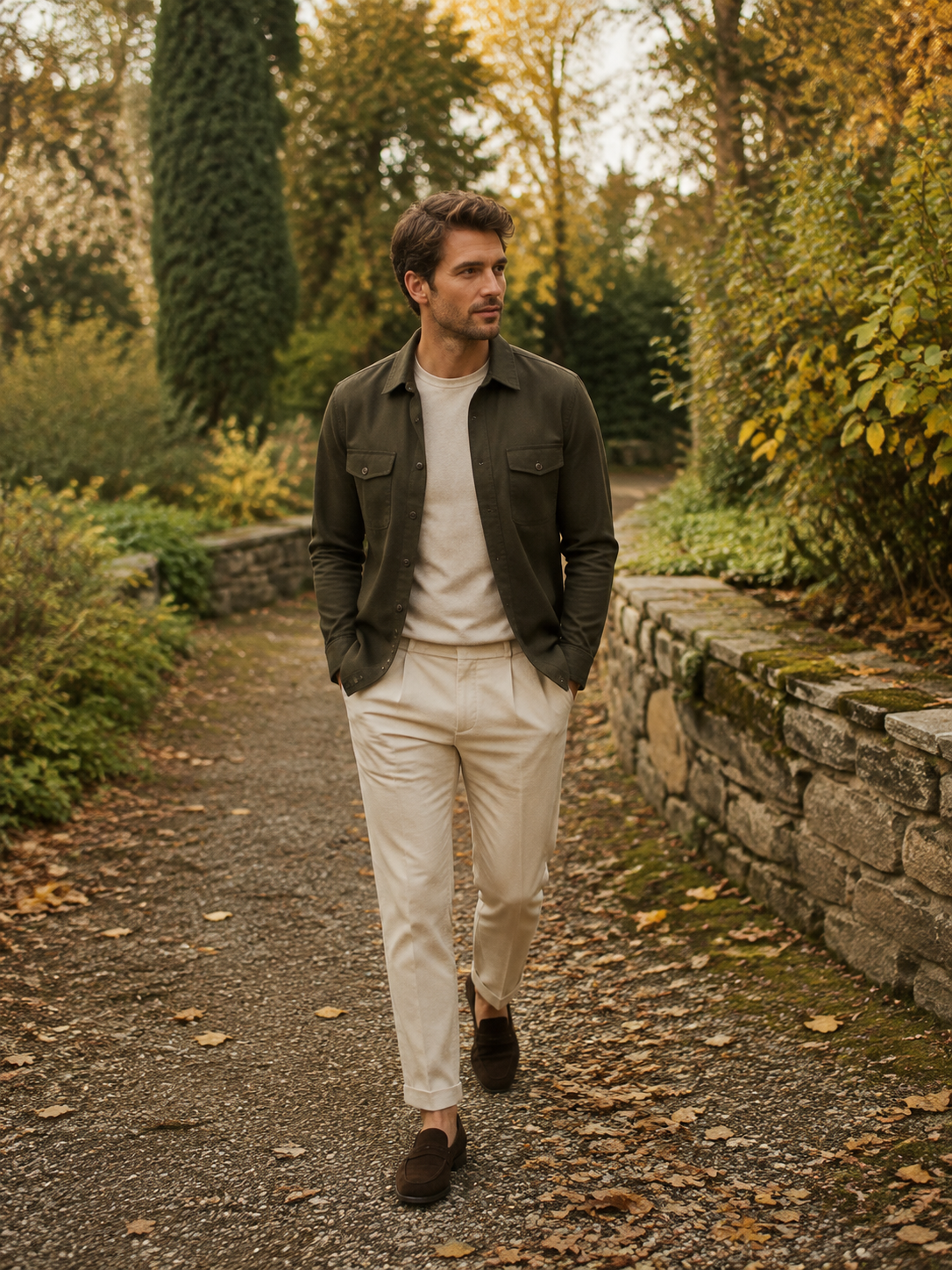
A mid-weight cotton overshirt worn open over a plain tee, with mid-weight chinos and clean leather sneakers. Steps: build the tee-and-chinos outfit first, add the overshirt open, then confirm the tee still works if the overshirt comes off. Check: three named layers, with the tee clean and flat beneath.
Buttoned over an oxford shirt
A moleskin or brushed-cotton overshirt fully buttoned over a white oxford shirt, with grey wool trousers and dark brown loafers. Steps: fasten the overshirt over the thin shirt, straighten the collar above the placket, match shoes to belt. Check: the front lies flat and the neck is comfortable when buttoned.
Under a coat as the middle layer
The same overshirt buttoned over a fine knit, with an overcoat on top and dark trousers. Steps: dress completely, close the coat, then reach forward and to both sides. Check: the coat closes without strain and your arms move freely — if not, this overshirt is an outer layer, not a mid-layer.
Make an idea your own.
Start with the open look: the overshirt you own, a plain tee that stands on its own, and chinos or straight jeans hemmed to a clean ankle.
Name the layers out loud — overshirt, tee, trousers, shoes — so you know which garment is doing which job before you add anything.
For the buttoned version, swap the tee for a white oxford or fine-gauge knit, button the overshirt, and straighten the shirt collar above the placket.
Press a hand flat against the buttoned front; if you feel bunching, the mid-layer is too heavy for this role.
Test the mid-layer job: add your coat over the buttoned overshirt, close it, and reach forward. Comfortable arms and a closing coat mean the combination works.
Adjust colour last: let a checked or washed overshirt lead with quiet clothes beneath, or let a plain overshirt support a bolder knit or scarf.
How an overshirt should fit: identify the intended cut, layer over your real base layer, then check placket tension, reach, cuffs and hem while sitting and bending before comparing sizes.