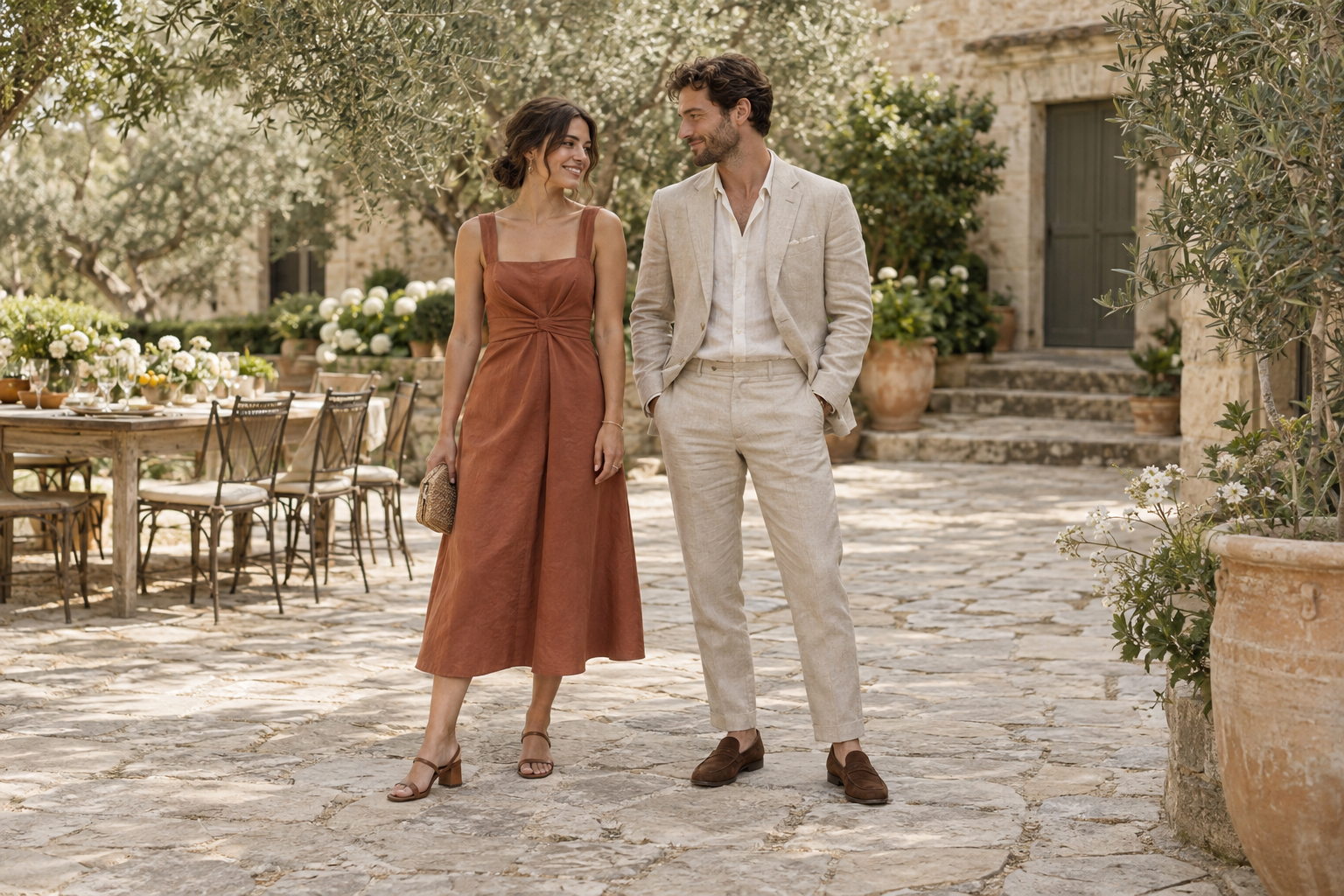
City hotel or formal venue
Lean tailored and dark: a suit-adjacent blazer and matching-weight trousers, or a structured midi dress with a jacket. Surfaces are paved and dry, so suede is fine here. Save the heaviest boots for rougher settings.
Occasion guide
A winter wedding asks for two things at once: an outfit that meets the invitation indoors, and coats, shoes and layers that cope with whatever the journey between venues is actually like.
Begin hereOccasion advice
For a smart casual winter wedding, build the outfit around the invitation, then add warmth for the journey and outdoor time. A coat should fit over your chosen layers without restricting movement. Check whether you can leave it somewhere indoors and whether your shoes suit the route between venues.
Winter changes outfits through logistics more than through cold. Two weddings on the same January Saturday can need different shoes depending on the distance between car park and ceremony room.
The base outfit has to stand on its own indoors, because part of the day will be spent without the coat and possibly without the blazer. Winter suits darker, richer fabrics — charcoal, navy, deep green, burgundy — in mid-weights that hold a shape. Pale summer linens and light open-weave cottons read as misread rather than bold in December.
| Layer | Winter choice | Why it earns its place |
|---|---|---|
| Base | Fine merino or cotton knit, or a silk-touch top | Thin enough to sit under a blazer without bulk at the shoulders |
| Mid layer | Mid-weight wool or wool-blend blazer; or a tailored jacket over a midi dress | Keeps the outfit complete when the coat comes off indoors |
| Trousers or skirt | Mid-weight wool trousers or a fuller midi skirt | Thin trousers offer no warmth and flatten out under a coat |
| Outer layer | Wool overcoat in charcoal, camel or navy | The piece every guest sees in outdoor photos — as considered as what is under it |
| Footwear | Derbies, grippy loafers, or block-heel boots | Handles wet pavement and stays comfortable over thicker socks |
| Accessories | Pocketable scarf and gloves; a bag that closes over a carried layer | Warmth you can remove, and room for the layer you shed by evening |
Coats bought or worn over everyday clothes often fail the wedding test: worn over a knit and blazer, they pull at the shoulders and ride up at the hem. Run the reach test with every layer on.
Put on the full indoor outfit first — knit, blazer, everything you expect to wear at the coldest indoor point of the day.
Coat on and buttoned, reach forward as if greeting someone and sit down on a chair. No pull across the back, no sleeve riding to the forearm.
Take the coat off over the layers in one movement. If it needs an unravelling routine, it will be a nuisance in a crowded cloakroom.
Check what winter actually means where the wedding is. A mild, wet winter day and a snowy one call for different outer layers — and the venue surface may not be cleared either way.
Mild and wet
Cold or snow
Smooth leather soles are slippery when wet, and thin heels struggle on gravel and salted steps. Choose shoes for the worst surface on the route, treat or protect leather beforehand, and give thicker socks room when you try them on.
You should carry a change of shoes to any winter wedding and switch on arrival.
Only the route decides. If the walk from car to door is short and paved, shoes with grip work all day and a change is one more thing to carry. If the route crosses grass, gravel or uncleared ground, either wear boots that suit the venue or change on arrival — but make that call from the venue, not from habit.
Run through once, the night before and again that morning:
If the dress code or season is different
The general wedding playbook this page winterises.
For the other end of the year: grass, sun and heat.
BEFORE YOU CHOOSE
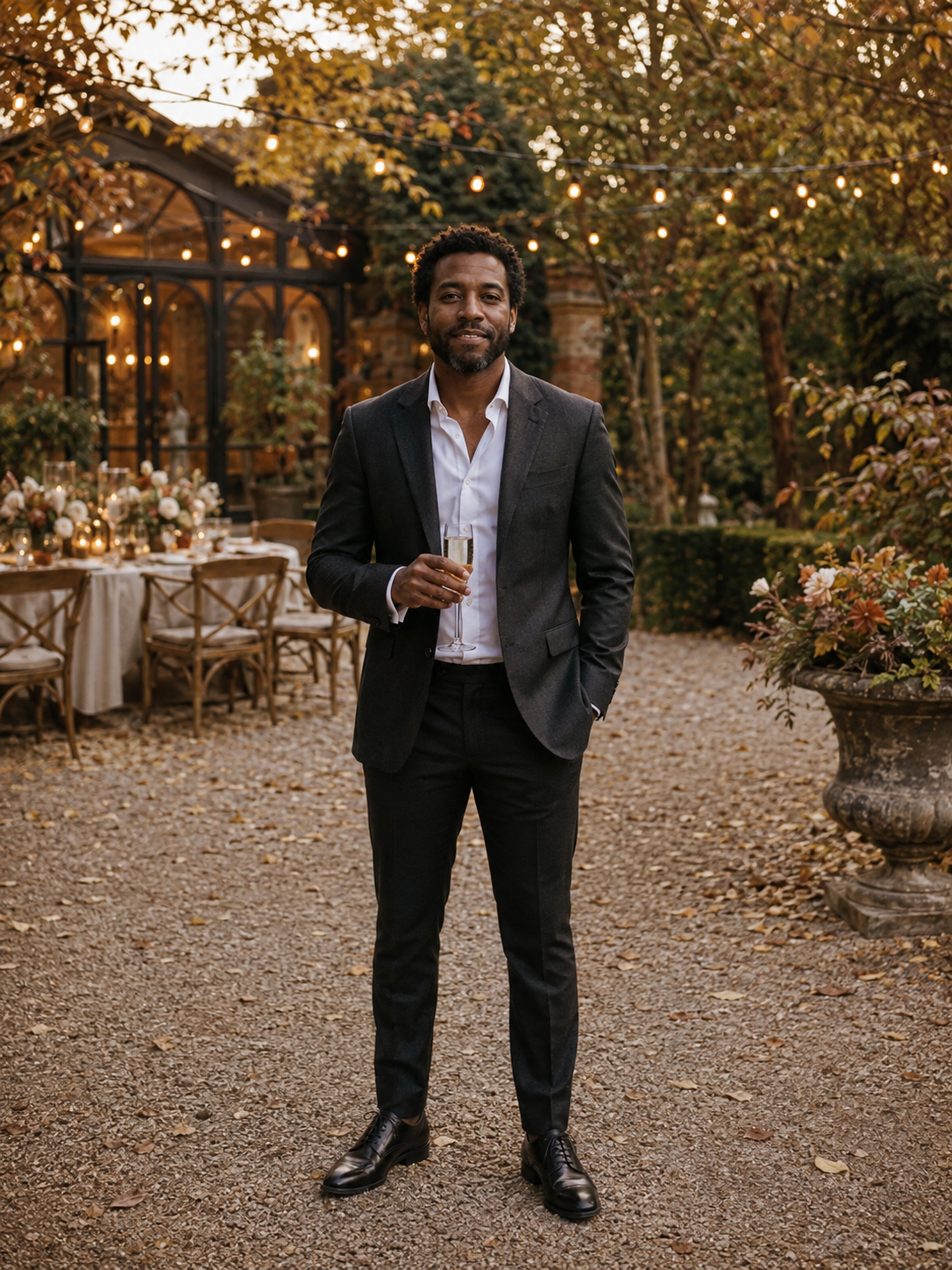
A charcoal wool blazer over a fine navy merino crewneck, mid-weight wool trousers in a lighter grey, and brown leather derbies with a grippy sole. Remove the blazer at a warm reception and the outfit still reads complete. The illustration shows the combination; it is not a winter wedding photograph.
A long-sleeve midi dress in a heavier crepe or velvet-touch fabric in deep green or burgundy, block-heel ankle boots, and a camel wool coat for arrivals and photos. Long sleeves cover a cold ceremony room, and the boots stand up to wet streets and gravel. The coat is warm enough to skip a scarf without looking underdressed.
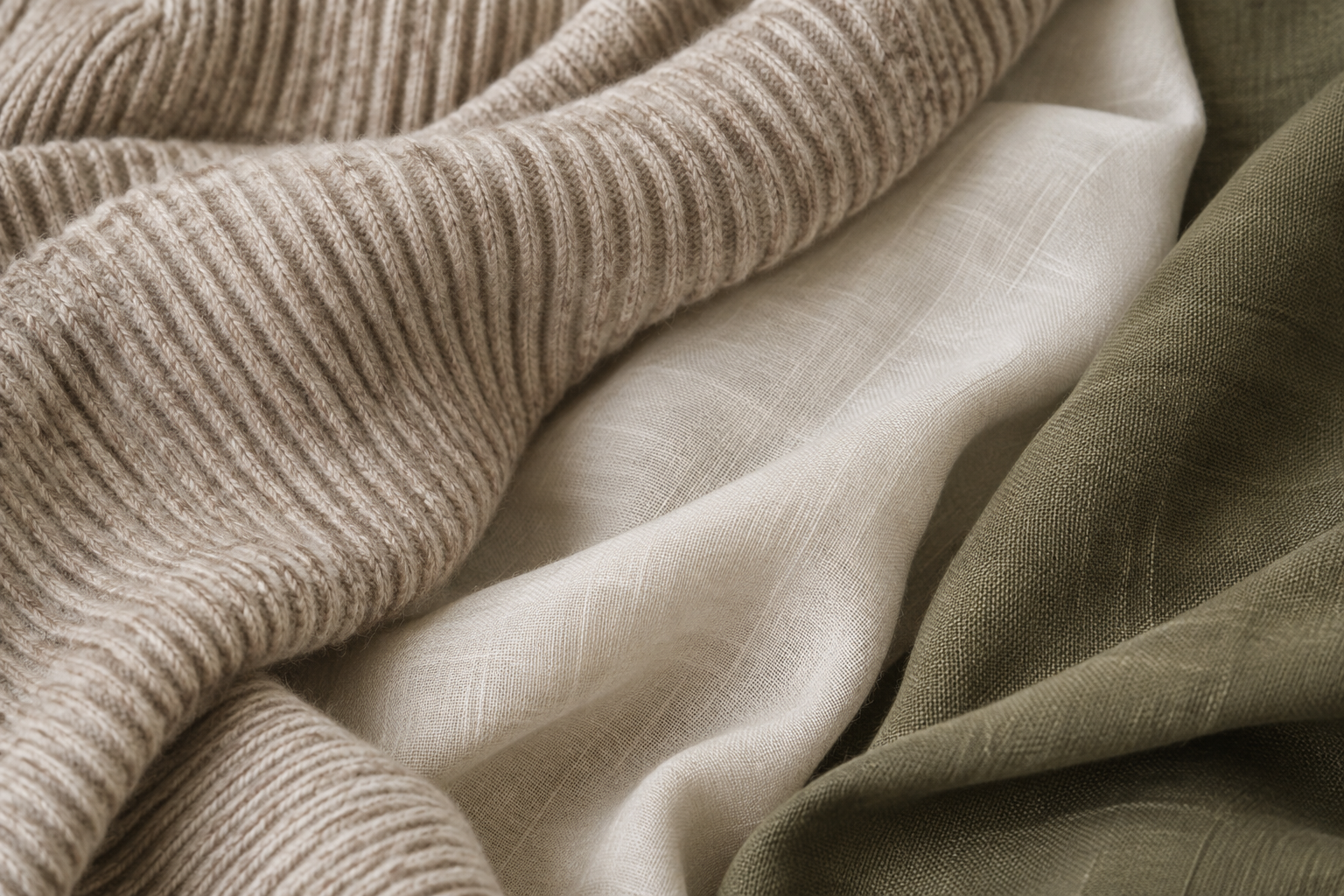
Dark wool trousers with a fine-gauge turtleneck or knit polo, an unstructured navy blazer, and dark suede loafers or leather boots. It sits a notch below a suit, layers flat under a coat, and suits a daytime or relaxed venue. The texture image shows the kind of knit-and-woven weight to look for — it illustrates layering fabrics, it is not proof of warmth.
Lean tailored and dark: a suit-adjacent blazer and matching-weight trousers, or a structured midi dress with a jacket. Surfaces are paved and dry, so suede is fine here. Save the heaviest boots for rougher settings.
Expect genuine cold and unpaved ground. A heavier knit under the blazer earns its place, boots or lug-sole shoes replace thin soles, and darker colours forgive the gravel a country venue adds to every hem. Ask the venue what the ground between car park and door is like.
The season, not the clock, sets the palette. A midday wedding still calls for dark, warm fabrics, with slightly softer pieces like a knit polo or knit dress sitting well. An evening ceremony justifies the darkest tailoring in your wardrobe and a proper overcoat for the late walk to the taxi.
Build the outfit so the weather pieces are removable. Thermals under trousers or fleece-lined tights can be skipped without changing the look, whereas a heavy jumper chosen as the main piece cannot come off indoors. Layers you can shed keep one outfit working across a changeable forecast.
Style & Culture
A smart casual wedding guest guide: complete outfit formulas for men and women, plus variations for beach, winter and evening ceremonies.
Weddings & Celebrations
Smart casual garden wedding outfits: shoes that hold on grass and gravel, layers for sun and evening cooling, and how to read the invitation before choosing anything.
Weddings & Celebrations
Check whether you are dressing for the ceremony, the party afterwards, or both: graduates follow their institution's gown guidance, guests follow the invitation, and everyone plans for sitting, walking and the weather.