A graduation celebration can mean a ceremony under a rented gown, a long lunch, a private party, or all three — graduates and guests dress for different parts of it, and the institution's rules come first.
For a graduation celebration, check whether you are dressing for the ceremony, a meal afterwards or both. Graduates should read any gown and footwear guidance from their institution; guests should follow the invitation. Choose clothes that remain comfortable through sitting, walking and whatever the day includes.
Work out which event you are dressing for
Graduation celebrations vary more than most occasions. Some include a formal ceremony under a rented gown; others are a family lunch or a party with no institution in sight. Settling this first stops you dressing for a gown that does not exist or underdressing for a ceremony that does.
Three scenarios, three starting points
Scenario
What sets the dress level
Reliable default
Graduate at the ceremony
The institution's gown, footwear and arrival guidance
Thin, smooth layer under the gown; clothes that stand alone once it comes off
Guest at the ceremony
The invitation, plus the venue's seating and walking conditions
One notch above weekend wear; comfortable shoes for the route
Party or meal only
The host's invitation, like any private celebration
Ordinary smart casual for the setting — no gown considerations at all
Institution rules beat anything you read online
Where a gown is worn, the university or school publishes the guidance that matters: how the gown closes, what necklines sit well under the yoke, what length of hem shows below it, and what footwear suits the stage steps. Read that page before shopping — institutions differ, and generic rules are guesses.
Gown closure and drape: what goes over your clothes, and how warm it runs indoors.
Neckline and collar: the parts of your outfit that stay visible under the yoke.
Visible hems: what shows below the gown's hemline in photos and on stage.
Footwear and stairs: any stated guidance for the stage crossing itself.
One short message to the host or institution resolves most graduation dress questions.
Myth
Everyone at a graduation dresses around the gown — thin layers, no jacket, photos first.
Fact
Only graduates wear the gown. Guests dress for a daytime celebration and the weather, and graduates dress for the whole day, of which the gown is one part. Dress for the day first; the photographs record it, they do not set the standard.
Plan for sitting, walking and the weather
The day is physically longer than a normal celebration: ceremonies run long, venues spread out, and queues happen outdoors. Comfort failures — new shoes, tight collars, strapless dresses that need adjusting — show up well before the toasts.
Check the practical side before the day:
Sit for ten minutes in the full outfit — nothing pulls, rides up or digs in.
Walk the likely route pace in the shoes; they are broken in, not new out of the box.
A backup weather layer is packed — a folding umbrella, a light layer, or both.
Graduates: the layer under the gown is thin and smooth, and looks complete on its own.
Phone, tissues and anything needed all day fit in a pocket or a small bag that stays comfortable.
Carry one outfit from ceremony to lunch
Most celebrations run straight from ceremony into a meal or party with no chance to change. The outfit that survives is the one planned as a sequence, not assembled for a single hour.
Choose the constant
Pick the trousers, dress or skirt that work at every stop — ceremony seating, a restaurant chair, a garden.
Make the change a layer
Shift the level with what comes off or goes on: a blazer removed after the ceremony, a knit added for the evening.
Park the extras
Plan where the scarf, umbrella or extra layer lives during the meal — a bag that closes, or a coat left with family.
BEFORE YOU CHOOSE
Read the room. And the invitation.
Separate the institution's ceremony from the private celebration that follows. Ceremony rules come from the institution; the party's dress level comes from the host. Neither automatically governs the other.
A gown is a condition, not a certainty. Confirm whether the ceremony includes one before building an outfit around thin, smooth layers — many celebrations, especially party-only ones, involve no gown at all.
Check the venue and season for real. An outdoor queue, a long walk between buildings, or a hot hall each change the shoes and layers more than any dress convention does.
Clothes should earn their place by lasting the day. Whatever you choose has to be comfortable through sitting, walking, standing for photos and eating — not just for the first hour.
A useful outfit formula.
Base: a thin, breathable shirt, blouse or fine knit — the layer that shows — in a solid mid-tone that reads cleanly in daylight.
Structure: a collar or neckline with a clean line, or an unstructured blazer that defines the shoulders once any outer layer comes off.
Trousers or skirt: tailored but not tight — pressed chinos, wool-blend trousers, or a midi dress or skirt you can sit, stand and climb stages in.
Footwear: polished leather shoes, loafers or block heels with grip — broken in beforehand, because grass, paving and stairs are all plausible parts of the route.
Finishing: a belt that matches the shoes, and a pocket or small-bag plan for the phone you will use all day.
Two starting points.
The graduate: trousers and a collar
A pale blue collared shirt with a firm collar that holds under a gown's yoke, dark tailored chinos, and brown leather loafers. Once the robe comes off, the outfit stands complete on its own. The illustration shows the combination — no gown is pictured, and your institution's guidance comes first.
The graduate: a dress under the gown
A knee-length or midi dress in a solid mid-tone such as rust, sage or navy, with short or three-quarter sleeves and low block heels. Smooth fabric stops a gown clinging, and sleeves spare your arms if the ceremony runs warm. Check the hem length against the institution's gown guidance rather than assuming.
The guest: daytime celebration level
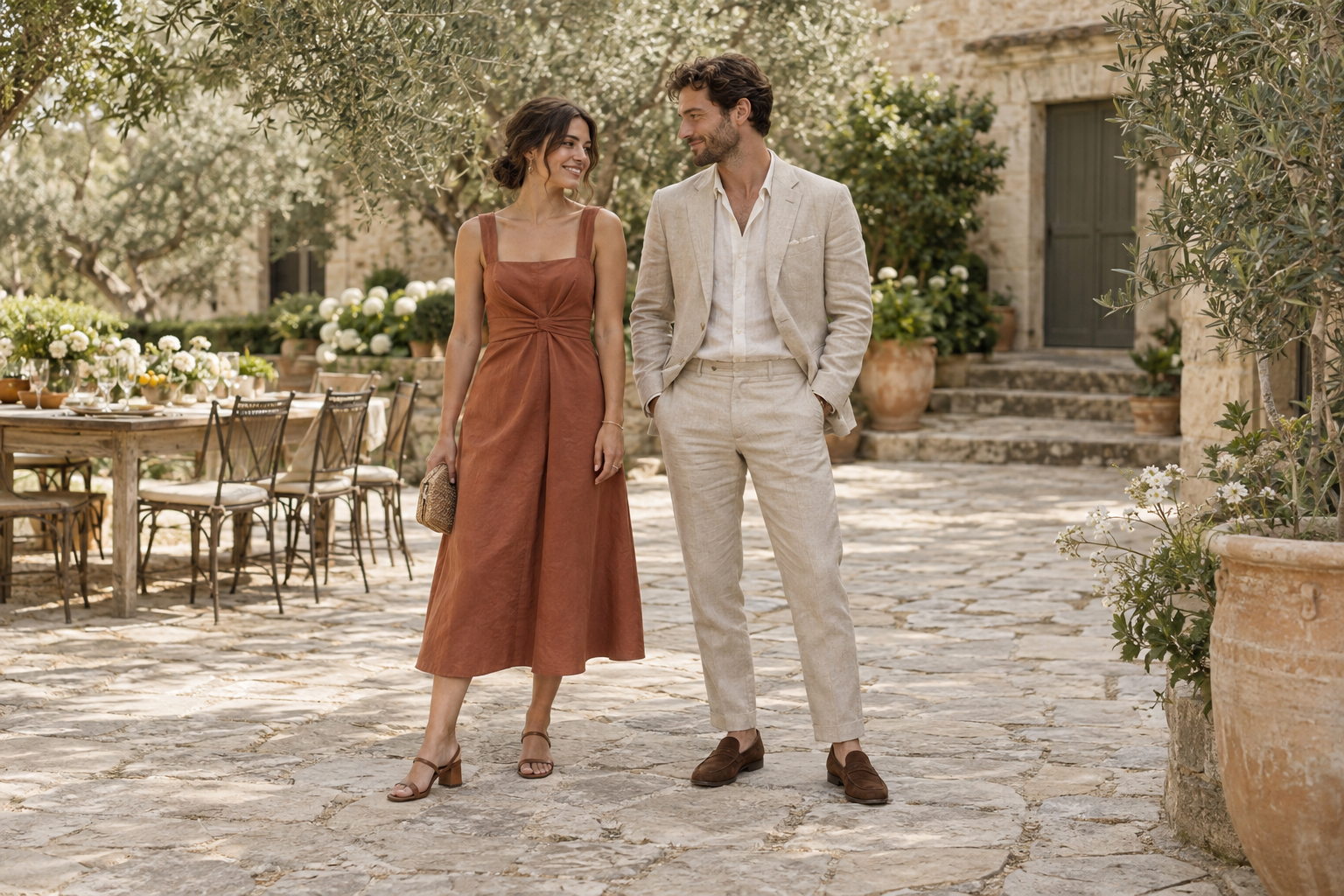
A midi dress, or a blazer over a pale shirt with dark chinos and loafers — one notch above weekend wear, below wedding formal. Correct for sitting through a ceremony and comfortable through a long afternoon. This is a celebration illustration of the level, not a graduation photograph.
Adjust for the day.
Ceremony with a gown
The under-gown layer should be thin, smooth and able to stand alone once the gown comes off. Confirm the closure, neckline and visible-hem guidance from the institution, and choose footwear that handles the stage steps as well as the rest of the day.
Party or meal only
Dress like any private celebration: the host's invitation sets the level, and gown logic does not apply. Ordinary smart casual for the setting — a blazer and dark trousers, or a dress with proper shoes — is right without any ceremony adjustments.
Hot weather
Assume heat and sun for outdoor ceremonies and queues. The thinnest presentable layer wins, light colours still photograph well, and shoes must survive grass and paving. Nobody regrets dressing cooler at a July graduation.
Cold or wet weather
A heavier knit or blazer works under and after a gown, and guests can dress warmer without penalty. Keep a coat worth wearing between venues, and pack a folding umbrella — photos may still happen outside, whatever the forecast said.
Leave these assumptions behind.
Dressing for an assumed gown. Guests in thin under-gown layers look underdressed, and graduates at gown-free parties have dressed for a ceremony that never happens — confirm which event it is first.
Inventing institutional rules. Gown guidance varies by institution, so anything not on their page is a guess; read it rather than borrowing a friend's experience from a different university.
Unbroken-in or impractical shoes. Graduates cross stages and lawns, guests stand through long photo sessions, and new leather blisters by midday.
Treating the day as one short event. The ceremony, the meal and the evening all happen in one outfit, so anything that only works for an hour — tight collars, delicate fabrics — fails well before the toasts.
Smart casual summer party outfits that start with the host's instructions: complete looks for garden, rooftop and waterfront settings, plus a layer plan for cooler evenings.
When a dress code is unclear, ask the host one specific question before buying anything. Classify the uncertainty, rank the evidence, send a usable question script, and plan a reversible fallback.
Build a winter smart casual wedding outfit around the invitation, then add removable warmth: a base outfit that works indoors, a coat that fits over it, and footwear for the route between venues.