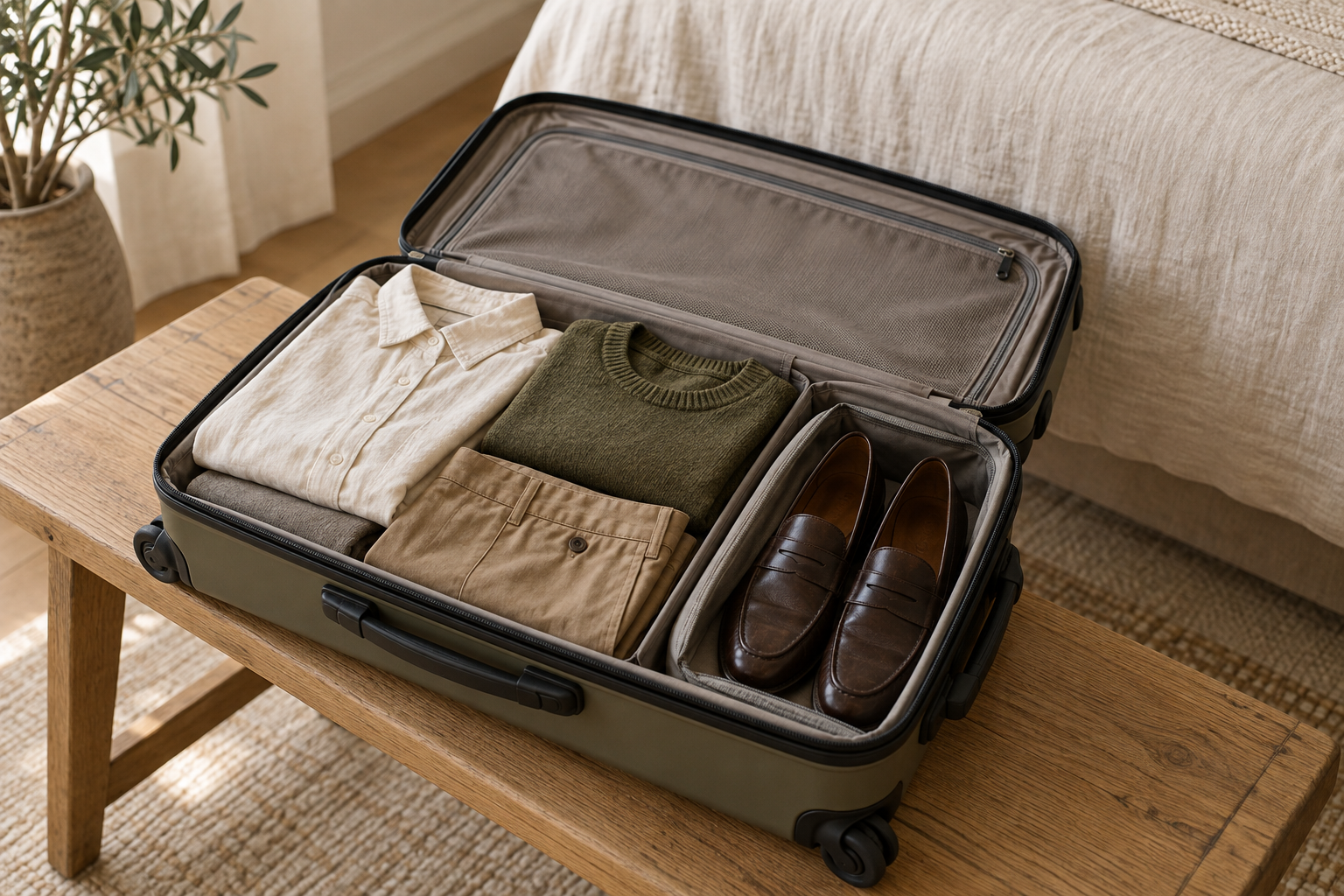
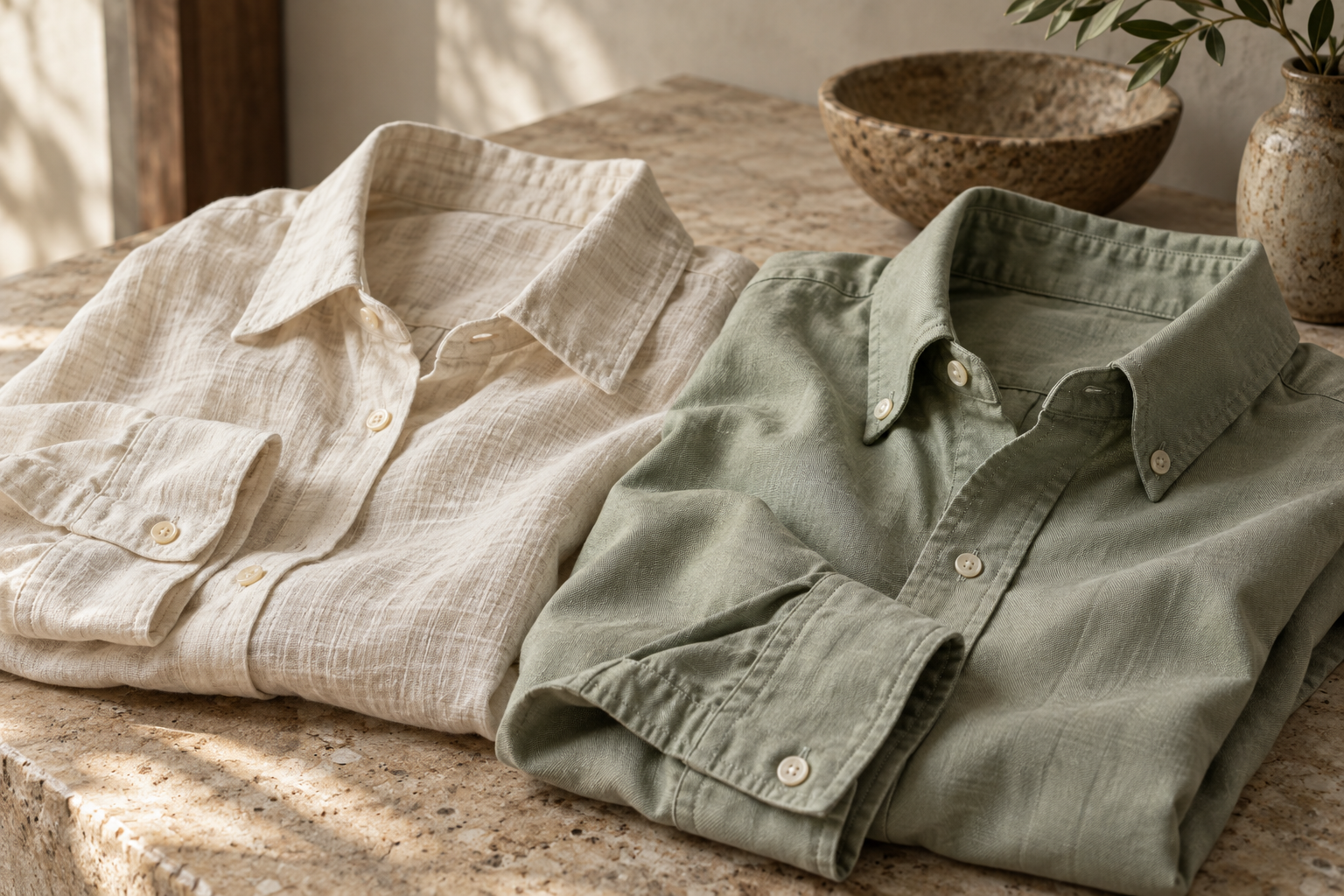
A SIMPLE STARTING POINT
Ease, with intention.
A women's smart casual capsule wardrobe is 25 pieces: five bottoms, eight tops, four layers, two dresses, three pairs of shoes, two outerwear pieces and one bag. Run it on three rules — a neutral base palette of navy, grey, black and white plus one accent, mostly solids, and every piece must pair with at least four others. That list covers an office working week, casual weekends and the dinners and events that land without warning. If 25 is too many to start with, the 15-piece budget subset below gets you dressed for work first and grows in the same order.
This guide gives you a repeatable way to get dressed. Read the short version of each step here, then follow the deeper guides when you want more detail.
01
The 25 pieces, listed up front
Here is the whole list, grouped, so you can audit your wardrobe against it in one pass. The men's version of the capsule follows the same skeleton with different garments.
- Bottoms (5): dark straight trousers, dark well-cut jeans, an A-line or straight skirt, a relaxed wide-leg trouser for events, and tailored shorts or a second skirt for hot climates.
- Tops (8): two quality shirts or blouses in white and a neutral, one silk-feel blouse that lifts everything, two fine knits for layering, two elevated tees for the casual end, and one striped or subtly patterned top so the solids have company.
- Layers (4): one blazer, one cardigan, one fine merino or knit layer, and one smart overshirt.
- Dresses (2): one structured day dress and one event-capable dress.
- Shoes (3): a closed pump or loafer-style pair, clean minimal sneakers, and one comfort flat.
- Outerwear (2): a trench or mac, and a proper winter coat.
- Bag (1): a neutral structured tote that fits a laptop.
Why these proportions: tops wear out fastest and carry the outfit's character, so they get the biggest group; bottoms and layers anchor and repeat. The design logic is the same one behind any working uniform — repeat the expensive quiet pieces, vary the visible cheap ones.
THE SHORT VERSION / 4 STEPS
Count what you own against the list before buying anything — most wardrobes already cover more than half.
Mark the empty slots only; ignore urge-buying anything the list does not ask for.
Choose the accent colour once — it lives in the second shirt, the knit and the scarf.
Note which slots your climate rewrites: shorts for hot cities, a real coat for cold ones.
02
The bottoms: five pieces that anchor everything
Dark straight or cigarette trousers are the workhorse — buy for a clean hip, a slight taper and a hem that meets your shoe without bunching at the knee. Dark, well-cut jeans cover casual Fridays and weekends; choose a rigid or near-rigid indigo with no distressing, because the wash is what keeps denim smart. The A-line or straight skirt is the dress-up option trousers cannot reach, and it pairs with every top in the list.
The relaxed wide-leg trouser is the event-flex piece — in a fluid fabric it reads dressed-up with the silk-feel blouse and dressed-down with a tee. The fifth slot flexes by climate: tailored shorts for hot cities, or a second skirt in a different weight. Fabric before label on all five — a mid-weight cloth with a little structure hangs better than anything flimsy, whatever the rail says.
THE SHORT VERSION / 5 STEPS
Buy the dark straight trousers first — they anchor more outfits than any other piece.
Add the jeans only if your weeks genuinely include casual days.
Choose the skirt in a neutral that pairs with every top you own.
Keep the wide-leg trouser long and fluid; a stiff wide leg reads costume.
Fill the fifth slot from your climate, not the calendar.
03
The tops: eight pieces from boardroom to dinner
Two quality shirts or blouses — white and one neutral — carry most working days, so buy for opacity, a fit that does not pull at the bust, and a fabric you are honestly willing to iron. The silk-feel blouse is the multiplier: over the dark trousers or under the blazer it converts the same basics into dinner-grade. Two fine knits or merino-blend tops handle layering season; check fibre content and pilling promises, because a pilled knit sinks an outfit faster than a cheap tee.
Two elevated tees in white and grey serve the casual end and the under-blazer days, and the last slot is one striped or quietly patterned top — the palette still needs a heartbeat. Together the eight cover every dress-code day a smart casual office can invent, which is exactly why tops get the largest share of the 25.
The layers group does quiet work here. One structured blazer in a neutral — worth spending up on, because budget blazers rarely hold a shoulder — plus the cardigan as a jacket alternative and a smart overshirt cover every temperature an office can weaponise.
THE SHORT VERSION / 5 STEPS
Buy the white shirt first; test it under the blazer with arms raised before keeping it.
Choose the silk-feel blouse in the accent colour — this is where the palette breathes.
Pick knits you can machine-wash or commit to hand-washing honestly.
Replace tees annually; they are wear items, not investments.
Let the patterned top be the only pattern until the capsule is complete.
04
Dresses and shoes: the shortcut and the foundation
Two dresses earn their slots by being one-piece outfits: the structured day dress solves the nothing-to-wear morning, and the event-capable dress absorbs every wedding invite and birthday dinner the other 23 pieces cannot. The three shoe slots decide more outfits than any top: a closed pump or loafer-style pair in black or a nude-for-your-skin tone, clean minimal sneakers for the casual end, and one genuinely comfortable flat for long days. Spend attention here even on a small budget, because scuffed or failing shoes sink a capsule faster than any cheap top ever will — the budget dress shoes logic applies to women's picks identically. Polish, heel taps and a cobbler visit on time keep all three pairs alive for years.
THE SHORT VERSION / 5 STEPS
Choose the day dress in a fabric that survives a desk chair and a commute.
Keep the event dress simple enough to re-wear across seasons — accessories change the occasion.
Break in the comfortable flat before a big day, never on one.
Keep sneakers clean; they are the only pair the internet will photograph.
Budget a cobbler fund alongside the shoe budget — heels and soles are consumables.
05
The mix-and-match proof: what 25 pieces actually produce
The math is the point: 25 pieces that all pair with at least four others produce far more outfits than a month has days. Run one week to see it — the Monday-to-Friday version is listed below. Notice every outfit mixes groups: no bottom sits with only one top, and no layer serves only one look.
- Monday: dark trousers, white shirt, blazer, loafers.
- Tuesday: day dress, cardigan, flats.
- Wednesday: jeans, striped top, sneakers — the casual day.
- Thursday: skirt, fine knit, loafers.
- Friday: wide-leg trouser, tee, blazer — pushed to evening with the silk-feel blouse for the dinner.
The honest test for any new piece: if it pairs with fewer than four things you own, it is not a capsule piece, it is a single outfit. And before buying anything, run the audit — most wardrobes already hold about half this list, just unsorted. When building from almost nothing instead, the starter checklist and buy order gives the twelve-item version.
| Day type | Bottom or dress | Top | Layer | Shoes |
|---|---|---|---|---|
| Office, standard | Dark trousers | White shirt | Blazer | Loafers |
| Office, warm day | Tailored shorts | Fine knit | Overshirt | Comfort flat |
| Office, presentation | Day dress | — | Blazer | Pumps |
| Casual Friday | Dark jeans | Elevated tee | Cardigan | Minimal sneakers |
| Client dinner | Wide-leg trouser | Silk-feel blouse | Blazer | Loafers |
| Weekend errands | Dark jeans | Elevated tee | Overshirt | Minimal sneakers |
| Weekend lunch | Skirt | Striped top | Cardigan | Comfort flat |
| Event, evening | Event dress | — | Coat | Pumps |
| Travel day | Wide-leg trouser | Fine knit | Coat or trench | Comfort flat |
| Long-day meetings | Dark trousers | Second shirt | Cardigan | Comfort flat |
THE SHORT VERSION / 4 STEPS
Lay out one full week of outfits from the list as a proof before adding anything.
Apply the four-pair rule to every candidate purchase.
Log what you actually wore for a month — the unworn pieces tell you which slot you mis-bought.
Swap seasonally at the edges: knits out, lighter fabrics in, core untouched.
06
Adapting the capsule: budget, body and climate variants
The 25 skeleton flexes to almost any constraint without changing its logic. Budget variant: start with the 15-piece subset — both dark trousers, the jeans, the white shirt, the silk-feel blouse, two tees, one fine knit, the blazer, the cardigan, the day dress, the loafers and the sneakers — and grow by the buy order. Over-50s and anyone whose style has settled often swaps the tee slots for a third knit and leans more structured, which the women over 50 smart casual guide covers properly.
Petite, tall and plus-size readers adjust lengths, not slots — hems and rises change, the four-pair rule does not. Hot climates rewrite the fabric list rather than the count: linen and cotton replace wool weights, per the hot and humid smart casual guide. The buy order if starting truly from scratch: bottoms, shoes, tops, layers — because outfits are blocked from the bottom up.
THE SHORT VERSION / 5 STEPS
Start with the 15-piece subset and grow one slot at a time.
Audit the wardrobe first; existing pieces often cover half the list.
Adjust lengths and cuts for your body — never delete slots for it.
Swap fabrics, not pieces, for hot or cold climates.
Buy in order: bottoms, shoes, tops, layers.
SEE THE IDEA AT WORK
The 15-piece budget start: one month of work days
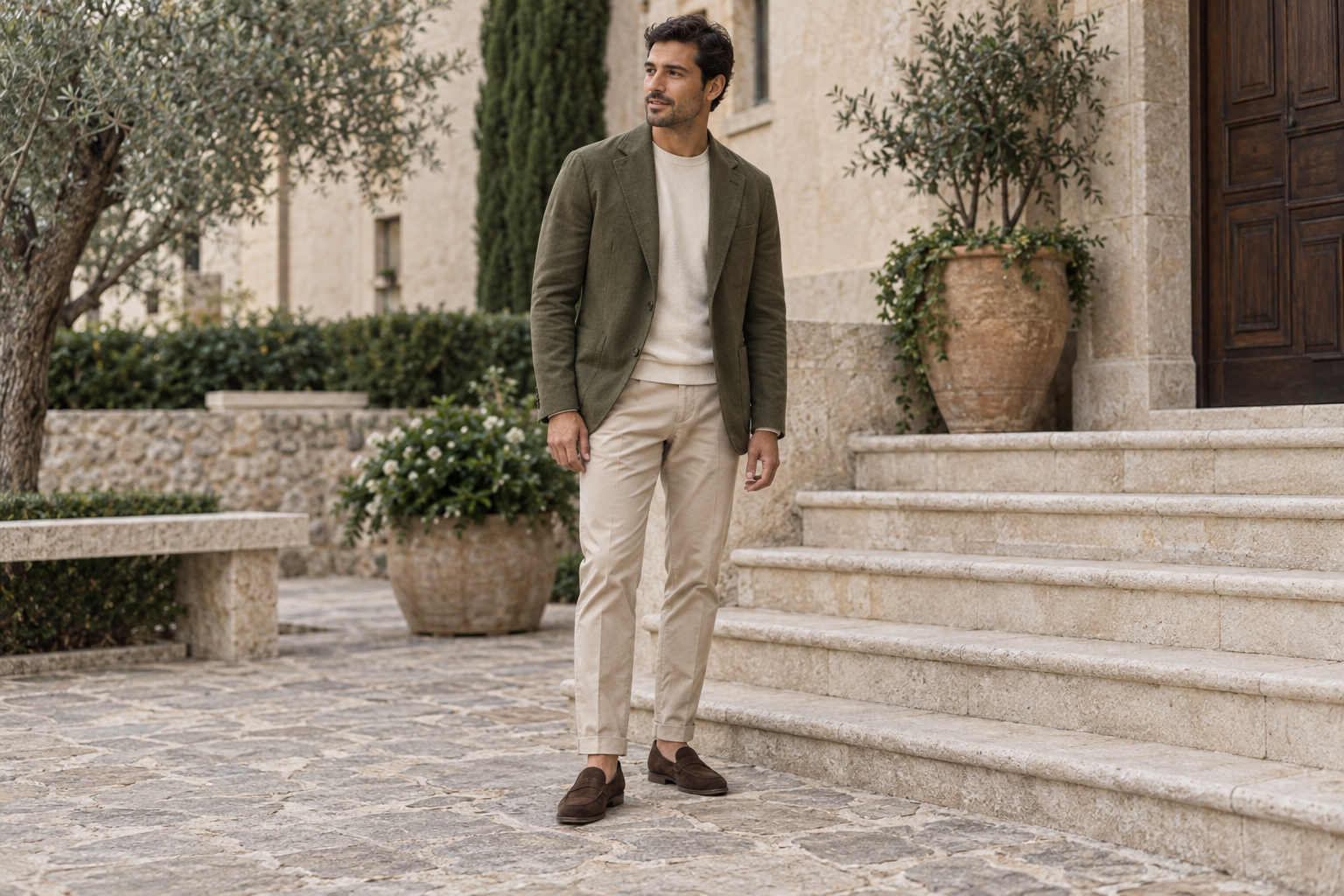
The budget subset in practice: week one runs on the core three pieces — dark trousers, white shirt and blazer on Monday, tees and cardigan midweek, the silk-feel blouse and loafers on Thursday, which doubles as the dinner look if an invitation lands. Week two repeats the skeleton with the knit swapped for the shirt and the skirt replacing the trousers on the dressiest day. The repetition is the system, not a failure — nobody outside your wardrobe can see the count. Add the remaining ten pieces in the buy order as budget allows, and the full 25 arrive without a single panic purchase.
- Dark straight trousers
- Dark jeans
- White shirt
- Silk-feel blouse in the accent colour
- Two elevated tees
- Striped top
- One fine knit
- Blazer
- Cardigan
- Day dress
- Loafers or pumps
- Minimal sneakers
- Structured tote
| Piece | Colour | Fit checkpoint | Tier note |
|---|---|---|---|
| Dark straight trousers | Charcoal or navy | Clean hip, no knee-bagging, hem at shoe | Worth spending up |
| Dark jeans | Indigo, no distressing | Waist stays up without a belt, straight leg | Mid is fine |
| A-line or straight skirt | Black or grey | Sits at natural waist, walks without riding | Budget is fine |
| Wide-leg trouser | Navy or stone | Fluid drape, hem skims the floor with shoes | Worth spending up |
| Tailored shorts or second skirt | Neutral | Mid-thigh or longer, tailored hem | Budget is fine |
| White shirt or blouse | White | Opaque, no bust pull, sleeve at wrist bone | Worth spending up |
| Second shirt or blouse | Neutral | Same rules as the white | Mid is fine |
| Silk-feel blouse | Accent colour | Hangs clean over trousers, no static cling | Mid is fine |
| Fine knit 1 | Navy or grey | Sleeve to wrist bone, hem below belt | Mid if you can |
| Fine knit 2 | Accent or camel | Same, in the second colour | Budget is fine |
| Elevated tee 1 | White | Mid-weight, opaque, hem at mid-fly | Budget is fine |
| Elevated tee 2 | Grey or black | Same | Budget is fine |
| Striped or patterned top | Base plus accent | Pattern small enough to pair widely | Budget is fine |
| Blazer | Navy or black | Shoulder seam at shoulder, room for a knit | Worth spending up |
| Cardigan | Neutral | Buttons without strain over a shirt | Mid is fine |
| Merino or knit layer | Grey or accent | Slim enough to sit under the blazer | Mid if you can |
| Smart overshirt | Neutral or flannel | Sits straight at hip, closes over a tee | Budget is fine |
| Day dress | Navy or black | Structured fabric, survives a desk chair | Worth spending up |
| Event dress | Accent or black | Re-wearable across seasons | Worth spending up |
| Pumps or loafer-style | Black or nude | Walkable heel, no gape at the side | Worth spending up |
| Minimal sneakers | White | Clean silhouette, leather or leather-look | Budget is fine |
| Comfort flat | Neutral | Broken in before a big day | Mid is fine |
| Trench or mac | Stone or navy | Fits over the blazer, sleeve at wrist bone | Worth spending up |
| Winter coat | Black or camel | Room for blazer underneath | Worth spending up |
| Structured tote | Black or tan | Fits a laptop, sits on the shoulder | Mid is fine |
A last look in the mirror.
A MOMENT BEFORE YOU GO
0 of 11 ready
SMALL ADJUSTMENTS
When it feels almost right.
Why does my capsule feel boring after a month?
Usually a missing accent: an all-neutral list needs the one accent colour and the one patterned top to breathe, or every outfit reads like the same outfit. If the palette is complete and it still bores you, the gap is accessories — belts, scarves and jewellery are outside the 25 for exactly this reason.
I bought pieces that only make one outfit each — what went wrong?
The four-pair rule was skipped: anything that pairs with fewer than four existing pieces is a standalone outfit, not a capsule piece. Return or resell the orphans and re-run the count against the list before the next purchase.
My budget vanished on tops and I still have nothing to wear.
The buy order ran backwards: tops were bought before bottoms and shoes, so nothing combined. Outfits are blocked from the bottom up — anchor the trousers and shoes first, and the tops you already own suddenly have something to pair with.
Still wondering?
What should be in a women's smart casual capsule wardrobe?
Twenty-five pieces: five bottoms, eight tops, four layers, two dresses, three pairs of shoes, two outerwear pieces and one bag, all in a neutral base palette plus one accent, with every piece pairing with at least four others. The full itemised list with fit checkpoints is in the table above.
How many pieces do you actually need?
Twenty-five core pieces cover work, weekends and most events, with seasonal swaps at the edges. You can run a working week on a fifteen-piece subset, and many wardrobes function on exactly that for years — the extra ten add event coverage and climate range, not basics.
How do you build a capsule wardrobe on a budget?
Start with the 15-piece subset, buy in the order bottoms, shoes, tops, layers, and audit your existing wardrobe first — most people already own about half the list. Spend up only on the three pieces that touch everything: the dark trousers, the blazer and the primary shoes.
What colours should a capsule wardrobe be?
A neutral base — navy, grey, black and white — plus one accent colour that lives in two or three pieces. Neutrals guarantee any two things pair; the accent stops the palette reading flat. Add the second accent only after a full season, if the wardrobe genuinely asks for one.