A SIMPLE STARTING POINT
Ease, with intention.
A men's smart casual capsule wardrobe is 20 pieces in a navy-grey-white-olive palette: four bottoms, six shirts and tops, two knits, two jackets, three pairs of shoes and three accessories, chosen so every piece works with at least four others. That covers a working week, a weekend and a wedding without buying anything single-purpose.
This guide gives you a repeatable way to get dressed. Read the short version of each step here, then follow the deeper guides when you want more detail.
01
The 20 pieces, listed
Here is the whole 20, grouped so you can audit your wardrobe in one pass.
THE SHORT VERSION / 3 STEPS
Count what you own against the list before buying anything — most wardrobes already cover half
Write the missing pieces on one line and buy in the order below
Reject any purchase that pairs with fewer than four pieces already on the list
02
The build order from scratch
Trousers first, because everything else is chosen against them: dark jeans, navy chinos, grey dress trousers. Shoes second, since they are the hardest to substitute and where budget goes furthest. Shirts third, knitwear fourth, outerwear last — jackets are the easiest to borrow, improvise and add later. At the budget end, the 12-piece starter subset is the four bottoms, white and blue shirts, two polos, the merino crew, sneakers, the dark derby and the brown belt; the rest follows over three months without panic.
THE SHORT VERSION / 3 STEPS
Buy trousers before shirts — the fits anchor every top decision
Buy shoes before knitwear — quality here pays for itself in years, not seasons
Leave outerwear until the core works on its own, then add one jacket at a time
03
The mix-and-match proof
Twenty pieces chosen under the four-pairings rule produce well over seventy distinct outfits — but the number matters less than a real week with no repeats. The table below is one, drawn entirely from the list. Seasonal swaps keep the 20 intact: summer trades the dress trousers for shorts and the crew for a second polo; winter swaps shorts for flannel and adds the coat and a scarf.
THE SHORT VERSION / 3 STEPS
Lay out Monday to Sunday and assign an outfit per day with no repeats
Any day you cannot fill points at a genuine gap, not a shopping urge
Run the swap test: pull one piece and count its replacements — more than four means it earns its place
04
Adapting the 20 to you
Hot climates: swap the dress trousers for a second lightweight chino, put shorts and knit polos in, and let the sneakers do more work. Bigger, shorter or taller frames: keep the same 20 but spend the alteration budget at the hem and the shoulder — the list survives, the tailoring does the fitting. Age changes the calibration, not the list: in your twenties buy the budget version and replace as things wear out; past forty, buy fewer but better within the same 20 slots. As a wedding guest, the existing pieces cover almost everything — the one add-on is an unstructured jacket in a lighter shade.
THE SHORT VERSION / 3 STEPS
Adjust for your climate before your aesthetic — heat and rain override taste
Tailor two or three anchor pieces rather than buying more pieces
Revisit the list every season and demote anything unworn twice in a row
SEE THE IDEA AT WORK
The week that proves the list
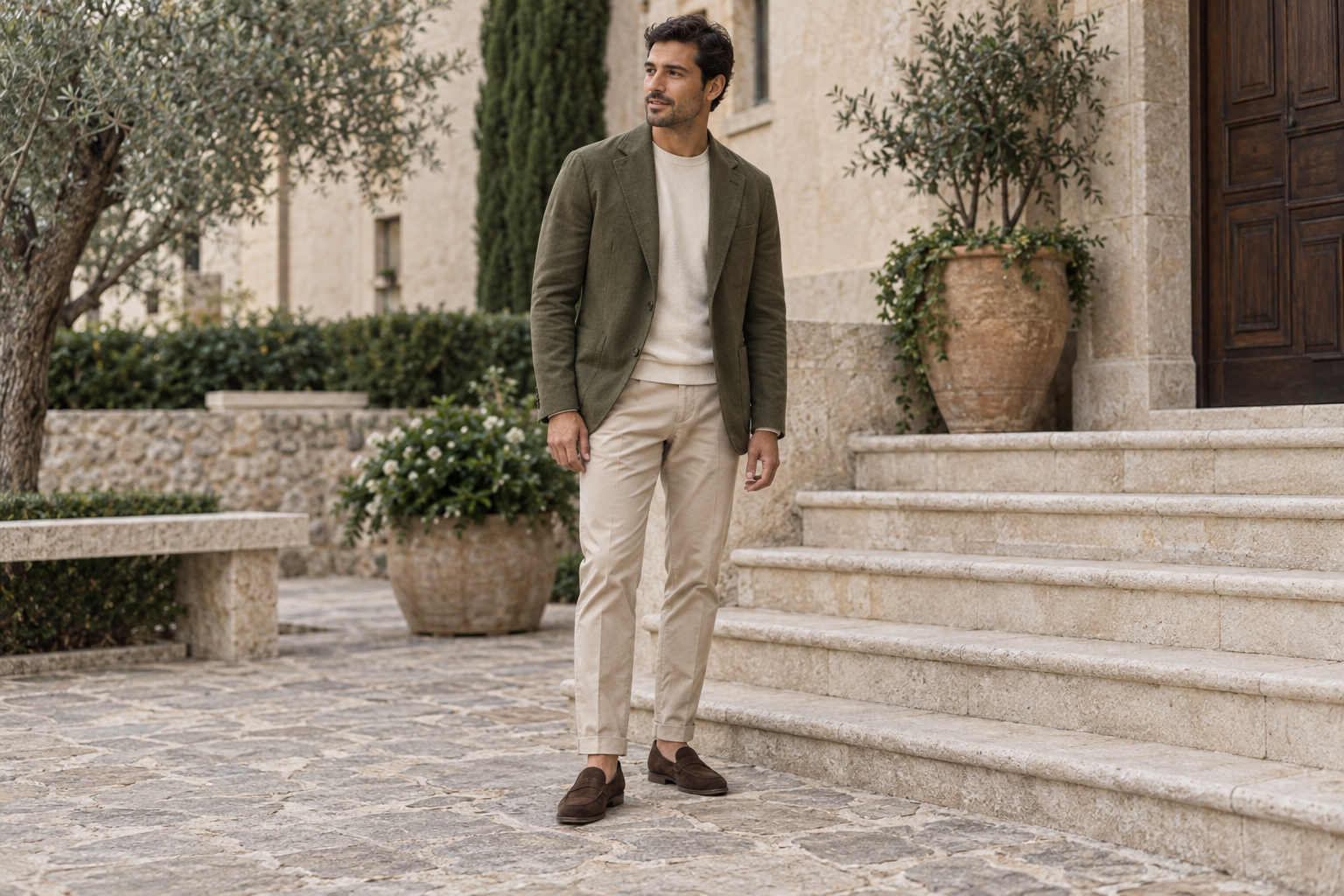
A working week with a pub night on Wednesday and a Saturday wedding as a guest, drawn entirely from the 20 pieces with one borrowed add-on — the light unstructured jacket. Nothing was bought for the wedding, and no outfit repeated. That is the whole argument for the capsule: the pieces were decided once, in advance, so the week runs on automatic.
- White oxford and light blue poplin doing five of the seven days
- Navy chinos as the trouser workhorse — three days, three formality levels
- The same suede Chelsea boots at an office on Tuesday and a wedding on Sunday
- One light unstructured jacket as the wedding-guest extension piece
| Day | Top | Bottom | Shoes | Layer |
|---|---|---|---|---|
| Mon — office | White oxford, tucked | Navy chinos | Dark derbies | Merino crew |
| Tue — office | Light blue poplin, tucked | Grey dress trousers | Suede Chelsea boots | None |
| Wed — office to pub | Knit polo | Navy chinos | White sneakers | Overshirt |
| Thu — office | Merino crew over white oxford | Dark jeans | Dark derbies | None |
| Fri — casual | Plain tee | Dark jeans | White sneakers | Bomber jacket |
| Sat — weekend | Knit polo | Smart shorts | White sneakers | None |
| Sun — wedding guest | Light blue oxford, open collar | Grey dress trousers | Suede Chelsea boots | Light unstructured jacket |
A last look in the mirror.
A MOMENT BEFORE YOU GO
0 of 18 ready
SMALL ADJUSTMENTS
When it feels almost right.
Do I have to buy all 20 at once?
No — and you probably should not. Audit the wardrobe first, because most men already own half the list, then buy the missing pieces in the build order: trousers, shoes, shirts, knitwear, outerwear.
Why knit polos instead of t-shirts?
A knit polo has a collar and a structured placket, so it reads smart without any layering — it is the one piece that makes shorts and chinos look deliberate. The two tees stay on the list for layering and the genuinely casual end.
What colours should a men's capsule be?
Navy, grey, white and olive as the base, plus one accent you actually wear — that palette is what makes the four-pairings rule possible. Two clashing accent colours are what quietly kill interchangeability.
Still wondering?
What is a men's smart casual capsule wardrobe?
Twenty pieces chosen so every one works with at least four others: four bottoms, six shirts and tops, two knits, two jackets, three pairs of shoes and three accessories. It covers office weeks, weekends, dinners and weddings as a guest — not black tie.
How many clothes does a man actually need?
About 20 core pieces plus seasonal swaps. Past that point, each new item halves in wear frequency — piece 25 gets worn a fraction as often as piece 5, which is why the list stops where it does.
How do you build a capsule wardrobe on a budget?
Start with the 12-piece subset — four bottoms, four tops, the merino crew, sneakers, the dark derby and the brown belt — and add one piece at a time. Spend the real money on shoes, where quality lasts for years.
What colours should a men's capsule be?
Navy, grey, white and olive, with one accent. Mostly solids, so any two pieces you pull from the wardrobe already agree with each other.