A SIMPLE STARTING POINT
Ease, with intention.
Build a smart casual wardrobe from scratch with twelve items: two bottoms, three tops, one knit or layer, one jacket, two pairs of shoes, a belt, a bag and a watch or simple accessory. Buy in this order — dark trousers first, shoes second, everything else after — and you are presentable for work within a week, complete within a season. Weddings and formal events are deliberately not covered by the starter twelve; they are extensions you add later, with wear evidence to justify them.
This guide gives you a repeatable way to get dressed. Read the short version of each step here, then follow the deeper guides when you want more detail.
01
The 12 items, and what they cover
The starter twelve are deliberately unisex slots — each fills with a men's or women's piece to taste, and the fuller versions are in the men's capsule wardrobe and women's capsule wardrobe guides — and once the twelve are assembled they combine into a working week on the five work outfits pattern. What the twelve cover: work, casual weekends and one dinner out. What they deliberately do not: weddings, funerals and formal events — those are grown in the final chapter below, not bought in a panic before you own anything else.
| Item | Colour | Fit checkpoint | Tier note |
|---|---|---|---|
| Dark tailored trouser | Charcoal or navy | Clean hip, slight taper, hem at your shoe | Worth spending up |
| Dark jean | Indigo, no distressing | Straight leg, waist sits without a belt | Mid is fine |
| Oxford-style shirt | White or light blue | Shoulder seam at shoulder, one finger at collar | Mid is fine |
| Quality tee | White or grey | Mid-weight, opaque, hem at mid-fly | Budget is fine |
| Second shirt or blouse | Your accent colour | Same shoulder rule; no chest pulling | Budget is fine |
| Knit or layer | Navy or grey | Sleeve to wrist bone, hem below belt | Mid if you can |
| Blazer or overshirt | Navy or neutral | Room for a knit under; shoulder seam correct | Worth spending up |
| Smart shoe | Brown or black leather | Thumb width at toe, no heel slip | Worth spending up |
| Minimal sneaker | White | Fits with a sock you own | Budget is fine |
| Belt | Matching your smart shoe | Waist plus two inches, middle hole | Budget is fine |
| Bag | Neutral | Fits a laptop or a day's errands | Mid is fine |
| Watch or accessory | Metal or leather tone | Quiet enough for every outfit above | Budget is fine |
The swap slots are deliberate equivalents, not workarounds: a jersey dress can stand in for a bottom plus top; chelsea boots can replace derbies; an overshirt can be the jacket. What is not swappable is the fit checkpoint in each row — that is what makes budget versions look intentional instead of cheap.
THE SHORT VERSION / 6 STEPS
Fill the two bottom slots: one dark tailored trouser, one dark jean or equivalent (a jersey dress fills both slots for some people).
Fill the three top slots: one white or light oxford-style shirt, one plain quality tee, one smarter blouse or shirt in a second colour.
Add one knit or layer — a merino or cotton crewneck that goes over the shirts.
Add one jacket: an unstructured blazer or a smart overshirt, depending on which you will actually wear.
Fill the two shoe slots: one smart pair (derby, loafer or block heel) and one clean minimal sneaker.
Finish with belt, bag and one accessory — a watch or its equivalent. That is twelve.
02
What do you buy first? The order and the reasoning
The sequence is trousers, shoes, shirts and tops, knit, jacket, accessories — ranked by wear frequency and by how much each purchase unlocks. The first purchase alone gives you a trouser-plus-tee combination; the second makes it leave-the-house presentable; by the fourth you have a full working week. If paydays rather than weekends pace your buying, the same order simply runs in instalments.
The deferred list matters as much as the order: no blazers beyond the one, no occasion wear, no trend pieces. Each is deferred for the same reason — it serves an event you may not have yet, while the starter twelve serve every day. Keep the whole twelve within the palette rules below and the budget takes care of itself.
THE SHORT VERSION / 6 STEPS
Buy the dark tailored trouser first — it appears in more of the eventual combinations than any other piece.
Buy the smart shoe second — outfits are blocked by shoes more often than tops, and this unlocks the trouser immediately.
Buy the three tops third — with trousers, shoes and tops you can already dress for five different days.
Add the knit when the weather or the office asks for a layer.
Add the jacket last of the clothes — it upgrades outfits you already own rather than creating new ones.
Fill belt, bag and accessory in one go, sized to the shoes and clothes you have confirmed, not guessed.
03
Fit rules for beginners: the five checks that matter
Beginners buy too big, almost always, because size reads as comfort and comfort reads as safety. Five checks catch it: the shoulder seam ends at the shoulder bone, the trouser rise sits at your natural waist without gapping, the shirt sleeve ends at the wrist bone, the trouser hem breaks once on the shoe, and nothing needs to be stretched or bloused to look right. The photo check beats the mirror check, because phone cameras see what vanity smooths over.
Buy the honest fit, not the aspirational one. Clothes that fit you today get worn; clothes bought for a future body stay tagged in the wardrobe, and the tags are the most expensive part of any wardrobe.
THE SHORT VERSION / 5 STEPS
Check the shoulder seam first — it cannot be altered cheaply, so a wrong shoulder is a return, not a project.
Sit down in trousers before deciding — the rise that works standing often fails in a chair.
Take a phone photo in the fitting room and look at it cold — the too-big trap is visible in seconds.
Separate what a tailor can fix cheaply (hems, sleeves, small take-ins) from what they cannot (shoulders, rises) before you buy.
Test one piece from any new brand before ordering three — sizing varies more between brands than between sizes.
04
The starter palette: colour decisions made once
Decide the palette once and every future purchase gets easier: navy, grey, white and one earth tone, with a single accent at most. Neutrals first because they maximise combinations and demand no colour confidence — any two things you own will pair. Black is fine as a smart casual base too, though head-to-toe black reads more formal than the same outfits in navy. If you want colour chosen for your skin tone rather than by rule of thumb, colour analysis does it properly.
This is also why the palette saves money: a twelve-piece wardrobe in four colours holds more outfits than a twenty-piece wardrobe in twelve colours. Combinations, not count, are what a wardrobe is made of.
THE SHORT VERSION / 4 STEPS
Lock the four base colours: navy, grey, white, one earth tone.
Allow one accent colour maximum in the starter twelve — it lives in the second shirt or blouse.
Buy every new piece against the palette: if it pairs with fewer than three things you own, it waits.
Keep patterns out until the second season — solid starters mix; patterned starters become outfits of one.
05
After the starter twelve: the growth map
The next additions, in order, each gated by wear evidence rather than by seasons on the calendar: an occasion shirt or dress when a real event lands, a blazer upgrade when the starter jacket is genuinely worn out, a proper coat for the first winter you commute through, better shoes once you know which pair you reach for. The audit habit runs underneath it all: quarterly, check what is worn, what is missing, and what never left the wardrobe. If the starting point was a life change rather than a new job — a move, a loss, a reset — the same twelve slots apply; give yourself the slower, phased timeline and skip the guilt.
THE SHORT VERSION / 4 STEPS
Log what you actually wear for one quarter — hangers backwards, notes app, any method you will keep up.
Add the next piece only when a real occasion or a worn-out starter piece creates the need.
Upgrade in the order you bought: trousers and shoes earn replacement first, because they were worn hardest.
Run the quarterly audit before any sale shopping — sales bought against an audit fill gaps; sales bought on their own fill wardrobes.
SEE THE IDEA AT WORK
Week one from three purchases
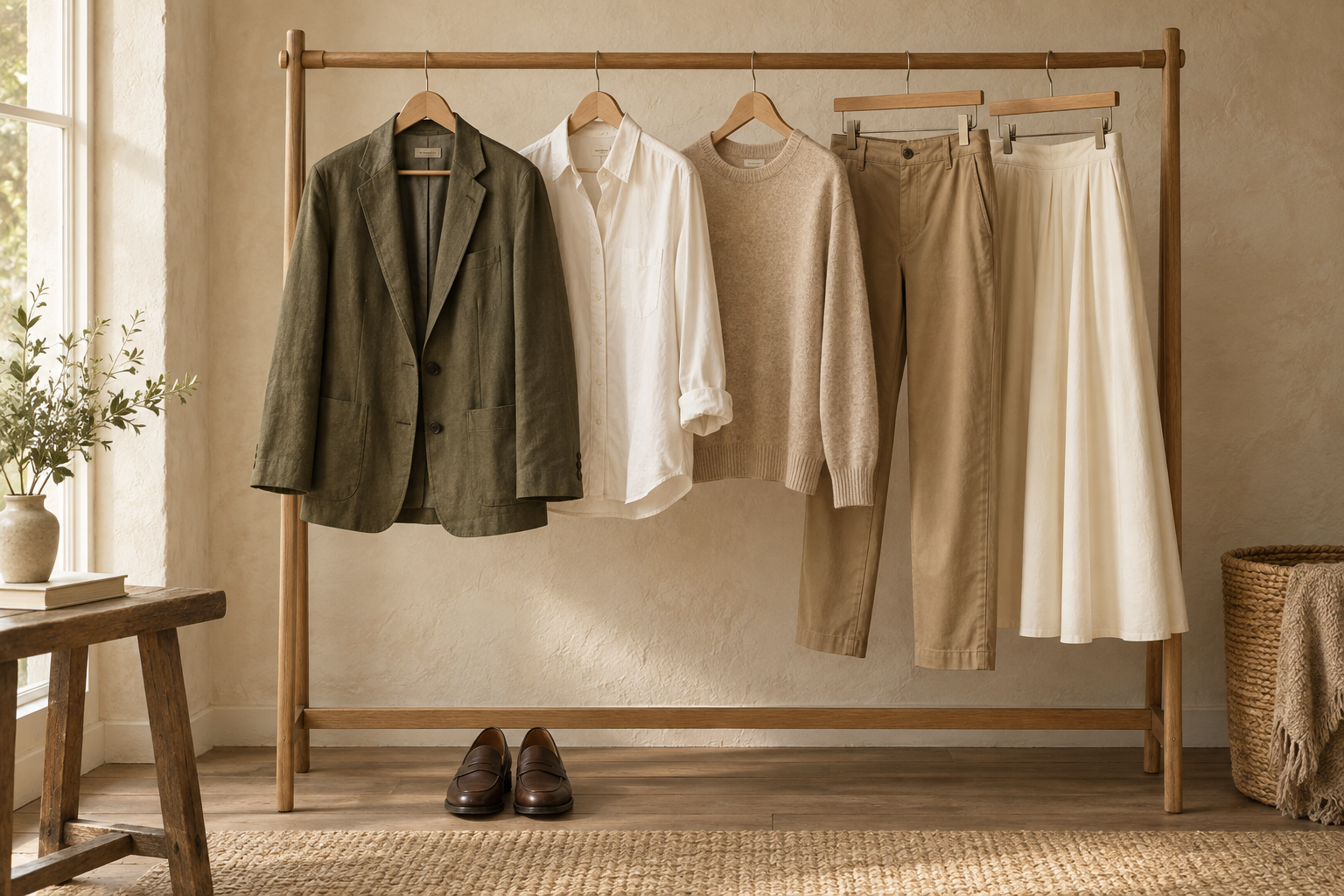
The first-week wardrobe in practice, using only the first three buys: the dark trouser, the smart shoe, and the three tops. Each day below reuses the same trouser and shoe rotation — repetition is the system working, a uniform with variations, which is what every good wardrobe is anyway.
- Monday: trouser, oxford shirt, smart shoe
- Tuesday: trouser, tee, sneaker — the casual day
- Wednesday: trouser, accent shirt, smart shoe
- Thursday: trouser, tee, sneaker again, different outer layer if the weather asks
- Friday: trouser, oxford shirt with sleeves rolled, sneaker — the office-to-evening version
| Path | How it runs | Trade-off |
|---|---|---|
| Budget tier, one month | All twelve at budget tier in the standard buy order | Presentable fast; the shoe and jacket get upgraded earliest |
| Mid tier core, two months | Spend up on trouser, smart shoe and jacket; budget the rest | Slower start; fewer replacements in year two |
| Phased, three instalments | One pay-cycle per tranche, standard order preserved | Same end point; week one runs on trouser, shoes and tees |
A last look in the mirror.
A MOMENT BEFORE YOU GO
0 of 12 ready
SMALL ADJUSTMENTS
When it feels almost right.
Why does everything I buy look wrong in photos?
Almost always size — beginners buy too big and the mirror forgives what the camera records. Take fitting-room photos, check the shoulder seam first, and return rather than tailor anything with a wrong shoulder or rise.
Why do I own clothes that go with nothing?
Because they were bought as standalone likes rather than against a palette. Lock navy, grey, white and one earth tone, allow a single accent, and buy only what pairs with at least three things you already own.
Why did my starter budget vanish on things I never wear?
Because the buy order was ignored: occasion wear, trend pieces and extra blazers were bought before the trouser-and-shoe core was complete. The order exists so every purchase unlocks the most outfits at that moment.
Still wondering?
How do I build a smart casual wardrobe from nothing?
Twelve items: two bottoms, three tops, one knit, one jacket, two shoes, belt, bag, one accessory. Choose against one palette in one fit standard, and buy them in the order that unlocks the most outfits at each step.
What should I buy first?
Dark tailored trousers, then a smart shoe. The trouser appears in more combinations than anything else, and the shoe is what most outfits are blocked by — those two alone make you leave-the-house presentable.
How much does a starter wardrobe cost?
It depends on tier, and we avoid quoting prices that go stale. The structure: a full budget-tier set costs about as much as one mid-tier jacket and pair of shoes — spend up on those three pieces and budget the rest.
How long does it take?
Presentable for work in a week — two or three purchases in the right order. Complete starter twelve in one to three months depending on budget, and genuinely settled in a season, once wear evidence starts guiding the upgrades.