A SIMPLE STARTING POINT
Ease, with intention.
Yes, good dress shoes exist under £100/$150 — with rules. At this price every shoe is glued (cemented) rather than stitched, so buy the styles that hide it well: a plain dark leather derby, a simple penny loafer, or a clean minimal leather sneaker. What you give up is resoling and decade-long daily wear; what you should never accept is a glossy pointed oxford, visible glue lines, or a slip-on hybrid. If you wear dress shoes three or more days a week, saving for a welted pair is genuinely worth it — for everyone else, a well-chosen budget pair with basic care does the job.
This guide gives you a repeatable way to get dressed. Read the short version of each step here, then follow the deeper guides when you want more detail.
01
Is it even worth it to spend more? The honest math
The question underneath every budget shoe search is whether the extra money is wasted. Here is the honest version: a cheap shoe worn daily dies in roughly a year — the glued sole lifts, the heel counter collapses, the lining flakes — while a welted shoe costs several times more and measures its life in years. Neither number changes your outfit; what changes everything is wear frequency.
At one day a week or less, the budget pair may outlast your interest in it. At three or more days a week, the welted pair wins on cost per wear and on how your feet feel at four in the afternoon — spend where the wear actually is, which is the logic behind every affordable brands verdict: cheap where rotation hides it, good where it shows.
One wrinkle that flatters small budgets: rotation. Two £60 pairs alternating never wear out at the rate one pair does, because leather needs a rest day to dry from foot moisture. Two cheap shoes in rotation can outlast one cheap shoe worn daily by years — the middle-ground shoe styles guide covers how to split the roles.
THE SHORT VERSION / 4 STEPS
Count your actual dress-shoe days from the last three months, not the ones you imagine.
One day a week or less: buy budget, buy the right style, and stop worrying.
Two to three days a week: one good mid-tier pair plus a budget backup.
Daily wear: the one case where spending more is not optional — your feet collect the difference.
02
What under-£100 shoes are actually made of
Every shoe at this price is cemented: the sole is glued to the upper, not stitched. That is not a scandal — plenty of shoes at several times the price are glued too. What varies is the material honesty: real leather creases softly, smells like a leather goods counter, and shows pores, while bonded scraps and coated synthetics feel cold and plasticky, fold with a crisp snap, and peel at the flex point within a season.
The label matters less than the fold test in your own hands. The 60-second inspection below catches most of the truth before you pay.
THE SHORT VERSION / 5 STEPS
Press the toe: it should firm up again, not stay creased like paper.
Look where the sole meets the upper — a neat bond line is fine, a wavy glue smear is not.
Squeeze the heel counter: it should spring back, not collapse like a biscuit.
Check the insole edge and lining: fabric or leather, not exposed foam.
Flex the sole: it bends at the ball of the foot, not in the middle of the arch.
03
What's good at this price: the styles that survive
Some silhouettes hide budget construction well and others expose it, so choose by shape. The plain dark leather derby is the champion: its open lacing flatters a heavier shoe, it forgives a chunkier sole, and nothing about it announces a price. A simple penny loafer in dark leather is the second survivor — the clean upper reads intentional, and the oxford versus derby split explains why the derby wins at this tier while the slim oxford does not.
The third survivor is the clean minimal leather sneaker, which is honest about being casual and therefore never looks like a failed dress shoe. Colour discipline does the rest: black and dark brown only, because every bargain tan, oxblood or two-tone pair limits your outfits to roughly one.
We deliberately name styles rather than specific models: ranges turn over season to season and prices go stale fast. Run whatever is currently on the shelf near you through the inspection above plus the style rules here — that combination outlasts any product list.
THE SHORT VERSION / 5 STEPS
Buy the dark leather derby first — it covers interviews, dinners and every office day.
Add the plain loafer when your week has smarter evenings than the derby wants.
Keep a minimal leather sneaker as the casual third, not a dress-shoe substitute.
Consider dark suede only if you accept weather fragility — see the skip list below.
Stay in black and dark brown until you own both.
04
What to skip: the false economies
The traps at this price are shapes, not brands. The glossy pointed oxford reads cheap from across a room — high shine, thin leather, and a silhouette borrowed from rental suits. Slip-on dress sneakers and gym-formal hybrids are the worst of both worlds: too sporty for trousers, too stiff for jeans.
Very cheap leather boots usually carry the same bonded material with more seams to peel. And any deep-discount final-sale shoe without returns is a fit gamble dressed up as a deal — at this tier, fit risk costs more than the discount saves.
Suede deserves its own warning. Budget suede is often thin, and water spots sit on it loudly — buy it only as a dry-weather loafer, and read the suede and light rain rules before you commit. If your week includes real weather, stay in smooth leather.
THE SHORT VERSION / 4 STEPS
Skip pointed, glossy, heavily decorated oxfords — the silhouette ages the shoe before you wear it.
Skip slip-on hybrid dress sneakers entirely.
Skip anything with a visible glue wave or plastic sheen on the upper.
Skip final-sale bargains unless you have already worn that exact model and size.
05
Making budget shoes last: the care that doubles lifespan
Care is where cheap shoes earn their keep, because the ceiling on their life is set by neglect more than by materials. A small kit — cedar shoe trees, a horsehair brush, one tin of polish — roughly doubles what a budget pair survives, mostly by drying the leather overnight instead of letting it rot from the inside. Rotation does the same work for free.
Weather discipline matters most of all: salt and standing water finish budget leather fast, so bad-weather days belong to the sneaker or the boot. And when the sole bond finally lets go, that is the end — glued soles are not worth resoling, and trying usually costs more than a new pair.
The full routine — products, motions, and what each one actually does — is in the leather shoe care basics guide. And when the moment comes to spend properly, the where to buy smart casual clothes online guide covers which retailers make the mid tier affordable.
THE SHORT VERSION / 5 STEPS
Put shoe trees in within an hour of taking the shoes off — this one habit does most of the work.
Brush off dust and buff with the horsehair brush each wear.
Polish monthly in regular use, and always the night before an event.
Never wear the same pair two days running — alternate pairs share the drying time.
Retire the pair when the heel counter collapses or the bond lifts; do not pay a cobbler to fight cement.
SEE THE IDEA AT WORK
One pair, one week: the dark derby test
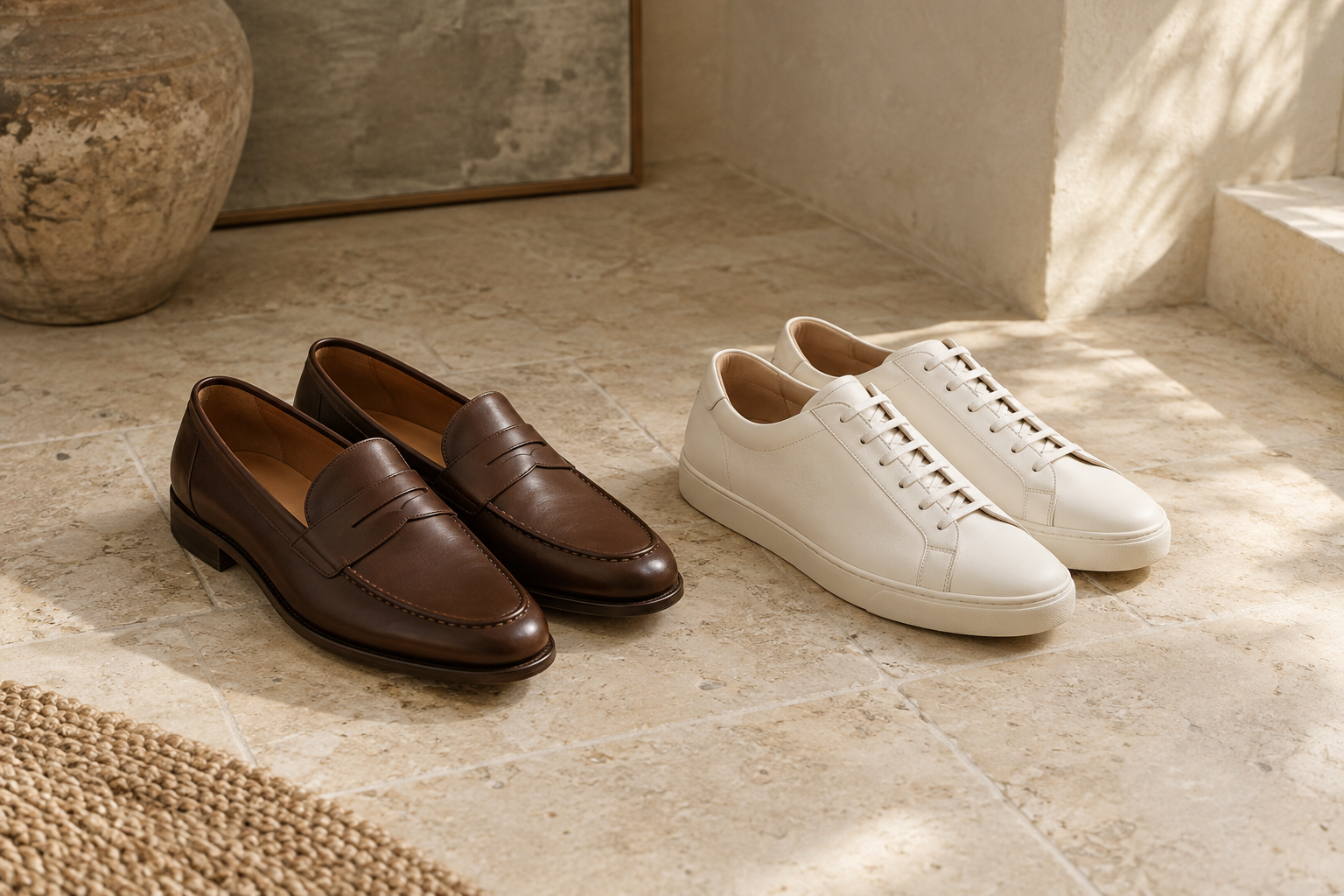
Here is what the single right budget purchase looks like in a real week: Monday interview with charcoal trousers and the derbies polished the night before, Wednesday office with grey chinos and an oxford shirt, then a Saturday dinner with dark jeans and the knit again. Friday the derbies rest while the minimal sneakers run. Three dressed-up days and a casual day, one pair under budget — and nobody in any of those rooms is thinking about sole construction. The derby only fails the week if it was bought glossy, pointed, or both.
- Dark brown leather derby, plain toe, rubber-soled
- Charcoal tailored trousers
- Grey chinos
- Dark straight jeans
- White oxford shirt and light blue shirt
- Navy crewneck knit
- White minimal sneakers for the casual day
| Pick | Verdict | Why | Care load |
|---|---|---|---|
| Plain dark leather derby | Buy | Open lacing and plain toe flatter cemented construction; most versatile shoe you can own | Low — trees, brush, monthly polish |
| Simple penny loafer, dark leather | Buy | Clean upper reads intentional; dresses up chinos and denim equally | Low — same kit as the derby |
| Minimal white leather sneaker | Buy | Honest about being casual, so it never reads as a failed dress shoe | Wipe-downs and midsole cleaning |
| Dark suede loafer | Cautious buy | Great looks, fragile in weather; thin budget suede shows water spots badly | High — brush routine, dry days only |
| Pointy glossy oxford | Skip | Shine and silhouette announce budget instantly | Not worth it |
| Slip-on dress sneaker or hybrid | Skip | Too sporty for trousers, too stiff for jeans — the worst of both | Not worth it |
| Very cheap leather boots | Skip | Same bonded materials with more seams to peel | Not worth it |
A last look in the mirror.
A MOMENT BEFORE YOU GO
0 of 10 ready
SMALL ADJUSTMENTS
When it feels almost right.
I bought the cheapest decent-looking oxford — why does it look cheap?
Because the oxford silhouette is the least forgiving of budget materials: its sleek profile highlights thin leather, high shine and a slim glued sole. The derby's open lacing and plain toe hide exactly the things the oxford exposes, which is why it is the budget pick and the oxford is not.
My budget shoes died in under a year — was I scammed?
More likely they were worn daily without trees or rest days. Cemented budget leather needs to dry between wears; a daily pair without rotation or cedar trees ages several times faster than the same pair worn twice a week with ten seconds of care.
Are vegan or vegan-look dress shoes okay for smart casual?
For occasional wear, honestly yes — modern synthetic uppers pass the eye test and shrug off rain better than cheap leather. The failure mode is the flex point, which creases and cracks earlier than leather, so check returns, expect a shorter life, and keep them to your lighter-wear slots.
Still wondering?
What are the best dress shoes under $100?
A plain dark leather derby is the safest answer, followed by a simple dark penny loafer and, for the casual end, a clean minimal leather sneaker. Run any specific model through the five-point inspection — toe press, bond line, heel counter, lining, arch flex — before you pay.
Is it worth spending more than $100 on dress shoes?
It depends entirely on frequency. Under one wear a week, no. Two or three days a week, one good welted pair starts winning on cost per wear. Daily wear is the only case where spending more is genuinely necessary, because comfort and durability gaps compound over a workweek.
How long do cheap dress shoes last?
With rotation, trees and basic polishing, a budget pair routinely serves occasional wearers for several years. The same pair worn daily with no care can look finished within a year. Lifespan is driven more by rest days and dryness than by the original price.
Can I wear budget shoes with a suit?
Yes, if the shoe is the right shape: a plain dark derby, polished and clean along the bond line, carries a suit at smart casual level and most business settings. What sinks a suit is a glossy pointed shoe or a sneaker — the price of the shoe matters far less than its silhouette.