What to Wear
Smart Casual Travel Outfits for Men: Airport to Arrival
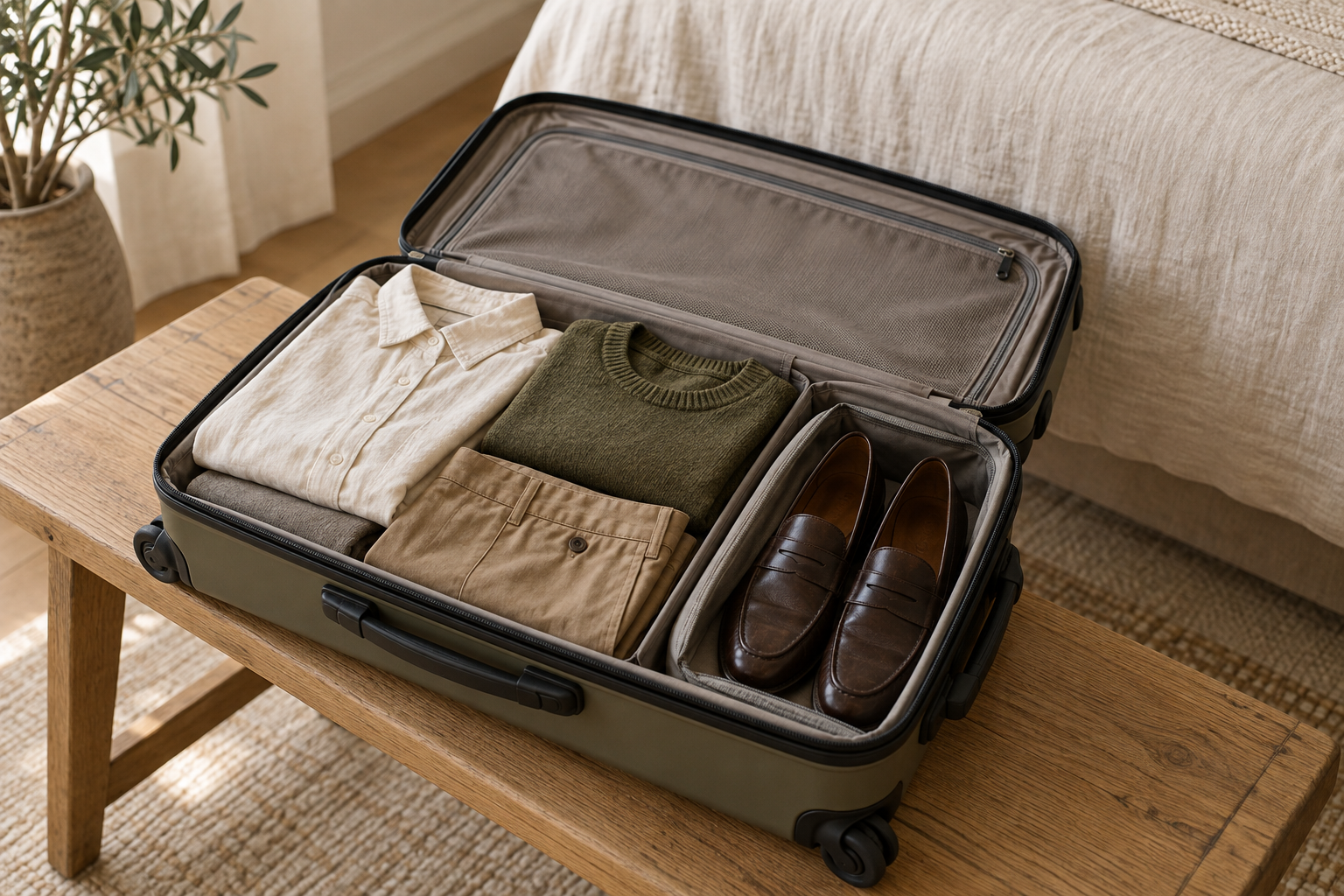
Smart casual travel outfits for men: an airport look that survives ten hours, the meeting-on-arrival formula, shoes for security, and what not to wear.

Occasion guide
You are visiting a church — or a mosque, temple or gurdwara — for the first time and you do not want to stand out or offend. Here is the outfit that passes everywhere, plus the rules that change by tradition.
Begin hereDefinition / explainer
One notch above everyday clothes is the whole rule: a collared shirt or plain knit, dark trousers or clean dark jeans, and closed leather or leather-look shoes. Below, what that looks like in practice, and what changes at mosques, temples and wedding services.
The default outfit at the top of this page. Wear the collared shirt, dark chinos and clean closed shoes and you will be correctly dressed at essentially any church in the country. Dark, clean jeans with a collared shirt or plain knit are acceptable at most modern congregations too.
What varies is the congregation, and it runs in three tiers. Traditional and high churches — suit territory, especially Sunday mornings. Evangelical and modern community churches — jeans and trainers are normal. Large contemporary churches — casual is the culture. You can tell the tier before you go: check the church website's photos, read the invite wording, or simply ask the friend who invited you. They will be pleased you asked rather than amused.
Two practicalities beyond dress: arrive about ten minutes early and sit toward the back, then follow everyone else for standing and sitting. Phone away, silent, out of sight.
Sunday best was the norm for generations, and most Western congregations have relaxed substantially since the 1990s. But dressing up is still the living norm in traditional denominations — Anglican, Catholic, Orthodox and many Black church traditions, where dress carries cultural meaning — and in congregations with older memberships.
Here is the asymmetry that should end your anxiety: in religious settings, you cannot be too respectful. Being the most dressed-up person in the room costs you nothing, unlike every other occasion in your calendar. Underdressing is the only move with a downside.
One checklist covers any first visit to any tradition: shoulders covered, long trousers, closed shoes you can remove easily, nothing tight or slogan-bearing, and a layer you can add. The modest-dressing guide expands this for regular attendance.
When the service is attached to an event, the event's dress code comes first and the venue's modesty rules second. Cover shoulders even if the couple's code is casual, and bring a jacket you can wear for the service and drop at the reception.
Comply with head-covering requests at events — yarmulke or, in some Catholic settings, a chapel veil — hosts usually provide them. And follow the venue's photography rules; pointing a phone around a worship space is the etiquette error first-timers actually get called out on. The smart casual wedding guide handles the reception half of the day.
Hats on in mosques, temples and gurdwaras. Hats off in churches. It is the exact opposite rule in buildings that first-timers often confuse, and it is the one mistake with real social cost — so say it to yourself in the doorway. Outdoor headwear like a cap or sun hat comes off inside any of them unless covering is requested.
If you are going back regularly, three outfits cover it: one collared shirt formula in three colorways plus a single pair of dark leather shoes. It costs less than people fear — the smart casual on a budget guide shows the order to buy in.
Seasonally, European churches in summer are often un-air-conditioned while American ones run cold — either way, the answer is a layer you can add or remove; the layering system guide is the template. In winter, the coat belongs on the back of the pew, not on your lap. Denim is fine at most modern congregations once you have seen what others wear; hold it back at traditional ones.
If money is tight, hear it plainly: congregations genuinely do not care. The dark-chinos-and-clean-shirt answer is not a brush-off — it is the outfit that regulars on every budget actually wear.
What should men wear to church for the first time? A collared shirt or plain knit, dark chinos or trousers, a belt, and clean closed shoes — one notch above everyday and correct almost everywhere.
Can I wear jeans to church? At most modern congregations, yes, if they are dark, clean and paired with a collared shirt or plain knit. Save them for tier two and three churches, not traditional ones.
Do men cover their heads in church? No — and that is the reverse of mosques, temples and gurdwaras, where covering is expected or required for visitors.
What does a male visitor wear to a mosque? Modest, loose clothing with shoulders and knees covered, plus easy-to-remove shoes and presentable socks; head covering is optional and usually provided. If you are attending alongside a partner or family new to any of this, the first-time church outfit guide covers the same ground for women.
A church outfit for men is one notch above everyday: a collared shirt or plain knit, dark chinos or trousers, clean closed shoes, and a belt. Modesty and quietness beat fashion in every religious tradition, so muted colors, covered shoulders and nothing loud or tight are the real rule. Over-dressing is harmless; being scruffy is the only genuine misstep.
What to Wear
Smart casual travel outfits for men: an airport look that survives ten hours, the meeting-on-arrival formula, shoes for security, and what not to wear.
What to Wear
What do parents wear to graduation? The one-notch rule for dads: navy suit or blazer and trousers, tie optional, worn-in shoes, photo-safe colours.
What to Wear
Petite smart casual solved: where every hem should hit at 5'0" to 5'4", the blazer length that works, and five elongating outfit formulas.