Occasion advice
Petite smart casual: define the waist, shorten every vertical
The rule is simple to state: raise the waistline visually, shorten every vertical line — hems, jacket, sleeves, torso — and keep one column of colour running top to bottom. Everything else on this page is that rule applied garment by garment, because smart casual on a 5'0" or 5'2" frame is won at the hem, not the shop.
Why regular sizing fails petites
Petite in sizing means height, not weight. A regular-cut garment assumes a longer torso, longer limbs and wider shoulders, so on a petite frame the shoulder seam slides down the arm, the waistband sits below your natural waist, and the hem eats the leg you have.
Before shopping, know three numbers: your inseam, your shoulder width, and your torso length. Measure the inseam on the best-fitting trousers you own, shoulder point to shoulder point across a well-fitting top, and torso from shoulder to natural waist in a mirror. Those three numbers settle most size-chart arguments.
Hem rules: exactly where each hem should hit
This is the section to bookmark. At 5'0" to 5'4", the difference between sharp and swamped is usually two to four centimetres of hem.
- Full-length trousers: just grazing the top of the shoe, with no break or a quarter break at most. Suits flats and heels alike.
- Cropped trousers: at the ankle bone, the narrowest point of the leg. Below that they read as floods.
- Skirts: knee-length lands at mid-knee at most. Anything past the widest part of the calf shortens the leg.
- Blazer sleeves: ending at the wrist bone, with one to two centimetres of shirt cuff showing beyond.
- Blazer body: covers the seat, hits at the hip crease at most.
Where a dress hem lands by height — the petite-safe column is the one to buy or tailor to.| Height | Mini | Knee length | Midi |
|---|
| 5'0" | Mid-thigh | Just above the knee | Mid-calf at the latest |
| 5'2" | Above mid-thigh | At the knee | Below mid-calf starts to shorten the leg |
| 5'4" | Mid-thigh | Just below the knee is the limit | Mid-calf, fitted top, pointed shoe |
You can fix simple hems yourself with fusible tape or a basic cuff. Lined trousers and blazer sleeves with functioning buttons need a tailor — and shoulder re-cuts are the one alteration usually not worth the money, which is exactly why the shoulder is the thing to buy right. See what tailoring can fix and what it costs in blazer alterations.
Blazer fit for petite frames
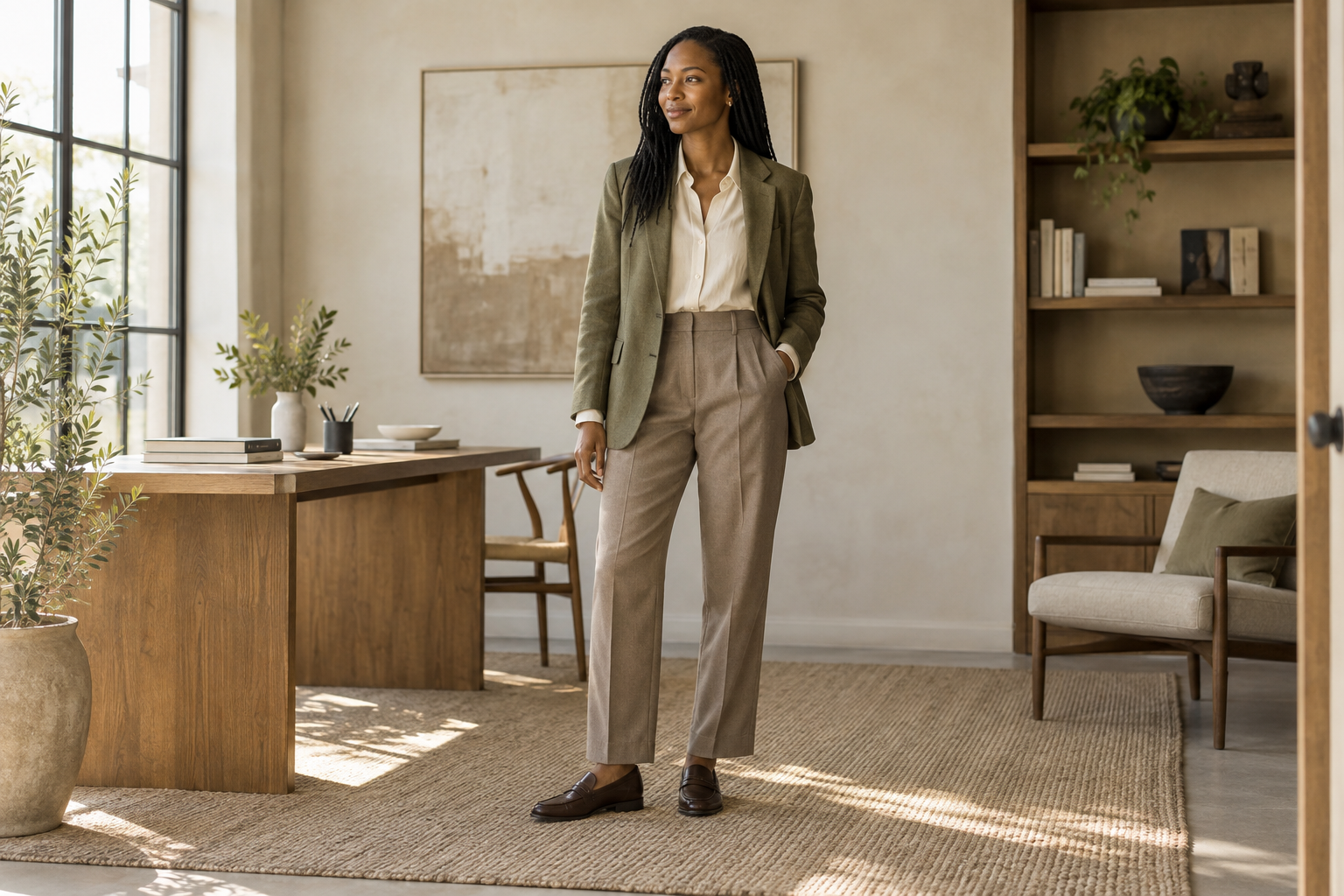
Three checks at the mirror. Shoulder seam lands on the shoulder point — this is non-negotiable and the reason petite sizing exists. Hem at the hip crease, not past it. Single-breasted with one or two buttons and a slight nip at the waist to build the vertical line.
Skip double-breasted and longline cuts on most petite frames: they add width and length in the two places you have least to spare. And never size up to gain length — a clean short blazer beats a swampy long one every time.
Trousers, rise and where to shop petite
High-rise is the petite default because it moves the visual waist up and lengthens the leg. Mid-rise only works with a tucked or cropped top. Best cuts are slim-straight, tapered and ankle-length cigarette; wide-leg can work if it is high-rise and full-length with a pointed or heeled shoe — see how to choose a trouser rise.
Where to shop: look for brands with genuine petite lines — real shorter inseams and raised waistbands, not just shorter hems. Sales racks are the worst place for petites because they stock regular sizes only, so plan purchases around petite-line drops instead. Secondhand, filter by measurements rather than size labels, since petite tags are rare; the measurement-first method in the plus-size petite guide works the same way.
Dresses and prints that elongate
V-necks and wrap silhouettes lengthen the torso; boat necks and high necks shorten it. Fit-and-flare and wrap shapes with a defined waist beat shift dresses on most petites. Empire lines work only when the seam sits above the bust — at mid-rib they just look like a fit problem.
Print scale matters more than pattern choice: small-to-medium prints flatter a shorter frame, while giant prints wear you. Pick one print per outfit and keep the rest of the pieces quiet.
Proportion tricks: thirds, verticals and shoes
Dress in thirds, not halves: define where the third line falls — jacket hem, tuck point, waist seam — and keep it at or above the natural waist. Long cardigans work only worn open with a defined waist underneath. Honest note: vertical stripes are a myth-level minor win, not a strategy.
Shoes do real work here. Low vamps and pointed toes extend the leg; ankle straps and chunky calf-high boots cut it. If you love boots, wear them under a midi skirt or match boot colour to hosiery so the line does not break. Adjust crossbody straps short so the bag sits at the waist, not swinging at the hip.
A petite capsule for the week
About ten items cover a week of smart casual: two petite blazers (one navy, one neutral), two pairs of high-rise ankle trousers, one knee-length wrap dress, three tucked-able tops, one fine cardigan, pointed flats and one heeled pair. The same skeleton, scaled to your numbers, is the womens capsule wardrobe — read it with petite hems in mind.
Outfit formulas by occasion, all using the petite rules above.| Occasion | Combination | Why it works at 5'2" |
|---|
| Office | Navy high-rise ankle trouser, tucked white shirt, cropped neutral blazer, pointed flat | Colour column plus third line at the waist; every hem at its landmark |
| Wedding guest | Knee or midi wrap dress, cropped cardigan, pointed heel | Waist defined, V-neck lengthening, hem at mid-calf at the latest |
| Dinner | Black column (trouser and knit one colour), grey cropped jacket, pointed flat or heel | Unbroken vertical with one contrasting layer for structure |
| Weekend smart | High-rise straight jean, front-tucked striped tee, cropped denim jacket, white sneaker | Casual pieces, petite proportions — the tuck does the work |
What to stop buying
- Capri-length crops that stop mid-calf and read as too-short trousers.
- Longline duster coats past the knee.
- Double-breasted oversized blazers.
- Low-rise trousers and jeans of any kind.
- Regular-size pieces bought 'because they'll do' — they never do at the shoulder.
The petite checklist
- High rise on every trouser and jean.
- Hems at the ankle bone or just grazing the shoe.
- Blazer at the hip crease, shoulder seam on the point.
- One colour column per outfit, contrast supplied by the layer.
- Third line of the outfit at or above the natural waist.
- Pointed shoe to finish the leg line.
- Petite size first, tailor second, walk away if shoulder and waist both miss.
- Measure before you buy — inseam, shoulder, torso.
Petite smart casual questions
Can petites wear midi skirts? Yes — keep the hem at mid-calf at the latest, tuck or crop the top, and wear a pointed shoe so the leg line survives.
Can petites wear oversized clothes? One oversized piece at a time, with the waist defined underneath. The front-tuck is what keeps a boxy shirt from wearing you.
Is petite sizing just shorter? It should not be. Honest petite lines raise the waistband, narrow the shoulder and shorten the torso as well as the hem — which is why the shoulder seam is your first check.
What should a 5'0" woman wear for business casual? High-rise ankle trousers, tucked tops, a hip-crease blazer and pointed flats — the office formula above, repeated in your best colours.