What to Wear
Restaurant Dress Codes Explained: Restaurants, Rooftops and Clubs
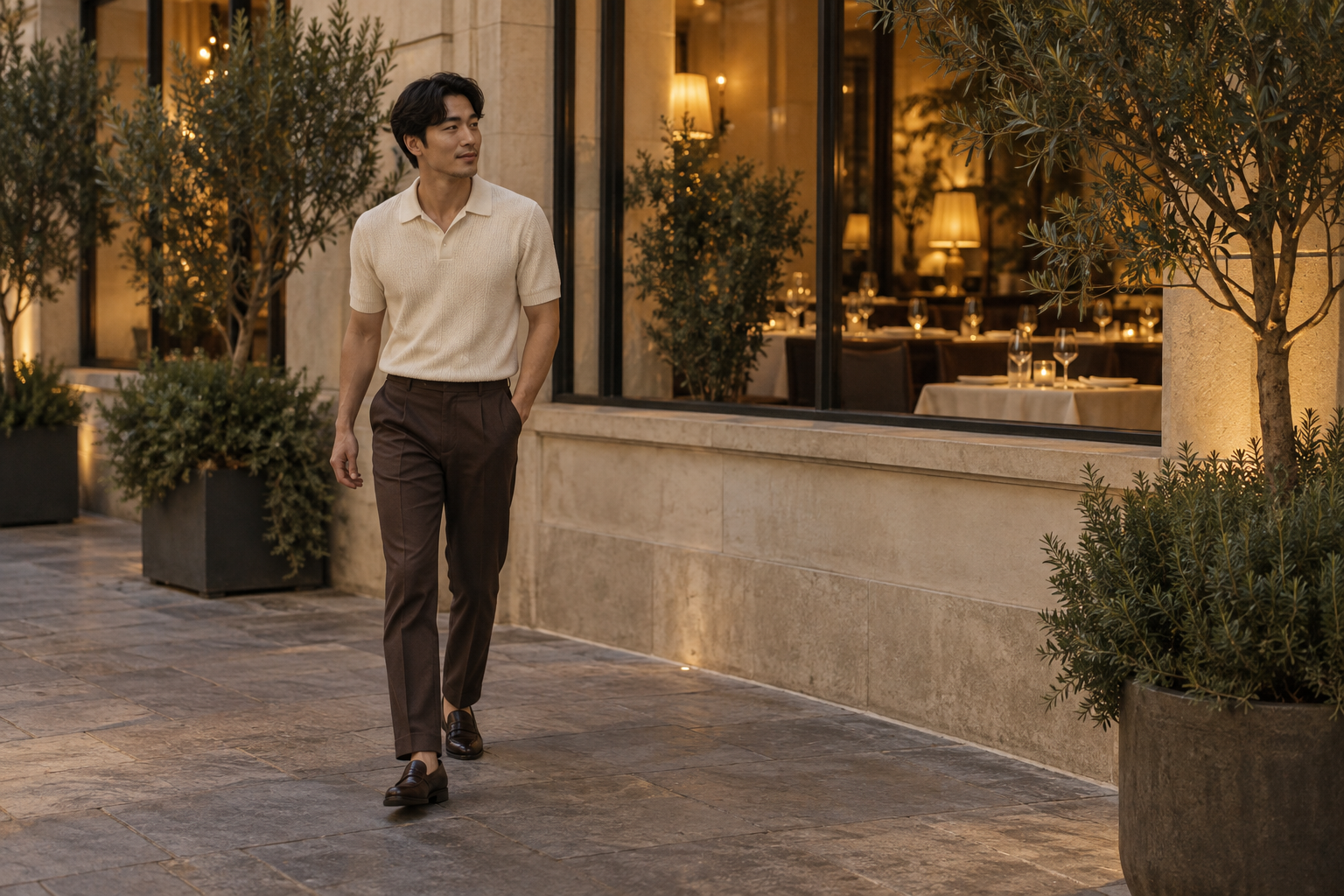
Restaurant dress codes explained by venue: what smart casual means at dinner, what rooftop bars enforce, and what gets refused at club doors.

Reading the room
If you dress smarter than your manager and it has started to nag at you, the problem is rarely the clothes. Formality at work is relative — this page gives you a system for finding the room's real ceiling and dialling down without dumbing down.
Begin hereDefinition / explainer
Being the sharpest-dressed person in the room is rarely a career problem — inconsistency is what gets noticed, not elevation. The right level is not on a chart: the official dress code is a floor, and the median of your respected peers is the actual ceiling. Match that median and put your effort into fit, fabric and shoes instead of formality.
The feared outcomes — being read as interviewing, as misjudging client days, as not understanding the culture — are all signals, not character verdicts, and all fixable with one wardrobe notch. Online, the anxiety around this is enormous; in offices, the consequence is usually a single light comment, if anything. Leaders overwhelmingly judge polish favourably; what they flag is the colleague whose formality swings without reason.
There are real exceptions. Client-facing optics matter, because you represent the firm to the buyer. In unionised or blue-collar settings, formality can read as distance. And in your first weeks anywhere, the room has not met you yet — so observation comes before investment.
The aim is to keep every quality signal and lower only the formality register — the most casual person in the room, but the best-fitted.
| Keep (craft) | Swap (formality) |
|---|---|
| Pressed, well-fitting everything | Structured blazer becomes an unstructured one or a knit layer |
| Good leather shoes, maintained | Tie comes out; open collar stays crisp |
| Grooming and haircut on schedule | Formal trousers become dark tailored denim where the median allows |
| Quiet, matched palette | Formal dress becomes a relaxed-cut dress or separates |
The returner's problem is calibration drift: codes moved down while you were away — further by industry and sometimes by gender — so instincts set in a stricter era now over-shoot. A reader coming back to an office after years remote described the exact worry: dressed smarter than everyone, including her manager, by Tuesday.
The week-one plan is observation before investment: wear the flexible middle — blazer in the bag — until the median is clear. The full playbook is in the first week at a new office guide, and the confidence point deserves saying plainly: the fear of outdressing colleagues is usually visibility anxiety, not a policy problem. That anxiety shows up constantly — men a decade into their careers asking online whether being overdressed is hurting them — and the honest answer is almost always no.
The never-outdress-the-boss rule has real roots in traditional industries — law, banking, hospitality management — and in strongly hierarchical cultures, where formality maps to rank. Everywhere else it is noise: in tech, creative and most modern offices, the boss in the hoodie is the median-setter, and craft polish is your differentiator.
One escape valve covers most edge cases: on client-facing days, you dress for the client, not the office. If the client's world is formal, you are formal, and your boss will expect it. The sector-by-sector calibration lives in smart casual by industry.
Is it unprofessional to overdress? No. What reads as unprofessional is inconsistency — three casual days, one formal, no event to explain it. Fix the pattern and the formality stops being noticed.
Should I dress like my manager? No — dress like the respected median. Your manager's wardrobe is one data point, and often a stale one.
I got teased for being overdressed — what now? A one-time comment needs no response beyond a laugh. If it repeats, that is the inconsistency signal: hold your quality, drop your formality one notch, and let a week pass.
Does this change for interviews? Yes — interviews are the one evaluated day, so one notch above the company's median is expected, not penalised. The no-suit version is in the smart casual interview outfit guide.
Dressing relatively means formality is set by the room, not the rulebook: match the median formality of the respected people around you, and outdress them only in craftsmanship — fit, fabric, shoes, grooming — never in formality.
What to Wear
Restaurant dress codes explained by venue: what smart casual means at dinner, what rooftop bars enforce, and what gets refused at club doors.
What to Wear
A smart casual rules list with zero hedging: the yes-list, the never-list, IF-THEN rules for edge cases, and one default outfit that always passes.
What to Wear
Build a smart casual outfit from what you already own: the 20-minute closet audit, the 3-layer formula, free upgrades, and the one gap worth buying.