
What to Wear
How to Ask the Dress Code Without Being Rude (Exact Scripts)
How to ask the dress code without being rude: copy-paste scripts by channel, who to ask first, timing rules, and what to wear when you cannot ask.
Venue decoder
The booking said smart casual — or said nothing. Here is what each venue type actually enforces in practice, from bistro to tasting menu to club door.
Begin hereDefinition / explainer
A venue dress code is less a rulebook than a signal about the crowd a place wants. Restaurants use dress notes to set expectations, rooftop bars lean them toward evening, and clubs use them as door policy. This page defines what each venue type means in practice, so you can walk in feeling normal instead of guessing.
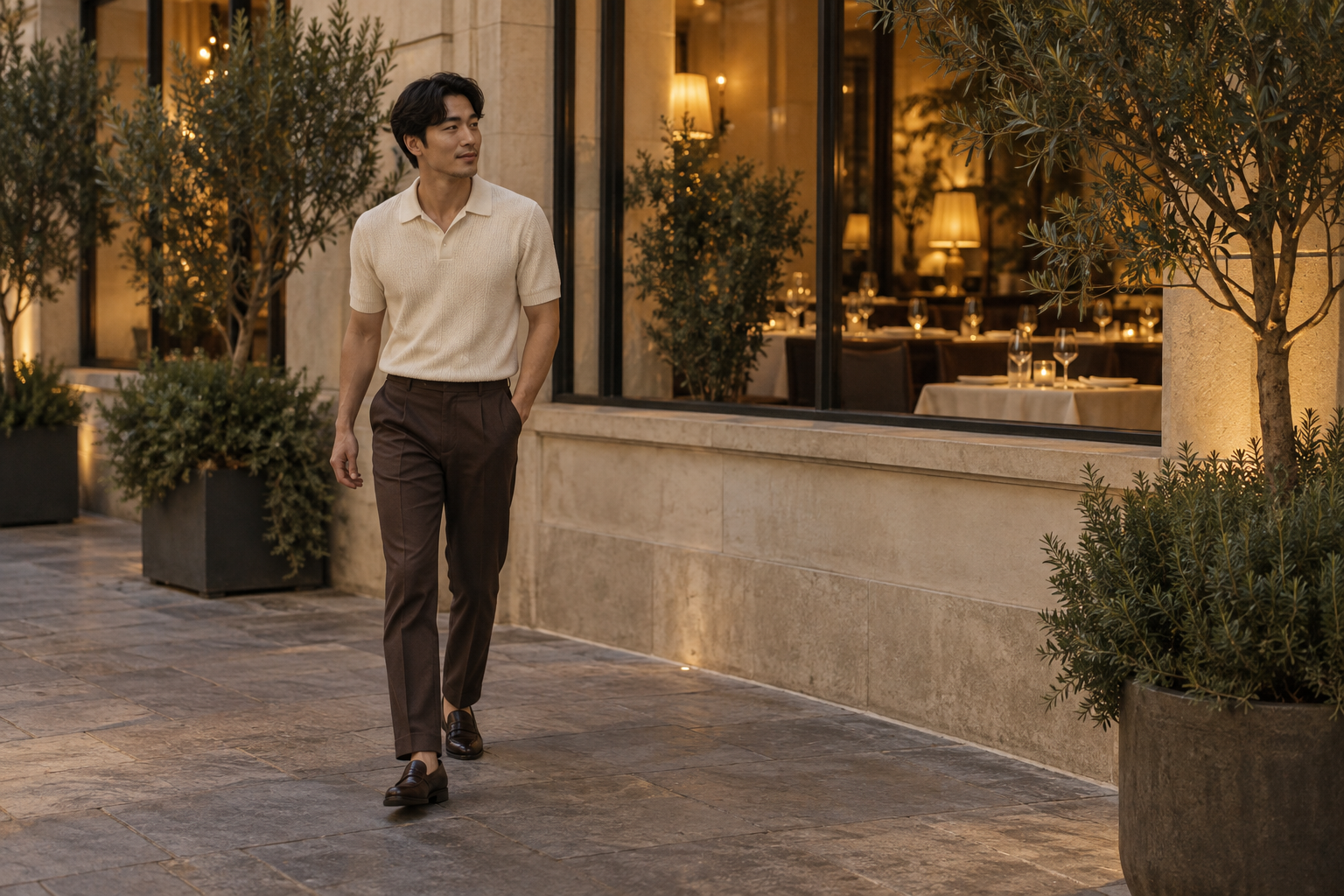
So what is considered smart casual in a restaurant? A collared shirt or fine knit on top, tailored trousers or dark straight jeans below, and leather or clean minimal shoes on your feet. A jacket is optional at this tier but never wrong. Shorts rarely pass for dinner service, even in summer, because evening reads dressier than lunch.
The tiers below that and above it are where people misjudge. At a casual bistro or pub food spot, anything tidy passes and trainers are completely normal — the only trap is assuming casual means sportswear is fine, which it still is not. At the top end, tasting-menu rooms often expect jackets, and the reliable way to check is the venue's own website photos or a quick call. Michelin-tier rooms commonly refuse sportswear, shorts and sometimes jeans outright.
Rooftop bar dress codes are usually smart casual with an evening lean. That means a darker palette than your daytime version, loafers or heeled boots instead of everyday shoes, and a structured layer after sunset — jackets, fine knits, or a tailored overshirt. The layer is practical as much as stylistic; rooftop wind turns a warm evening cold fast.
Hotel bars apply their code all day but enforce it harder in the evening, roughly from eight o'clock. Guests get more latitude than walk-ins, though not unlimited — a non-guest in a clean, structured outfit usually passes more easily than a guest in beachwear. The fine print to read on their site is the phrase no sportswear: it typically means athletic shoes, track tops and visible logos, while clean leather minimal sneakers often pass. Their wording tells you which.
A club dress code is a gatekeeping tool, not an etiquette note. Door staff apply it unevenly, and the mix of the group, the queue's atmosphere and each person's presentation all feed the decision. You cannot control their judgment; you can control the common refusal triggers: athletic wear, open sandals on men, caps, and large logos or slogans.
Two practical fixes earn their place in every group's night out. A jacket upgrades an outfit at the door more than any other single item, and a pair of shoes flat in a bag solves the trainers problem in a taxi. The honest group advice: the smartest-dressed friend should not be the only one who dressed up, because a wildly underdressed friend can hold the whole group back. Coordinate at the level of the door's expectations, not your own.
The note you already have usually answers the question. Smart casual means the formula above. Elegant dress or dress to impress means step up one tier — structure on top, dark below, proper shoes. No sportswear is the entire code, and everything tidy passes. No note at all means smart casual by default; when the venue is expensive, behave as if the note said elegant.
If the note stays ambiguous, the venue's own channels settle it. Website galleries, recent tagged photos, and Google review photos are the three free calibration sources. And venues answer dress questions daily without offence — ask one concrete question like, is there a dress standard you enforce at the door? The scripts and wording are covered in what to do when the dress code is unclear.
Summer rooftops are the classic collision: the code says smart casual, the forecast says otherwise. Tailored shorts pass at daytime and casual-leaning rooftop venues but not at fine dining or door-enforced clubs; linen shirts and knit polos close the gap elsewhere. For hot and humid cities, the full fabric and outfit workarounds are in smart casual for hot, humid weather.
In winter, the problem is the coat. If the evening starts at a rooftop, layer the outfit so it still works when the coat is checked: the knit or shirt underneath should carry the look alone. And for the walk from the taxi in rain, darker trousers and treated leather shoes survive far better than pale suede — a contingency that takes ten seconds to plan.
| Venue type | What passes | What gets refused or noted |
|---|---|---|
| Bistro or pub food | Tidy jeans, tee or knit, any intact shoes; trainers fine | Sportswear, beachwear, stained clothes |
| Smart casual restaurant | Collared shirt or fine knit, tailored trousers or dark jeans, leather or minimal shoes | Shorts at dinner, ripped denim, gym shoes |
| Fine dining / tasting menu | Jacket, collared shirt, tailored trousers, leather shoes | Jeans at many rooms, trainers, sportswear, shorts |
| Rooftop bar (evening) | Evening-lean smart casual: dark palette, loafers or heeled boots, structured layer | Athletic shoes, track tops, large logos |
| Hotel bar after 8pm | Same as rooftop; clean minimal sneakers usually pass | Beachwear, sportswear, caps |
| Club | Fitted shirt or plain tee plus jacket, dark trousers or dark jeans, closed shoes | Athletic wear, open sandals (men), caps, big logos |
| Wine bar | Smart casual light: knit or shirt, dark denim fine, clean shoes | Beachwear, heavily distressed denim |
| Members' club | Full smart casual, conservative read | Trainers at many houses, sportswear, casual shorts |
What is considered smart casual in a restaurant? Collared shirt or fine knit, tailored trousers or dark jeans, clean leather or minimal shoes — a jacket is a bonus, not a requirement.
Can I wear jeans to a nice restaurant? Dark, straight, unripped jeans pass at most mid-tier rooms and some fine dining rooms. When the jeans question matters, the venue's own photos answer it — or see are jeans smart casual? for the full rules.
Do rooftop bars have dress codes? Yes, usually smart casual with an evening lean, enforced more strictly after dark — darker colours and proper shoes are the safe read.
What do bouncers actually check? Shoes, visible logos, headwear and overall effort, applied quickly and unevenly — a jacket and closed shoes clear most refusals before they happen.
Is there a dress code for my booking note? Run it through the decoder above: match the venue's tier, treat the words as the floor, and call if the venue is expensive and the note is silent. For country-specific venues with their own codes, see country club dress codes decoded and the dress codes hub.
A venue dress code is the standard a specific type of venue enforces in practice, not just the words on the booking. Restaurant dress codes explained simply: the venue's price point sets the bar. A smart casual note means staff and regulars are the enforcement; at clubs, the person on the door is. Match the venue's typical crowd and the written words become the floor, not the ceiling.
What to Wear
How to ask the dress code without being rude: copy-paste scripts by channel, who to ask first, timing rules, and what to wear when you cannot ask.
What to Wear
A smart casual rules list with zero hedging: the yes-list, the never-list, IF-THEN rules for edge cases, and one default outfit that always passes.
What to Wear
Overdressed at work, or outdressing your boss? The real rule is relative: match the room's median and exceed it in craftsmanship, never in formality.