Trousers & Pants
Chinos vs Dress Pants: Choosing Smart Casual Trousers
How chinos and dress pants differ in fabric, sheen, crease and care, and how to tell which one a given smart casual setting actually calls for.
Buying guide
Comfort you can feel and structure an office accepts come down to a handful of checkable details. Here is how to judge waistband, stretch, opacity and fit on your own body before you buy.
Begin hereHow-to
To find work pants that feel like leggings, look for a pair that lets you sit and move comfortably while meeting your workplace's clothing rules. Stretch fabric can help, but check the waistband, opacity and shape after movement rather than trusting a comfort label. Try the pair with your work shoes and anything you normally carry in the pockets before deciding.
| Construction | What it is | Tradeoff |
|---|---|---|
| Elastic-backed waist | A wide band with elastic or a knit backing behind a structured outer layer | Often the easiest feel, but a narrow or weak band can roll when you sit |
| Partially elasticated waist | Elastic at the sides or back only, with a structured front panel | Reads most like a classic trouser, but the fixed front can press when seated |
| Structured stretch waist | A firm, non-elastic waistband relying on stretch woven into the whole garment | Holds its shape well, but offers the least give if your day involves lots of bending |
Treat any stated elastane percentage with caution — listings vary and labelling is not always precise. Judge the fabric by hand: it should stretch when you pull it and return without staying stretched. Which construction suits you depends on your shape, your day and the formality of your office.
If the label promises four-way stretch and all-day comfort, the pants will perform.
A comfort label describes intent, not your result. Stretch quality, recovery and opacity vary between garments and between bodies, and fabric can behave differently after washing. The only reliable test is wearing the pair through the movements of your actual day.
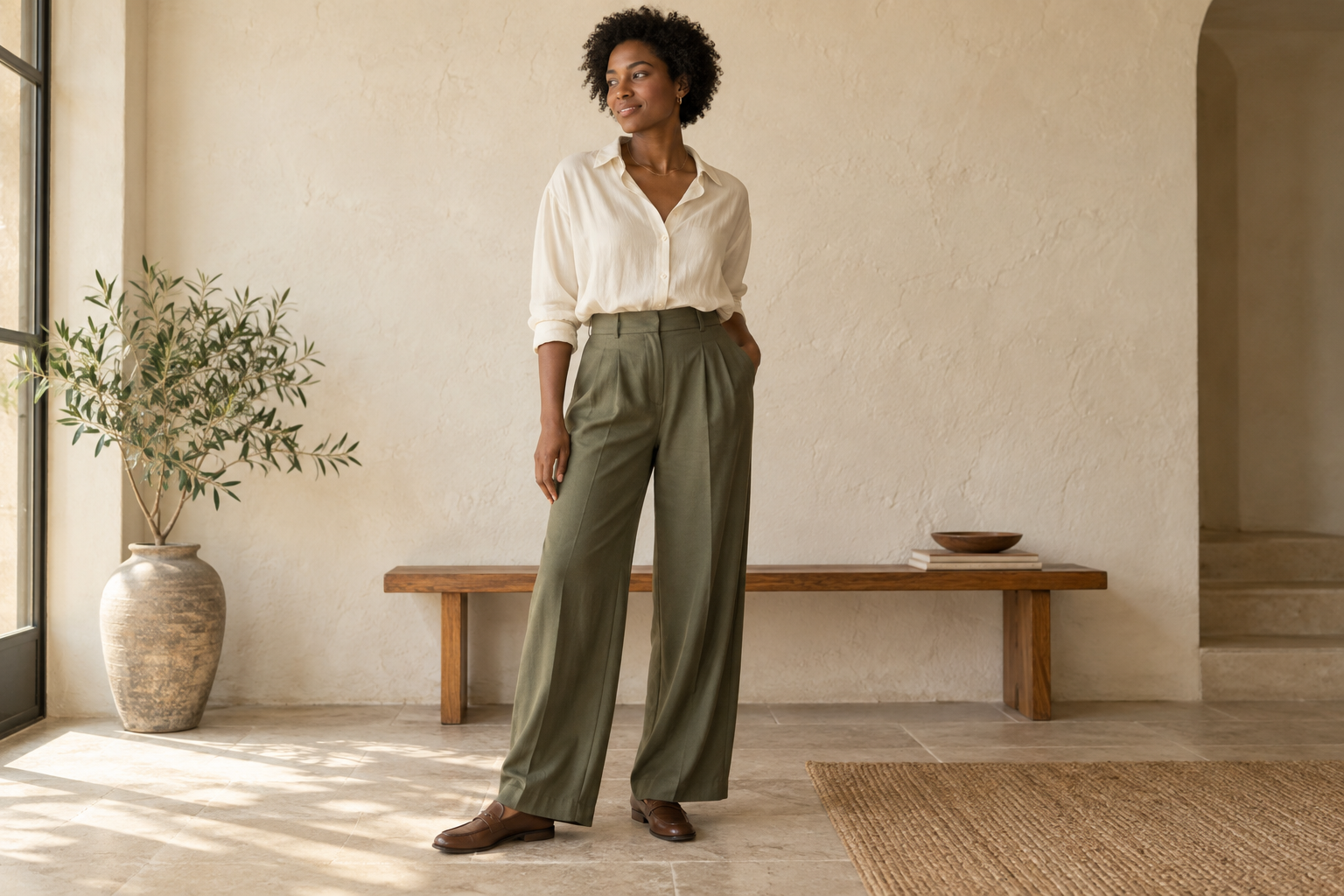
The image in this guide shows a full work-context outfit: a cream blouse, olive wide-leg trousers and brown loafers in a warm neutral room. Use it to see the kind of complete, shoe-included look these pants need to hold up in — not as a claim about stretch, recovery or any specific fabric.
Leave the shop, or the delivery doorstep, with work pants that move with you through a full workday without pinching or going sheer, and still read as trousers in your workplace. You will know exactly what the pair does when you sit, bend and rise — because you tested it. And you will know your dress code permits the style before you commit.
Before browsing, write down what the pants must survive: hours seated, how often you bend or reach, whether there is a uniform rule, and which waist feel you prefer. A long desk day rewards a soft wide band; a job on your feet rewards recovery and a hem that clears the floor. This decides what to prioritise before any label does.
Check: You can name the three things that would make you return the pants — for example rolling, sheerness or bagging — before you look at a single pair.
Try one of each type you can find: elastic-backed, partially elasticated and structured stretch. Pull the fabric outward and release it — it should return to shape rather than staying stretched. There is no universal winner; you are learning which tradeoff suits your day.
Check: Each pair you keep considering stretches with a pull and returns without visible bagging, and you know which waistband type it has.
This is where stiff trousers fail and legging-like ones earn their keep. Sit as you would in a meeting, cross your legs, bend to pick something off the floor and squat fully. The waistband should stay put rather than rolling at the front or gaping at the back, and the fabric should move without pulling across the hips or thighs.
Check: After sitting and rising three or four times, the waistband sits where it started and nothing needed hitching or tugging during any of the movements.
Stretch fabrics can go sheer when stretched taut, and you notice it bending forward under office lighting, not standing in a dim fitting room. Stretch the fabric across your hand first — if you can see your fingers through it, it will be worse in motion. Then face a bright light or window and bend, checking the seat and thighs.
Check: In bright light, bent over, no skin or underwear shows through the seat or thighs — check pale colours especially, since light shades are the usual offenders.
Decide honestly whether you need functional pockets or whether flat welt pockets suit you better, since bulky items in side pockets can spoil the smooth line. Sit down with your phone and pass in the pockets and notice anything that digs, gaps or distorts. A gusset or panel construction is a good sign the pattern was designed for movement rather than stretched from a standard trouser block.
Check: Seated with your real everyday items in the pockets, nothing digs, gaps or distorts the line, and the front stays smooth.
Put on your actual work shoes and check the hem: it should just touch the top of the shoe for a straight or tapered leg, or break cleanly once for a wider leg. Confirm the care label fits your laundry habits, and read the return conditions — comfort on day ten, not day ten minutes, is the real test, and some stretch fabrics change after their first wash.
Check: Standing naturally in your work shoes, the hem neither drags nor floats well above the ankle, and you know the care requirements and return window before paying.
Rolling usually means the band is too narrow, the elastic is weaker than the fabric above it, or the rise is slightly too small so the band tips forward when you bend. Sizing up alone often fixes rolling but adds bagging elsewhere. Look for a wider, more substantial band or a higher rise, and re-run the sit test before deciding.
Some knee memory in the first minutes of wear is normal, but fabric that stays bagged by lunchtime lacks recovery — the stretch content is likely low or the knit is loose. Observe how long recovery takes on your body rather than expecting an instant snap-back; fabrics vary. If a pair stays bagged, a denser fabric is the honest fix — pressing or washing rarely restores a knit that has lost its bounce.
The usual culprits are a shiny surface, a visible elastic waistband, or a silhouette that is tight through the whole leg. A matte fabric and a flat waistband often help, though neither is a rule — judge the read in your own mirror under your office's light. Styling does real work too: a tucked top, a blazer or a longer layer over the hip shifts the read toward trouser. Our guide to styling ponte pants covers those combinations look by look.
Trousers & Pants
How chinos and dress pants differ in fabric, sheen, crease and care, and how to tell which one a given smart casual setting actually calls for.
Trousers & Pants
Ponte is a fabric, leggings are a cut — the categories can overlap. How to inspect structure, opacity and waistband so you can pick the right pair for the setting.
Trousers & Pants
A fitting-room method for pull-on trousers: waistband construction, opacity, real pockets, drape, seat fit, and the sit test that settles it.