What to Wear
Smart Casual in Australia: What It Means and What to Wear
Smart casual Australia explained: the neat casual ladder, what to wear to weddings, offices and clubs, and how visitors should dial down.
UK dress code
On a British invite, smart casual means no suit required and no sportswear either — and it runs more forgiving than Americans expect. Here is what that means at the pub, at a wedding and in the office, with straight answers on jeans and trainers.
Begin hereDefinition / explainer
In Britain, smart casual translates to one line: no suit required, but no sportswear either. The sweet spot is a jacket or structured knit, decent trousers or dark jeans, and clean non-trainer shoes — with clean minimal trainers increasingly passing. The words mean different things in Mayfair and Manchester, so this page decodes by venue rather than issuing one national uniform.
The pub runs on a gradient. An after-work city pub wants your office baseline lifted a notch; a gastropub dinner wants a collared shirt or knit and, at the nicer ones, no trainers; your local boozer wants whatever is clean.
Jeans are fine at most pubs, given the conditions: dark, unfrayed, no rips. Swap to chinos when the gastropub has a smart casual policy on the door or the invite names the venue with valet parking. On footwear, pubs are the one place decent dark trainers pass almost everywhere — the exceptions are members' clubs and swanky rooftop-adjacent venues, the same door logic that venue dress codes decoded explains.
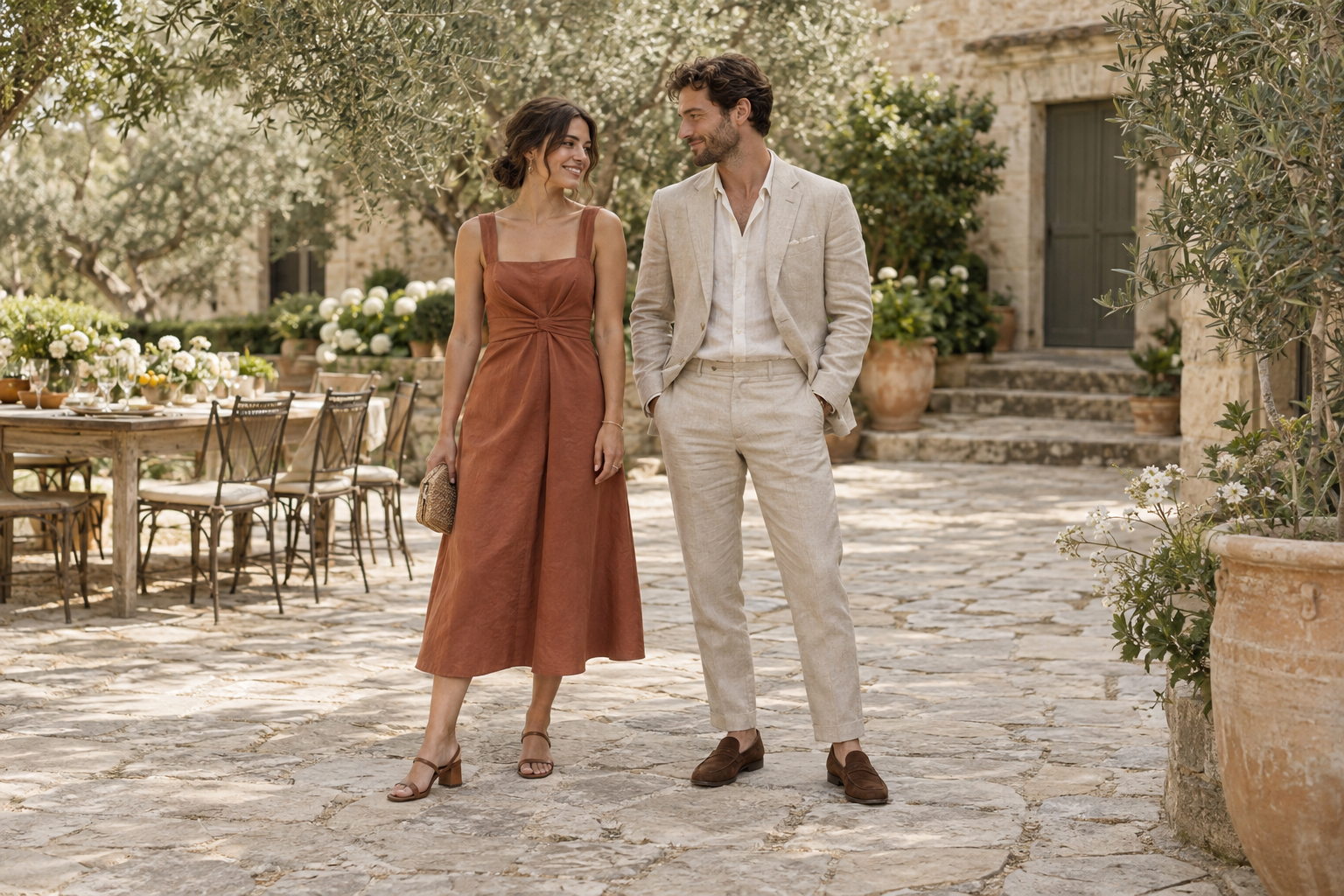
The default British wedding-guest read is a suit or blazer with contrasting trousers, tie optional — increasingly skipped at relaxed venues — and brown shoes. The venue drifts the code: a country house or barn forgives, a city hotel hotel-ifies, and half the room wears suits regardless of what the invite says. Aim for the better-dressed half.
Season moves the palette more than the formality. Summer outdoor weddings accept linen blends and no jacket; winter asks for flannel weight and a darker register. Full builds are in the men's summer wedding outfit guide.
Sector sets the bar. Finance and law stay suit-adjacent, tech and startups take jeans without comment, and the public sector runs the classic no-jeans baseline. The full breakdown is in smart casual by industry.
Two British office quirks matter more than the policy: dress-down Friday drift, and the client-day dial-up where everyone quietly smartens. Read your first week before buying anything — the method is in the first week at a new office guide. In the hybrid era, a structured knit with chinos clears the bar in most UK workplaces; for women, blazer optional and smart jeans are accepted in most non-client offices.
For US readers: trousers are pants, trainers are sneakers, a jumper is a sweater, and smart jeans is a genuine category here. Learn four words and every UK dress-code thread becomes readable.
Fabric follows the weather, not the fashion: British drizzle is constant and light, so a waxed or shower-proof layer earns its place in a way it does not in dry climates. The wet-weather kit is covered in rainy weekend outfits. On the high street, Brits actually buy this wardrobe at M&S, Uniqlo, Next and Cos, each covering a different price band — check current stock rather than trusting any fixed list.
One paragraph version: the UK is more casual at the top end — ties rarer, blazers optional — but stricter about the middle, where sportswear reads sloppy faster. An American overdresses at a country pub in full blazer-and-loafers; a Brit underdresses at a US office in the same outfit that works at home.
| Garment | UK read | US read |
|---|---|---|
| Dark straight jeans | Fine almost anywhere smart casual is named | Fine in most offices, risky in formal sectors |
| Clean minimal trainers | Pass at pubs and relaxed offices; not weddings | Pass in tech and creative; pass at fewer social venues |
| Polo shirt | Weekend-leaning; needs a jacket to clear the bar | Standard business casual in summer |
| Blazer over an untucked shirt | Trying slightly hard at a pub; right at dinner | Normal office uniform |
| Tie without a suit | Reads odd outside finance | Reads odd everywhere |
The transatlantic comparison runs the other way too: what a Brit underdresses at a US office would pass at home. For the full picture across every code, start at the dress codes hub.
Does smart casual mean a jacket? No — a structured knit does the same job in most UK settings. A jacket helps at weddings, gastropubs with door policies, and London finance; it overdresses at the local and in most tech offices.
Can I wear jeans to smart casual in the UK? Yes, if they are decent jeans: dark, unfrayed, no rips, fit without sagging. Swap for chinos at weddings, members' clubs and anywhere the door enforces the policy.
Are trainers OK for smart casual? Venue-based verdict: clean dark minimal trainers pass at most pubs and relaxed offices; they do not pass at weddings, gastropubs with a policy, members' clubs or finance floors.
What do I wear to a smart casual wedding in the UK? Suit or blazer with contrasting trousers, brown shoes, tie optional — dress for the venue type and expect half the room in full suits.
Is smart casual the same as business casual in Britain? Almost, but looser: business casual implies office trousers and no jeans; smart casual admits decent jeans and a knit instead of a shirt. Brits mostly write smart casual on invites; the US uses business casual as a workplace default.
Smart casual in the UK is a jacket or structured knit, decent trousers or dark unfrayed jeans, and clean shoes — more forgiving than US business casual, and stricter about sportswear than visitors expect.
What to Wear
Smart casual Australia explained: the neat casual ladder, what to wear to weddings, offices and clubs, and how visitors should dial down.
What to Wear
What smart casual means in the USA: how it differs from business casual, regional formality by city, event rules, and a vocabulary guide for UK visitors.
What to Wear
What to wear with grey trousers: the shade-first rule, best shirt and shoe colours, whether black shoes pass, and five outfits that always work.