Dressy Casual vs Smart Casual: the Difference, Solved
The two codes overlap almost entirely, but they lean in different directions: dressy casual drifts toward finer fabrics and evening settings, smart casual toward tailoring and daytime. Your smart-casual wardrobe already covers dressy casual — with one swap.
Dressy casual vs smart casual: same wardrobe, different lean
If your smart-casual outfit passes at a daytime event, it passes dressy casual too — the codes are near-synonyms. The difference shows up in the evening and in the fabric choices, and one element swap closes it.
What transfers between the two wardrobes
Almost everything, which is the reassuring part. Tailored trousers, blazers, fine knits, structured dresses and leather loafers serve both codes without adaptation. The pieces that only live on the smart side are the most casual ones — dark jeans in the daytime, minimal sneakers, chore jackets — and even those cross over with one swap.
That overlap is why the two names cause so much anxiety relative to the actual difference. If you own a working smart-casual wardrobe, you own a dressy-casual one; you are choosing an accent, not a second wardrobe. For the code one rung above this pairing, see casual elegant explained.
Dressy casual for women: what the invitation usually means
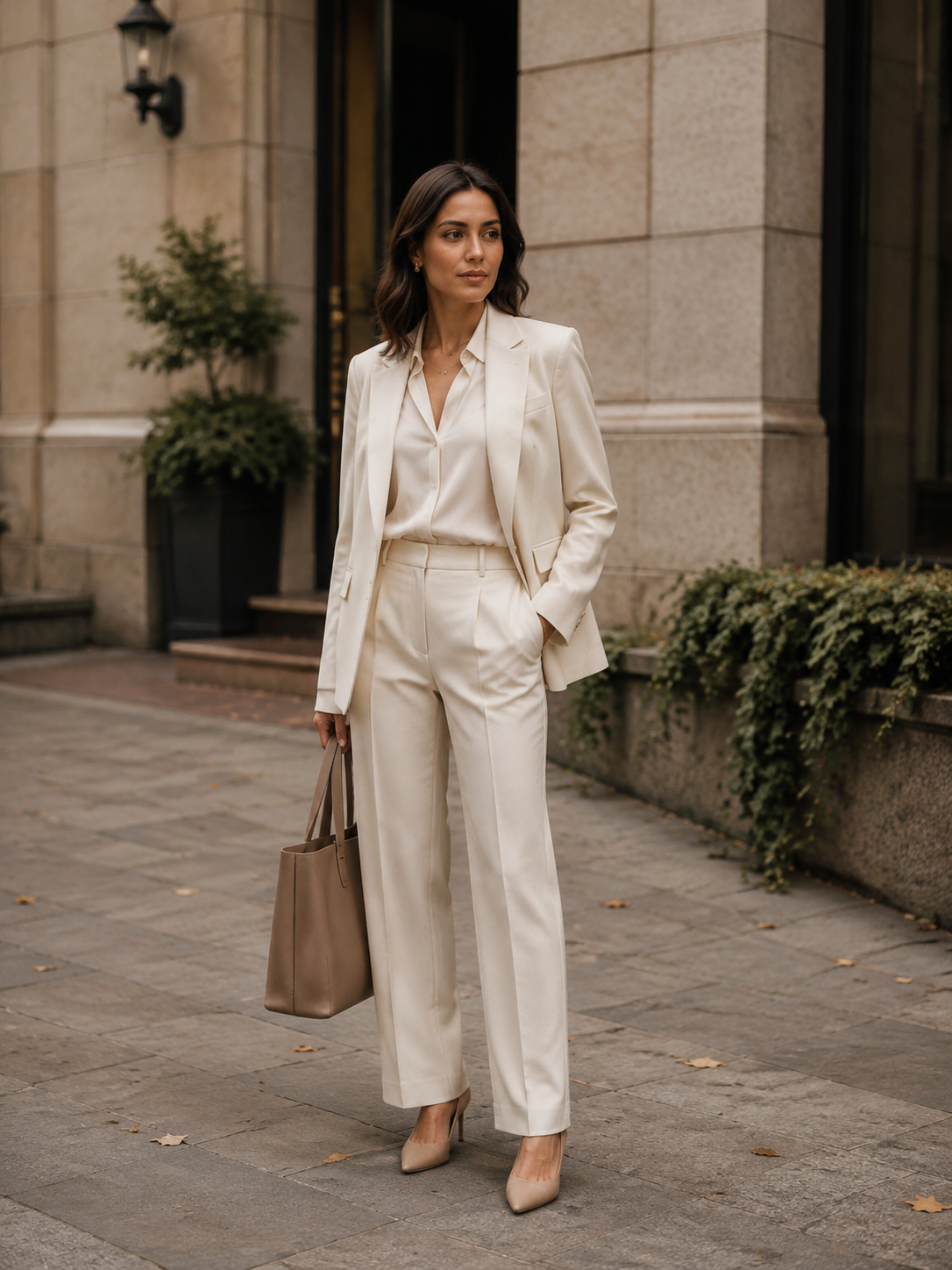
Three formulas cover nearly every dressy-casual women's event. An elevated midi dress with heeled sandals. A satin or silk blouse with tailored trousers. A skirt with a fine knit and dressy flats. Each one reads deliberate without crossing into cocktail territory.
The evening upgrade checklist is three lines: swap the fabric (cotton to silk or satin), swap the shoe (flat to heel), add one statement accessory. What reads too casual for dressy casual: distressed denim, jersey t-shirts, canvas sneakers and the everyday canvas tote.
Dressy casual for men: the smaller delta
The men's gap between the codes is small enough to name in a sentence: swap the polo for a button-up, the sneakers for loafers or boots, and add the blazer for evening. The base formula — button-up or fine knit, chinos or dark tailored denim, leather shoes — sits comfortably in either code by day.
The blazer question is occasion-driven: expected at weddings and rehearsal dinners, optional at dinners out and work parties. When you do wear it, darker shirts and leather-sole shoes are what make it read dressy rather than office.
By occasion: how the same outfit flexes
Event type, the code read that actually applies, and the example outfit.
Event
Code read
Example outfit
Rehearsal dinner
Dressy casual, blazer expected (men)
Satin blouse and trousers with heeled sandals; button-up, blazer, loafers
Work dinner or party
Smart casual base, one evening element
Dark shirt and chinos with boots; midi dress with dressier flats
Baby shower or engagement party
The codes merge entirely
Skirt and fine knit; button-up and dark tailored denim with loafers
Nice dinner out
Dressy casual, venue-calibrated
Elevated dress with heels; knit polo swapped for a button-up, leather shoes
Daytime gallery or lunch
Smart casual as written
Dark jeans, blouse or oxford, clean sneakers or flats — no swap needed
For evening events that sit one notch above dressy casual, the boundary with cocktail attire is fabric and shoe depth rather than garment type: when the invite says cocktail, treat the dress as fancier and the shoes as heeled, and keep the personal styling to a minimum. Events like showers and engagement parties sit exactly on the merge line, so pick the better shoe and stop there.
The one-element upgrade rule
Here is the portable takeaway: identify the single most casual element of your smart-casual outfit and replace only that. Jeans become trousers. Sneakers become loafers. A cotton shirt becomes a silk blouse or a knit polo. The canvas tote becomes a structured bag. One swap moves the whole outfit across the code boundary.
This beats re-planning an outfit from scratch because it costs nothing — the pieces were already hanging next to each other — and it scales: a second swap moves you another notch if the room turns out dressier than expected.
Common misreads, fixed on the fly
Reading dressy casual as pure casual — the t-shirt-and-jeans arrival at an evening event. Fix: lose the tee for any collared or knit layer you can buy or borrow, and let shoes carry the recovery.
Over-shooting into cocktail territory — the full gown or suit-and-tie in a relaxed room. Fix: remove the tie or the statement layer, and read the venue before you arrive next time.
Layer and shoe failures — sporty outerwear or white trainers sinking an otherwise dressy outfit. Fix: the swap rule applies to the most casual element, which is usually the shoe, not the shirt.
Dressy casual questions
Are dressy casual and smart casual the same? Roughly four-fifths the same. Dressy leans evening with finer fabrics and dressier shoes; smart leans structure, tailoring and daytime. One swap converts either way.
What is dressy casual for a woman at a wedding? An elevated midi dress, or a satin blouse with tailored trousers, finished with heeled sandals and one statement piece — below cocktail, clearly above daytime smart.
Can men wear jeans for dressy casual? Dark, tailored, undistressed denim can work at the relaxed end — dinners and parties — always with a button-up and leather shoes. At wedding-adjacent events, trousers are the safer call.
Is dressy casual more formal than business casual? Roughly a half-notch: dressy casual trades business-casual structure for evening polish, so they overlap without either clearly outranking the other.
The takeaway
Treat dressy casual as smart casual with an evening lean, and the one-element upgrade rule does the rest: find the most casual thing you are wearing and replace it. For the neighbouring rungs on the ladder, compare smart casual versus smart and smart casual versus casual, or start from the dress code guides.
THE SHORT ANSWER
Choose for the day ahead.
Dressy casual and smart casual overlap by roughly four-fifths, and no venue will police the gap. Dressy casual nudges toward finer fabrics — silk, satin, fine knits — dressier shoes and evening settings; smart casual nudges toward tailoring, structure and daytime or workplace settings. The practical rule: anything that passes smart casual passes dressy casual at a daytime event, and for an evening event you add one dressy element — a silkier fabric, a heel, one piece of jewellery, a darker palette. As for who uses which word: dressy casual is common on American invitations and women's-event phrasing, while smart casual dominates UK and Australian usage and the workplace.
Side by side.
The differences that matter
Feature
Smart casual
Dressy casual
Fabrics
Cotton, oxford cloth, denim, merino — texture over shine
Silk, satin, fine gauges, dressier weaves — a touch of sheen is welcome
Bottoms
Chinos, tailored trousers, dark jeans in the daytime
Trousers, skirts, dresses; dark jeans only dressed up hard
Tops and dresses
Collared shirt, polo, blouse, structured knit
Silk or satin blouse, elevated dress, fine knit with polish
Time of day: daytime leans smart, evening leans dressy
Fabric finish: matte and textured versus a hint of sheen
Footwear floor: clean sneakers sometimes pass smart, rarely dressy
Who wrote the invite: workplace or UK/AU phrasing versus US party phrasing
The right choice depends on the setting.
A rehearsal dinner or evening wedding event says dressy casual
Treat it as one notch below cocktail. Women: an elevated midi dress or satin blouse with tailored trousers and heeled sandals. Men: button-up, chinos or dark tailored denim, loafers, and the blazer on — at weddings-adjacent events the blazer moves from optional to expected.
A work dinner or evening office party
Start from your smart-casual daytime base and add one evening element: a darker shirt or fine merino knit for men, a fabric or shoe swap for women. Nobody re-plans the whole outfit for a work dinner — the single swap is the move.
A baby shower, engagement party or nice dinner out
This is the middle ground where the two codes fully merge — the same blouse-and-trousers or shirt-and-chinos outfit reads correct under either label. Pick the better shoe and you are done; that is genuinely the entire decision.
Casual vs smart casual in one line: casual plus one deliberate upgrade. A garment-by-garment table, the two-question test, and the cheapest upgrade moves.
The informal dress code meaning: why it means suit-level attire, where it sits on the formality ladder, and how to tell which informal your invite means.
What to wear to a visa interview, court or PhD viva: the one-notch-up rule, one outfit covering all three, and the details these rooms read as seriousness.