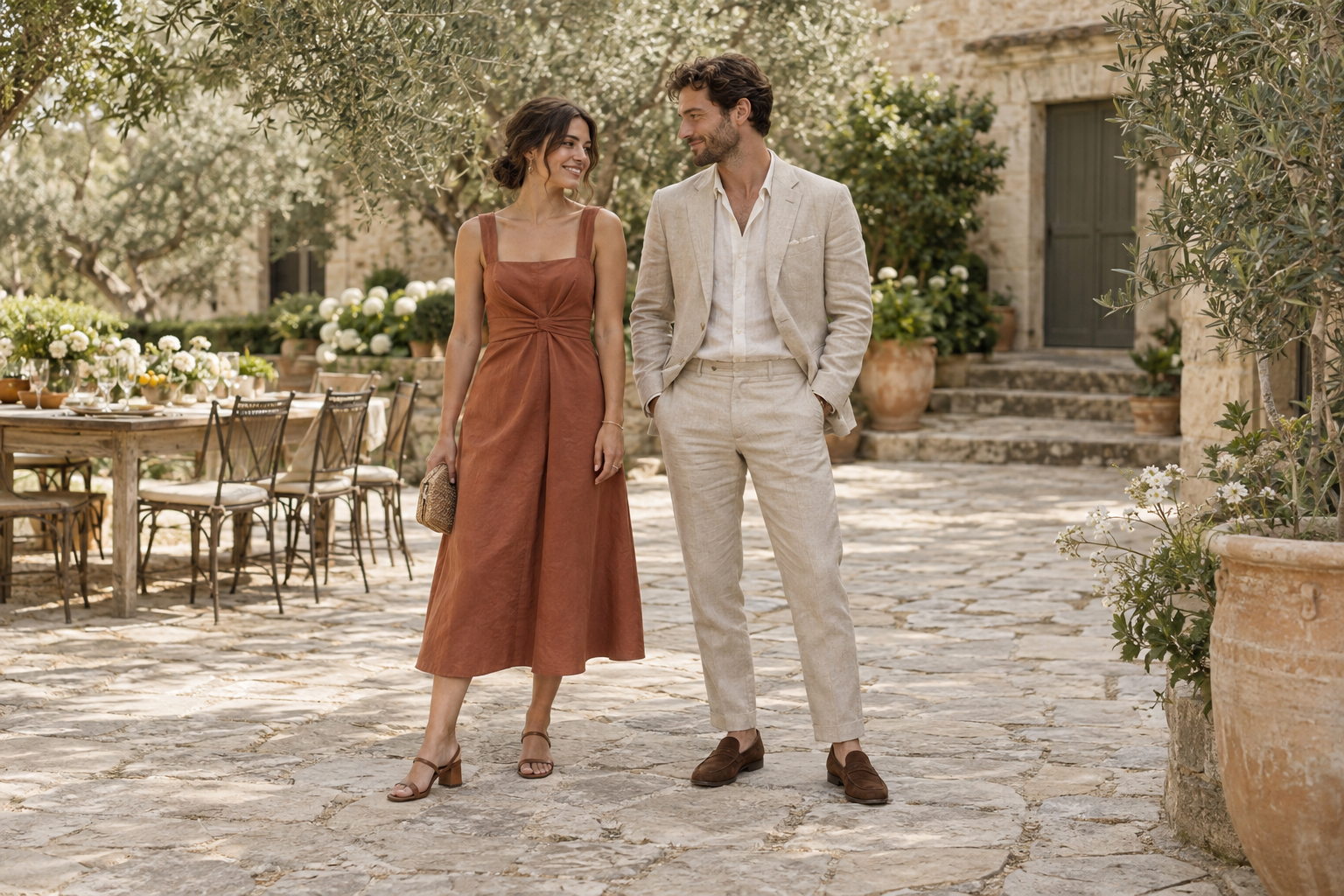
A SIMPLE STARTING POINT
Ease, with intention.
Men's smart casual essentials come down to 20 pieces: a core 12 of jackets, tops and trousers that make outfits year-round, three pairs of shoes that cover every setting, and 8 supporting pieces — outerwear, knitwear and finishing touches — bought only when a real need triggers them. Score what you already own against the table tonight; the gaps are your shopping list, in the build order given below.
This guide gives you a repeatable way to get dressed. Read the short version of each step here, then follow the deeper guides when you want more detail.
01
The core 12: jackets, tops, trousers
The core 12 earn their places because each combines with at least three other items on the list to make a full outfit — that is the versatility test every row passed. The one spec per piece is in the table; resist buying the supporting 8 until the core is worn in. Fit-first substitutions are allowed where your body or workplace demands one swap: in hot climates a knit polo can stand in for an oxford, and where you dress up rarely, the second blazer slot waits longest.
- Two blazer-family pieces (1, 2) plus one dress trouser (11) cover every smart setting on the list.
- Shirts 3 to 5 cover collar duty; tees 6 and 7 are base layers, never the visible top in smart settings.
- Trouser trio 9 to 11 spans casual to dressy — nothing on the list fails to pair with at least two of them.
THE SHORT VERSION / 3 STEPS
Lay out everything you own against rows 1 to 12 tonight and mark the gaps.
Replace items that fail the fit spec before buying anything new — a shoulder seam is cheap to fix on paper, expensive to ignore on the body.
Buy the gaps in the build order given in the third chapter, not all at once.
02
The three shoes: brown derbies, Chelsea boots, white sneakers
Three pairs cover everything: brown derbies for the formal end, Chelsea boots as the winter default, minimal white sneakers for the casual end. The purchase order is derbies first, Chelsea boots second, sneakers third — the criterion is what your current rotation is missing at the formal end, because it is easier to dress sneakers down than derbies up. If you can only buy one pair now, make it the brown derbies: they appear in the most outfits the core 12 can build.
- Buy brown derbies first — they cover dinners, events and office, the hardest settings to improvise.
- Add Chelsea boots when autumn arrives or formal coverage exists — whichever comes first.
- Add minimal white sneakers last, once smart coverage is handled, for weekends and travel.
- Other styles can fill the same slots — see the middle-ground shoes guide.
THE SHORT VERSION / 3 STEPS
Buy brown derbies first — they cover dinners, events and office, the hardest settings to improvise.
Add Chelsea boots when autumn arrives or formal coverage exists — whichever comes first.
Add minimal white sneakers last, once smart coverage is handled, for weekends and travel.
03
The build order and the budget split
Build in this sequence over roughly three months: shoes, then trousers, then shirts, then jacket, then outerwear — each step completes outfits the previous steps started. Upgraders in their 40s should audit before buying: keep what fits, replace what does not, and let the table mark the true gaps. Pacing is simple — one item per paycheck — and the milestone check comes after the first five purchases (derbies, chinos, blue oxford, dark jeans, blazer): those five already build three complete outfits, which is the proof the order works.
- Spend on shoes, the blazer and the overcoat — cost per wear is lowest where the piece serves the most formal contexts and lasts the longest.
- Save on tees, chinos and belts — high-turnover items where mid-tier quality is indistinguishable in wear.
- Buy wool coats and derbies safely secondhand when the leather and soles have life left; never buy tees or sneakers used.
- The full maths of spend-versus-save lives in the wardrobe audit guide.
THE SHORT VERSION / 3 STEPS
Audit what you own before the first purchase — the starter checklist for true beginners covers the from-zero version.
Buy one item per paycheck in the sequence: shoes, trousers, shirts, jacket, outerwear.
After five purchases, verify the three-outfit milestone before continuing.
04
The colour system and the fit checklist
Every piece on the list obeys one five-colour palette: navy, grey, white, olive and stone. That is the entire reason the list works — any top, any trouser and any shoe from the table combine into a valid outfit. Texture provides the variety, one pattern at a time. Substitutions keep the system running: olive swaps for stone, navy for grey, when something sells out or does not suit you.
THE SHORT VERSION / 3 STEPS
Check every new purchase against the three mirror tests before the tags come off for good.
Route one alteration per season to a tailor rather than replacing a piece that nearly fits.
Apply one-in, one-out: every new staple displaces a weaker item so the wardrobe stays at capsule size.
SEE THE IDEA AT WORK
One core-12 week: three outfits from the table
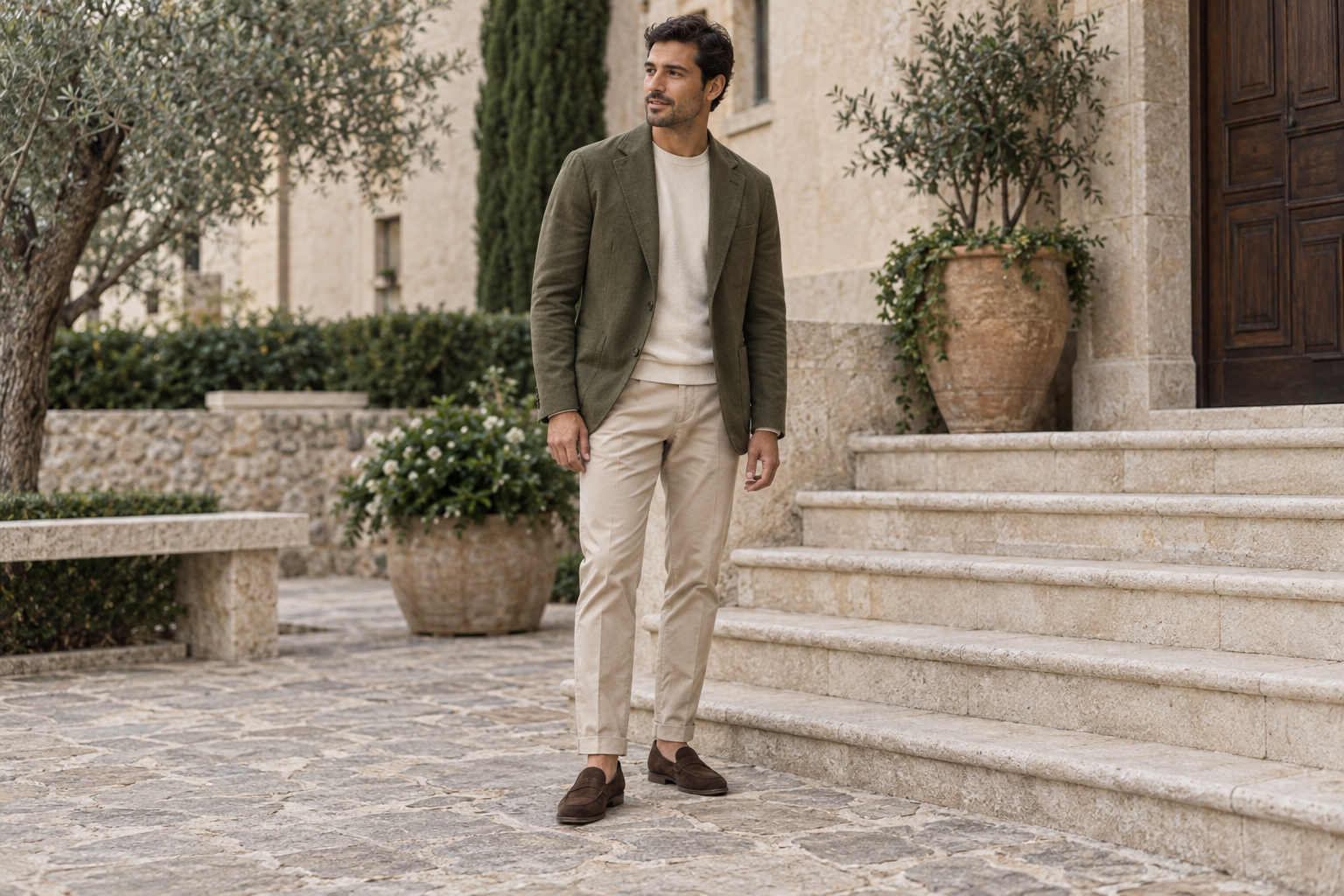
The proof of the palette: Monday is the blue oxford, navy chinos, brown derbies and the blazer — office and a late meeting. Thursday is the merino crew over the white tee, dark jeans, Chelsea boots — dinner with friends. Saturday is the white tee under the overshirt, the same dark jeans, white sneakers — errands and a casual lunch. Nine items from the core 12, three settings, zero decisions that needed more than thirty seconds.
- Light blue oxford shirt (row 4)
- Navy chinos (row 9)
- Brown derbies (row 13)
- Unstructured blazer (row 1)
- Merino crew neck (row 8)
- White t-shirt (row 6)
- Dark indigo jeans (row 10)
- Chelsea boots (row 14)
- White sneakers (row 15)
| Piece | Spec to check | Why it earns its place | When you actually wear it |
|---|---|---|---|
| 1. Unstructured blazer or knit jacket | Soft shoulder, half-lined, mid-navy or grey | The instant structure piece for offices, dinners and events | Work, dinners, weddings-adjacent |
| 2. Wool overshirt | Mid-weight wool or wool-blend, chest pockets flat | The layer between shirt and coat; dresses up jeans | Autumn daily wear, smart-casual offices |
| 3. White oxford shirt | Shoulder seam at shoulder, collar stands alone | The cleanest smart top in menswear, untucked or tucked | Office, dinners, under knitwear |
| 4. Light blue oxford shirt | Same fit spec, blue | The workhorse colour: forgiving, pairs with every trouser below | Everything the white one does, more often |
| 5. Knit shirt or knitted polo | Fine-mid gauge knit, plain colour | Softness of a tee with the collar of a shirt | Warm months, evenings, smart holidays |
| 6. White quality t-shirt | Heavyweight cotton, mid-weight fit | The base layer under blazers and overshirts | Under layers, casual Fridays, weekends |
| 7. Navy quality t-shirt | Same spec, navy | Second base colour so layers never repeat consecutively | Same, alternating |
| 8. Merino crew neck | Fine-to-mid gauge, hem at mid-fly | The smart winter top: works alone, over a shirt, under a coat | October to March, everywhere |
| 9. Navy chinos | Slim-straight, mid-weight cotton twill | The default smart-casual trouser | Office, dinners, weekends |
| 10. Dark indigo jeans | Slim-straight, no distressing | The casual end of the list that still reads deliberate | Weekends, casual offices, evenings |
| 11. Charcoal dress trousers | Wool or wool-blend, slight taper, unfinished hem for tailoring | The dressy anchor that pulls every top up a level | Dinners, events, smarter offices |
| 12. Brown leather belt | Width matching trouser loops, tone near your shoes | Finishes every trouser above; one belt, worn constantly | Every day |
| 13. Brown derbies | Round toe, slim-ish sole, welted if possible | The shoe that covers the most formal ground you will face | Dinners, events, office |
| 14. Chelsea boots | Dark brown leather, slim sole | The winter default: jeans-smart and trousers-smart | Autumn and winter daily |
| 15. Minimal white sneakers | Plain leather, no branding, no chunky sole | The casual shoe that survives smart settings | Weekends, travel, casual offices |
| 16. Wool overcoat | Mid-grey or navy, knee-length, fits over a blazer | The coat that makes every winter outfit look finished | First real cold spell onward |
| 17. Quilted or Harrington jacket | Fits over an overshirt, dark colour | The in-between-season layer the overcoat is too much for | Spring, mild winter days |
| 18. Charcoal roll-neck | Mid-gauge merino, close neck roll | The no-jacket formal knit for winter evenings | Winter dinners, events |
| 19. Shawl-collar cardigan | Mid-gauge merino, worn open | The blazer substitute for office, pub dinners and flights | Cool months, travel |
| 20. Watch on a leather strap | Simple dial, 36-40mm, strap tone matching shoes | The single accessory that finishes every outfit above | Daily |
A last look in the mirror.
A MOMENT BEFORE YOU GO
0 of 6 ready
SMALL ADJUSTMENTS
When it feels almost right.
Buying the supporting 8 before the core 12
The overcoat, roll-neck and cardigan only make sense on top of a working core. Buy them first and you own nice pieces with nothing to wear them with.
Counting occasion-only items as staples
A suit jacket, tuxedo-adjacent pieces and single-event outfits fail the test: worn under twice a month, or workable with only one specific outfit. Occasion wear is a separate purchase for a separate need.
Treating the list as fifty items because a listicle said so
Twenty is the whole list. If a piece has no wearing context — work, dinner, weekend — it does not earn a row, no matter how good it looked in the photo.
Still wondering?
What are the essentials for smart casual?
The core 12 in one breath: a blazer, an overshirt, two oxford shirts, a knit shirt, two tees, a merino crew, chinos, dark jeans, dress trousers and a brown belt. Everything else on the list supports them.
How many shoes do I need for smart casual?
Three: brown derbies, Chelsea boots and minimal white sneakers — bought in that order, with derbies first because they cover the most formal ground.
Is this list different in your 40s?
Mostly no — the 20 pieces are the same. The deltas are fit and grooming: audit what you own before buying, tailor what nearly fits, and let the watch and shoes carry more of the polish.