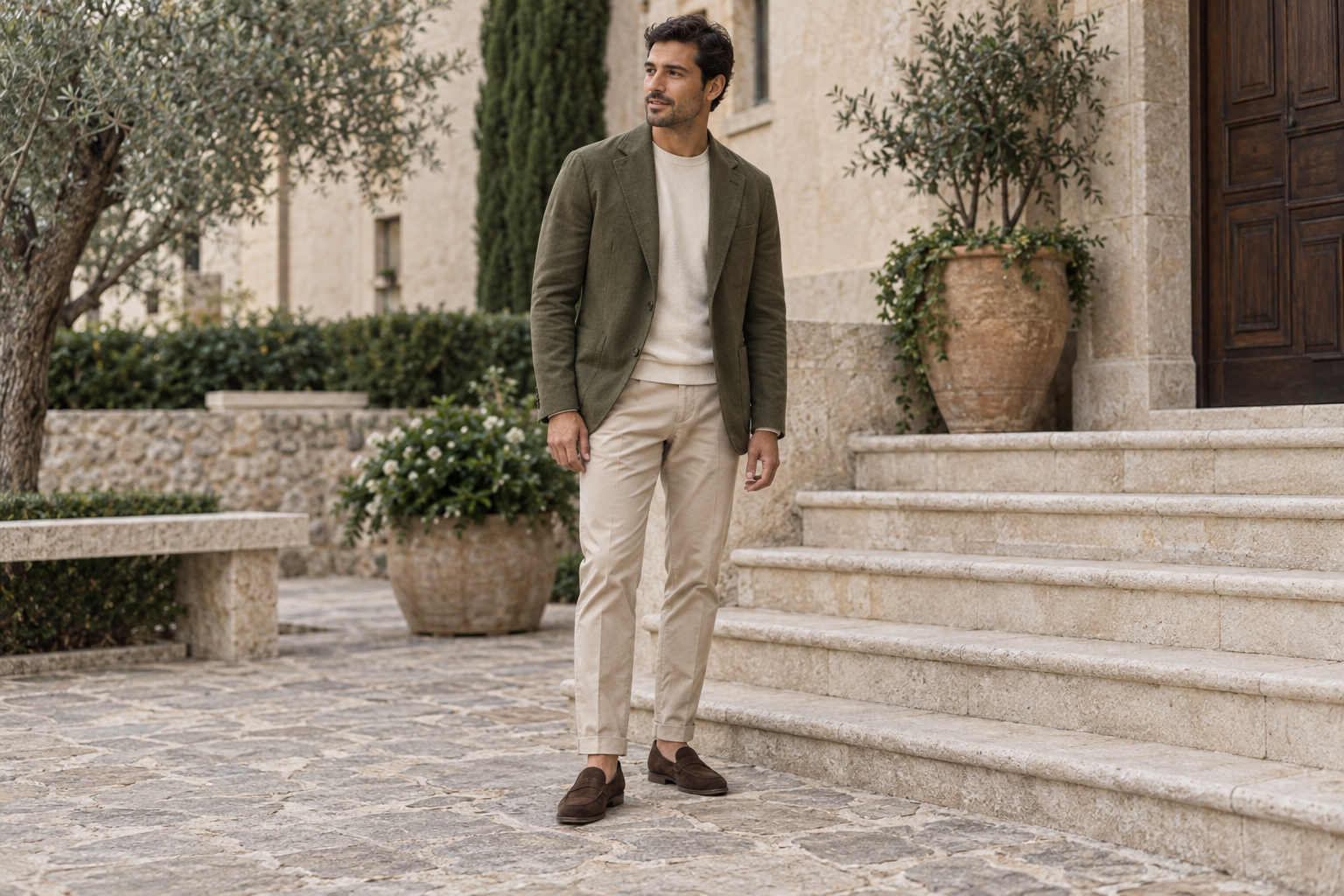
You have a dress shirt on and it is genuinely freezing — the missing piece is not a puffer blob or a suit blazer, it is a wool coat over a knit layer. Here are the five jackets that solve it and the order to layer them in.
The mistake most men make is asking which jacket is warm enough to replace everything. In deep winter the jacket is only one third of the answer — the knit layer between shirt and coat is the part that actually fixes the cold. Get the order right and even a modest coat keeps you warm while the shirt stays sharp underneath.
What jackets do men wear with dress shirts in really cold weather?
Five, in order of dressiness: the wool overcoat, the topcoat, the wool overshirt or heavy shirt-jacket, the smart quilted jacket, and the wool pea or Harrington-style jacket. Each has a temperature band it owns rather than one being universally warmest.
Wool overcoat — the dress answer for cold from around freezing up to cool autumn days; the knee-length cut covers suits and shirt-only outfits alike.
Topcoat — the sharp, hip-length version for commutes and dinners where the coat comes off indoors.
Wool overshirt — dry, cold-but-not-freezing days when the overshirt IS the jacket.
Smart quilted jacket — the coldest days, styled dark and minimal over the knit stack.
Pea or Harrington-adjacent wool jacket — the casual-smart middle for weekends and pub-level settings.
The layering order that solves the problem
The stack is: dress shirt, then a merino crew or cardigan, then the coat. The middle layer is the fix most men miss — it insulates, it lets the coat stay elegant instead of padded, and it means the shirt underneath never has to work for warmth.
Bulk management is about fabric choice: fine-gauge merino collapses flat under a coat, chunky knits stack. If the coat closes cleanly over the knit without pulling, the fit is right. The full system, including how many layers different temperatures justify, is in the smart casual layering system guide.
Overcoat or parka: the honest trade-off
When snow or genuinely low temperatures arrive, function has to win — and a parka can still pass smart casual if it meets the checklist: matte fabric, no giant logos, a hood that lies flat, a dark neutral colour. Worn over a shirt and knit, it reads as a commuter's coat, not a costume.
The compromise piece is the quilted jacket: small-scale quilting and a clean collar make or break it. And one honest line: below a certain temperature the shirt is simply the wrong base layer — swap to a roll-neck under the parka and stop fighting. Which option suits which winter day also depends on the rest of the outfit; the men's autumn winter smart casual guide covers the seasonal wardrobe around it.
When the mid-layer replaces the jacket question
In dry cold, a heavy shawl-cardigan worn as the outermost layer solves the problem entirely — warm, textured, and it never comes off wrong at the door. The trade-off: mid-layers keep the silhouette sharp but surrender wind and rain protection, so they stop working the moment weather turns.
For the office variant, remember the coat comes off at the door — so whatever sits under it must stand alone as an outfit piece. Choose knit quality accordingly; a pilled cardigan is exposed all day in a way the coat never is. A fine merino over a shirt also solves the no-jacket work outfit, as set out in the men's knitwear guide.
Scarves, gloves and the finishing layers
Scarf — the warmth-per-gram champion: one simple drape or a single over-and-through beats complicated knots, in a tone matching the coat's secondary colour.
Gloves — plain leather for smart settings, touchscreen knits for the commute; never running gear.
Hat — a quiet beanie or wool cap in a coat-matching colour; skip anything with a giant pom or logo.
Do — stash gloves and scarf before the service, meeting or dinner; the pockets exist for the walk.
Don't — let accessories introduce a new accent colour; winter extras should deepen the outfit, not busy it.
Complete cold-weather outfits
Winter wedding guest: dress shirt + fine merino + overcoat + dress trousers + Chelsea boots — the coat comes off at the venue and the outfit underneath is complete.
Commute-smart: shirt + knit + dark minimal parka that comes off at the desk, shoes changed if the walk was wet.
Dinner in the cold: topcoat over shirt and knit — or a roll-neck instead of the shirt if the coat is the star and the venue is relaxed.
Care and practical notes
Brush road salt and rain off wool coats when you get home and let them air before hanging. At the office or venue, a proper hanger keeps the shoulders alive — wire hangers wreck wet wool. Hang the shirt in bathroom steam at the destination to relax commute creases, or wear the knit layer loose enough not to press the shirt front.
End of season, brush and air the coat before storage and keep it on a wide wooden hanger in a breathable garment bag. Coats are an investment piece; the care routine that protects it is the same one in the leather shoe care and winter kit guide for everything salt touches at street level.
Jacket-over-shirt questions
Can you wear a blazer under a coat? Yes — an overcoat sized with room for the blazer's shoulders works over suit-or-blazer outfits; a close-cut topcoat usually does not have the room, so layer it over a knit instead.
Overcoat or parka for smart casual? Let temperature decide: dry cold from around freezing upward, the overcoat; snow and genuinely low temperatures, the dark minimal parka over the same shirt-and-knit stack.
What do you wear over a dress shirt when it's freezing? Shirt, then a fine merino crew, then a wool overcoat — the knit layer is the warmth, the coat is the shell, and the shirt only has to look good.
Open the symptom that matches. Start there.
The puffer-blob problem
Possible cause: The only winter coat to hand is a technical puffer, so the sharp shirt underneath disappears under shiny, logo-covered bulk.
Try first: Swap to a wool overcoat or topcoat for dry cold, or a dark minimal quilted jacket for the coldest days. The smart inner layers do the dressing; the coat only has to not ruin them.
Freezing in just a blazer or just the shirt
Possible cause: Treating the jacket as the only warm layer. A single layer of wool or cotton, however nice, cannot hold heat in genuinely cold weather.
Try first: Add the middle layer: a fine-gauge merino crew or cardigan between shirt and coat. This one change is the fix most men miss — the knit is the insulation, the coat is the shell.
The coat that fits over nothing
Possible cause: The coat was bought to fit over a shirt alone, so there is no room for the knit layer — or it was sized up so far the shoulders swallow the wearer.
Try first: Size the coat for its mid-layer: it should close comfortably over a fine knit with room to move, without the shoulder seams dropping down the arm.
The shirt ruined by the commute
Possible cause: Bulk layers and backpack straps crease the shirt front, and by the office the collar and placket are a mess.
Try first: Wear the knit layer loose enough not to press the shirt front, carry the bag in hand or over one strap for the final stretch, and hang the shirt in bathroom steam at the destination to relax creases.
Different causes need different fixes.
The problem is structural: a dress shirt is a thin, smooth layer designed to look crisp, and winter demands loft, coverage and wind protection — three things a shirt cannot supply. A blazer adds style but little warmth, and a technical puffer adds warmth but destroys the silhouette. The resolution is the classic three-layer system: shirt for presentation, knit for insulation, coat for weather. Almost every winter outfit failure comes from skipping the middle layer or letting the outer layer fight the inner one.
Make one small change.
Tonight: put a fine merino crew neck over the shirt and wear your warmest coat over it. The knit buys you more warmth than any jacket swap, and it takes thirty seconds to try.
Work on the part that needs it.
The wool overcoat: the canonical answer
A knee-length wool overcoat in charcoal, camel or navy is the correct jacket over a dress shirt — it covers the whole outfit, layers over a knit without strain, and works over a shirt-only outfit or a full suit alike. It is the single highest-leverage winter purchase for this exact problem, because it upgrades every dressed outfit you own at once.
The topcoat: shorter, sharper, office-first
A hip-length topcoat is the slimmer, style-first sibling — cut closer than an overcoat by design, layering over a shirt or fine knit but not a chunky cardigan. Best where the coat comes off indoors and the shirt must look sharp: the commute, the office, dinner. Its cold ceiling is real; in the deepest cold, take the longer coat.
The overshirt and the smart quilted jacket
A wool overshirt or heavy shirt-jacket is the jacket itself in dry, mildly cold weather — roughly the dry autumn-to-winter shoulder range — and pairs naturally with chinos and boots. For snow and single digits, a dark, minimal quilted jacket over the shirt-and-knit stack passes smart casual if the quilting is small-scale, the collar sits cleanly and there are no giant logos.
When to stop adjusting.
Stop trying to make one layer do everything. If temperatures sit below freezing for the whole day, the shirt itself becomes the wrong base — swap it for a roll-neck, let the parka win, and accept that the shirt-and-coat look is for the indoor portion. And if the forecast is sleet or rain on wool, that is a coat-destroyer: carry the good coat, wear the weatherproof one, or drive.
Mens smart casual essentials in one list: the core 12 to own first, 8 supporting adds, the three shoes that cover everything, and the order to buy them in.