What to Wear
Minimal Sneakers With a Blazer: The Rules for Men
Sneakers with a blazer work for men under clear rules: the four-check test, the rooms where it passes and fails, and the outfit that makes it read.
Footwear buying guide
Chelsea boots keep getting named a men's staple, and the reputation is earned — but only in the right colour and sole. Here is the pair to buy first, and exactly what to wear it with.
Begin hereInspiration
Are chelsea boots smart? Yes — for smart casual men, a brown or dark-brown leather pair with a slim sole is the default boot, clean enough for dress trousers and relaxed enough for jeans. The look works because the boot's unbroken line from trouser to toe reads deliberate with almost no styling effort. What follows is how to pick that first pair and how to wear it with everything you already own.
Ask men who upgraded their wardrobe in mid-life what they bought first and Chelsea boots come up again and again — the r/AskMen staple-items thread names them explicitly. They survive that attention because they solve two problems at once: they are genuinely smart, and they require zero morning decisions. No laces means no bows to re-tie, no contrast laces to get wrong. The same staple-list logic puts them alongside the other core pieces in the men's staples checklist.
They are also the rare shoe that spans washes of denim and weights of trouser. The same dark brown pair works with dark jeans on Saturday and flannel trousers on Thursday, which is what a staple is supposed to do.
| Choice | Buy this | Skip for now | Why |
|---|---|---|---|
| Colour | Dark brown | Black as a first pair | Dark brown pairs with grey, olive, navy and blue denim; black only earns its keep in tailoring-heavy wardrobes |
| Material | Smooth leather | Suede | Leather shrugs off rain and scuffs; suede looks excellent but punishes winter and needs a care routine |
| Sole | Slim leather or low dark rubber | Chunky lug, work-boot soles | A slim sole keeps the profile dressy; chunky soles drop the boot two formality rungs |
| Fit | Snug heel, thumb-width toe room | Room to slip at the heel | Heel slip ruins the gait; the leather stretches across the forefoot, not at the heel |
Expect a break-in period of a few wears: the elastic side panel and heel stiffen up as they mould to your foot. If a boot hurts at the ankle bone on day one, it will not improve — the fit problem is structural, not break-in.
The hem decides everything. Jeans should end at or just above the top of the boot, so the clean line from denim to leather stays visible. No stacking, no tucking — both break the line that makes the boot look smart.
With chinos or dress trousers, aim for a slight break or no break, so the boot top shows clean as you walk. Chelsea boots upgrade chinos even more than they upgrade jeans, because the dressier trouser pulls the whole outfit up — the boot reads smarter in better company.
Colour pairings that always work with dark brown boots: grey, olive and navy trousers. Avoid anything that pools at the ankle — a trouser that hides the boot makes the Chelsea pointless; you might as well wear laced shoes and let the hem do its job.
The honest answer is conditional. With an unstructured or textured suit — flannel, tweed, a matte weave — and a slim dark boot, Chelsea boots pass at smart casual weddings and events. With structured boardroom tailoring, especially pinstripe, they fail, and oxfords stay correct.
For suit-adjacent events where a full suit is too much, the separates move works better: jacket and trousers in different fabrics with the boots bridging both. That version is covered in the suit-jacket-as-blazer guide.
Autumn and winter are the Chelsea boot's home season — it is the default cold-weather smart shoe. In rain, wipe mud and grime off leather the same evening and let boots dry at room temperature, never on a radiator. Road salt leaves white blooms on leather; wipe them off with a barely damp cloth before they set into a stain.
In real summer heat, boots get uncomfortable fast — swap to loafers or minimal leather sneakers for the hot months. Suede Chelsea boots belong to the dry season and the second-pair slot, never to a first pair facing an unknown winter.
Across entry, mid and premium tiers, the money buys leather grade and finishing: entry-level boots from brands like Clarks or high-street own-labels use corrected leather that creases faster; mid-tier boots use full-grain leather that ages instead of wearing out; premium adds hand-finishing and named construction. The construction line that matters most is welted versus cemented — a welted sole can be replaced by a cobbler, a cemented one usually cannot, which decides whether the boot is resoleable or disposable.
For a first pair, mid-tier is the value play: cheap boots look old within a season, and the premium jump buys things you cannot see from outside. When the pair does wear out, the resole-or-replace decision is worth a check before you bin them.
Are Chelsea boots smart casual? Yes — with the slim-sole rule. A slim-profile leather Chelsea is smart enough for dress trousers; a chunky lug sole pulls the same boot into weekend territory.
Do you tuck jeans into Chelsea boots? Almost never. Tucking reads denim-head styling, not smart casual — let the hem finish at the boot top instead.
Suede or leather for the first pair? Leather. Suede is the beautiful second pair you buy once the rotation already has a weather-proof option.
6 looks to explore
The winter default: dark brown leather Chelseas with a slim sole under dark straight jeans, a navy merino crew and a wool overcoat. The jean hem ends just at the boot top so the clean line stays visible.

Grey dress trousers with no break, dark brown Chelseas, a light blue oxford and a wool overshirt. The dressier trouser pulls the boot up a formality level — this reads office-appropriate with no blazer.
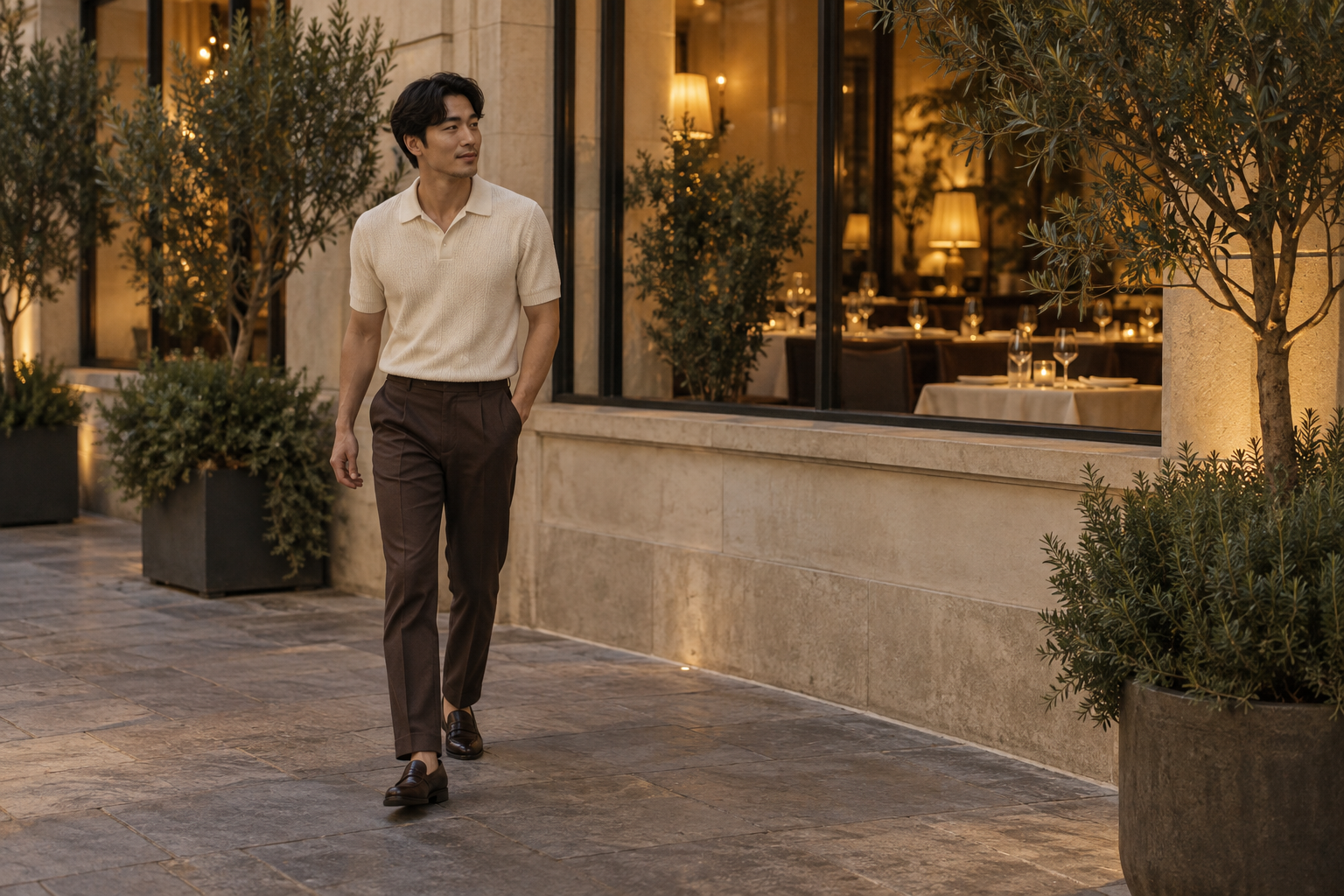
Charcoal flannel trousers breaking slightly over dark brown boots, with a knitted shirt. The textured trouser and the sleek boot balance each other — the formula for dinners where jeans would fall short.

A matte flannel suit in mid-grey with slim dark brown Chelseas — the wedding-adjacent configuration. It passes because the suit is unstructured and textured; the same boots under a crisp pinstripe would fail.

Tan suede Chelseas with olive chinos and a grey shawl-collar cardigan. This is the second-pair look: beautiful in dry autumn light, and exactly what you should not wear into rain or salt.
Black leather Chelseas with charcoal dress trousers and a charcoal roll-neck. The tailoring-heavy wardrobe look — for men whose rotation already leans black, this is the boot colour that agrees with it.
What to Wear
Sneakers with a blazer work for men under clear rules: the four-check test, the rooms where it passes and fails, and the outfit that makes it read.
What to Wear
Smart casual shorts for men, solved: the tailored-short spec, the polo pairings that pass, shoes that work in heat, and the settings where shorts never do.
What to Wear
Loafers smart casual rules for men: socks or no socks, dark-wash jeans, chinos and suits, penny vs tassel, and the season each material owns.